
This article contains affiliate links. If you make a purchase through these links, we may earn a small commission at no extra cost to you. This helps support our work in creating free travel guides.
Booking a hotel in China is straightforward, but two things catch first-time visitors off guard: not every hotel accepts foreign guests, and every place you sleep has to be registered with the police. The registration part sounds intimidating — it isn't. When you stay at a hotel, the front desk does it for you automatically at check-in. The only time you handle it yourself is when you stay somewhere that isn't a hotel, like a rented apartment or a friend's home. This guide covers how to book a room that will actually take you, what happens at check-in, and how to register on your own when you need to.

Can foreigners stay at any hotel in China?
For a long time, China limited foreign guests to specially licensed "foreigner-designated" hotels (涉外饭店, shèwài fàndiàn). That system is gone. Beijing dropped the requirement back in 2003, other regions followed, and there is no longer any legal concept of a "foreigner-approved" hotel category.
More recently, the central government has pushed hard to make this clearer. In May 2024, the Ministry of Public Security, the Ministry of Commerce, and the National Immigration Administration stated that hotels cannot refuse foreign guests simply because they lack a license to receive foreigners. A follow-up notice from seven ministries in mid-2024 told local authorities and booking platforms not to use "qualification requirements" as a barrier to accepting overseas guests, and to make accommodation registration and payment easier.
So on paper, you can stay anywhere. In practice, you'll still run into hotels — usually budget chains, small guesthouses, and some homestays — that turn foreigners away. The reason is rarely hostility. Smaller properties may not have staff trained on the registration system, may lack the equipment to scan and upload passport data, or worry about being fined if they enter your information incorrectly. It's a hassle for them, so they avoid it.
How to book a hotel that will take you
You have two broad options: international platforms you already know, and Chinese platforms with much deeper local inventory.
Booking platforms compared
| Platform | Strengths | Watch out for |
|---|---|---|
| Trip.com | Largest hotel inventory in China, multilingual, multi-currency, accepts international cards, often labels whether a hotel takes foreign guests | Interface can show many small properties; still confirm the foreign-guest policy |
| Booking.com / Agoda | Familiar interface, free cancellation on many rooms, easy for Western users | Thinner coverage of smaller Chinese cities; foreign-guest status not always reliably marked |
| Domestic apps (Meituan, Ctrip CN) | Cheapest rates, every property listed | Chinese-only, harder to confirm foreign-guest acceptance, payment usually needs Alipay/WeChat Pay |
For most visitors, Trip.com is the easiest starting point because it carries China's biggest hotel inventory, works in many languages and currencies, takes Visa and Mastercard, and lets you filter for hotels that accept foreign guests. If you prefer an interface you already trust, you can also book through Booking.com, which offers generous free-cancellation options — just double-check that the specific property accepts foreign passport holders before you commit.

What happens at hotel check-in
This is where China's registration rules kick in, but the hotel does the work. Under the Exit and Entry Administration Law, hotels are legally required to register foreign guests and report that registration to the local public security organs (the police). You'll see this happen at the front desk.
Here's the standard sequence:
- Show your passport. Every hotel requires the original — not a photo, not a copy. The staff will scan or photograph the photo page and your entry stamp or visa. (Travelers from Hong Kong, Macau, and Taiwan use their relevant mainland travel permit instead.)
- The hotel uploads your details to the police system. This is the "police registration" (住宿登记, zhùsù dēngjì) you may have read about. It's automatic and takes a minute or two.
- Pay and leave a deposit. Most hotels require prepayment or a deposit. Three-star properties and above generally accept international credit cards; Alipay and WeChat Pay are accepted almost everywhere; cash still works but is less common. Credit-card deposits are usually a pre-authorization hold rather than a charge.
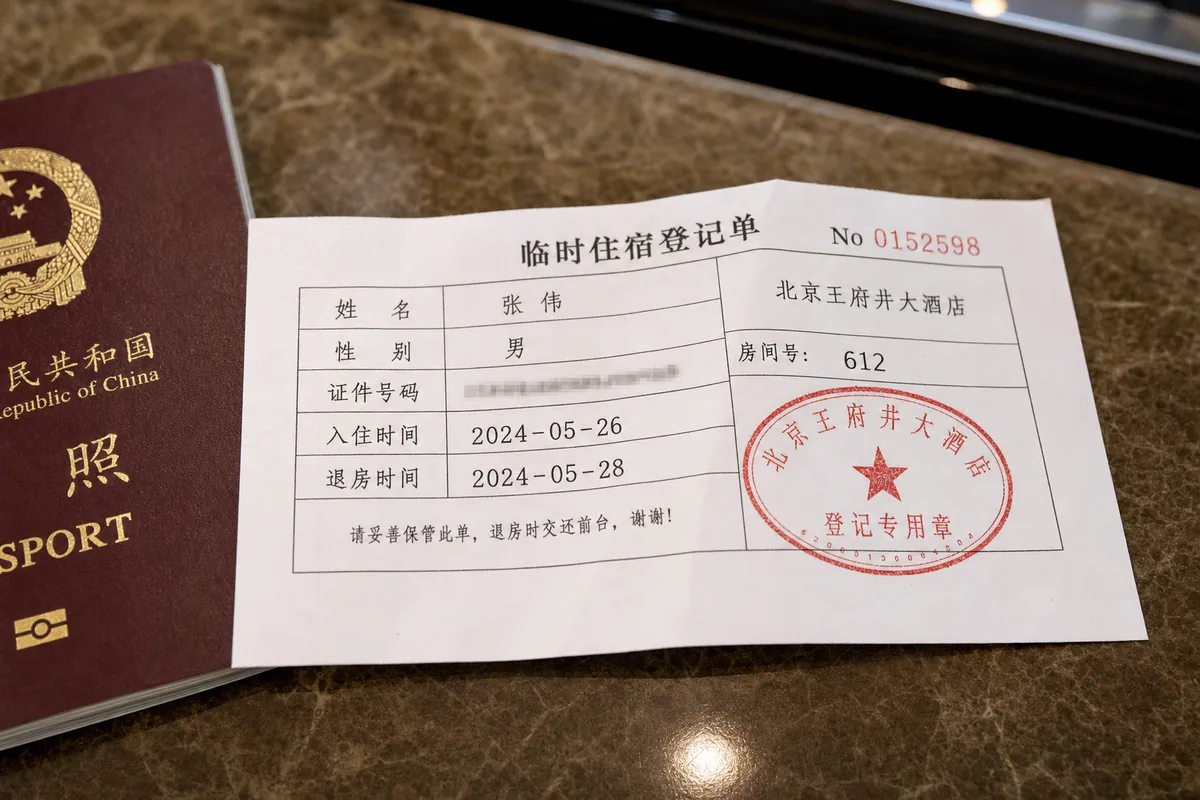
- Collect your registration slip. Ask for the temporary residence registration form (临时住宿登记表) — a small printout with the hotel's stamp and your check-in/check-out dates.
Deposit amounts and how quickly a pre-authorization hold is released vary by hotel — there's no single national rule. If the timing matters to your budget, ask at check-in. Reports of holds releasing within a couple of days are common, but treat that as the hotel's call, not a guarantee.
Registering when you DON'T stay in a hotel
This is the part many travelers miss. If you stay anywhere that isn't a hotel — a rented apartment, an Airbnb-style homestay, or a friend's or relative's home — you are responsible for registering, because there's no front desk to do it for you.
The rule, from the National Immigration Administration: a foreigner staying in lodging other than a hotel must register with the local public security organs within 24 hours of checking in. Either you or your host can do it.
The penalties are real but modest. According to the National Immigration Administration's rules on accommodation registration, failing to register can bring a warning and a fine of up to CNY 2,000. It rarely escalates to that for a genuine short-stay tourist who registers promptly, but it's a real requirement worth taking seriously — especially if you're staying weeks rather than days.
How to register in person
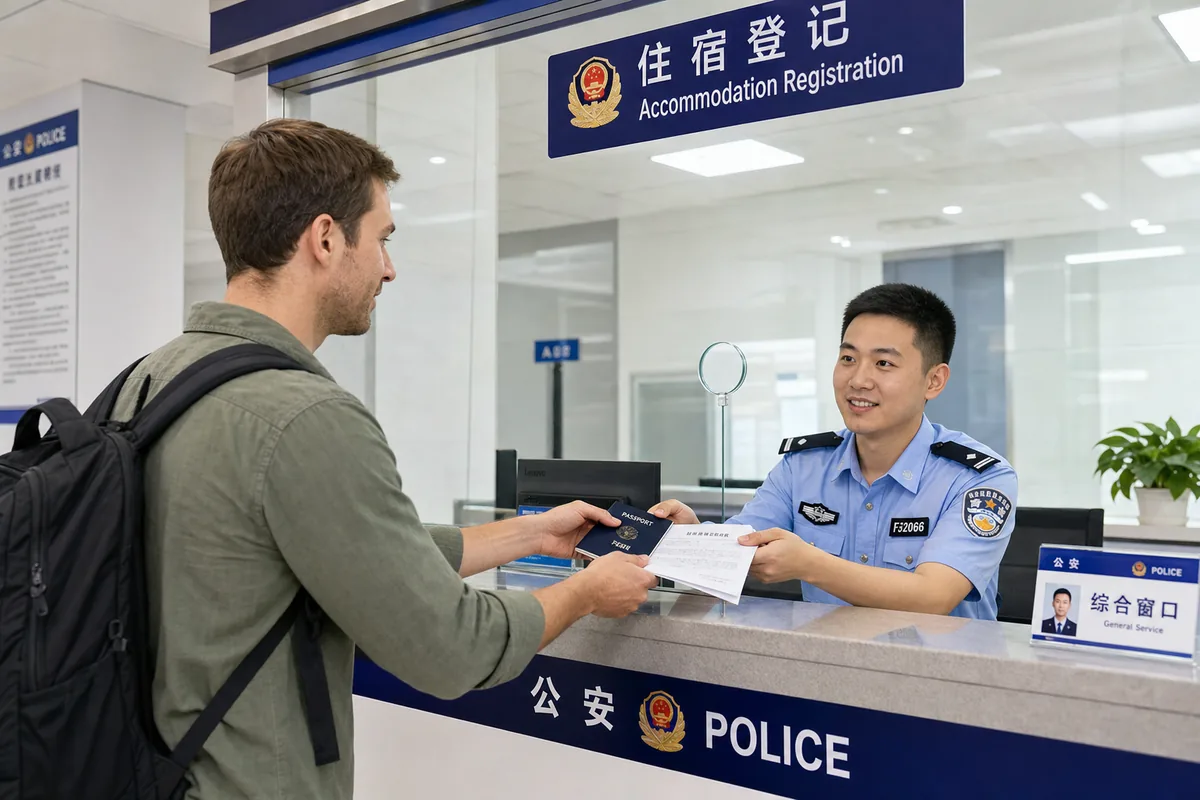
The traditional route is to go to the local police station (派出所, pàichūsuǒ) for the neighborhood where you're staying. In many cities you can also do it at a community police office or a dedicated foreigner service station. Bring:
- Your passport (original, with your valid visa or entry stamp)
- Proof of address — the property ownership certificate if it's owned, the lease if it's rented, or the host's ID plus property document if you're staying with someone
- If your host or someone else registers on your behalf, that person's valid ID as well
Requirements vary slightly by city. Some places have added flexibility — for example, Shanghai allows you to skip the proof-of-address document if you sign a written declaration on the spot, though anyone who falsifies that loses the privilege for future registrations.
Registering online (newer option)
China is rolling out online registration for non-hotel stays, which removes the trip to the police station. The National Immigration Administration has launched a pilot in seven provinces and municipalities — Hebei, Liaoning, Zhejiang, Hubei, Guangxi, Chongqing, and Sichuan — with plans to expand nationwide. Online registration carries the same legal effect as registering in person.
You register through the NIA's official service channels: the immigration administration's government service website, or the "12367" app, WeChat mini-program, or Alipay mini-program. After registering and verifying your identity, you complete the steps in the "foreigner services" accommodation registration module. Either the guest or the host can file it; the first time is usually done with the host's help, but if you've registered at the same address before or you own the home, you can do it yourself. The official English explainer is on the National Immigration Administration website.
Paying for your room
Payment trips up some travelers more than registration does. A few practical notes:
- International cards work at most mid-range and upscale hotels, but smaller properties may only take Alipay, WeChat Pay, or cash.
- Mobile payment is the smoothest path. Both Alipay and WeChat Pay now let you link an overseas card. Note there are caps — on WeChat Pay, a foreign card has a per-transaction limit of around CNY 6,000 and monthly/annual ceilings, so a long luxury stay might exceed them. Setting these up before your trip is worth the ten minutes.
- Cash is still accepted at hotels, and carrying some is wise as a backup, but day-to-day China runs on QR codes.
For step-by-step setup, see our guides on using Alipay with foreign cards and using WeChat Pay with foreign cards.
Frequently asked questions
Do I really need to show my passport every time?
Yes. The law requires hotels to verify identity documents and register guests, so the original passport is non-negotiable at check-in. A copy or photo won't be accepted.
What if a hotel refuses me even though I have a confirmed booking?
It still happens, despite the 2024 directives that hotels can't refuse foreign guests for lacking a special license. Your most practical move is to avoid the situation by confirming the foreign-guest policy when booking. If you're stuck, the National Immigration Administration runs a 24/7 bilingual hotline at 12367 that can advise you. There isn't a single published step-by-step complaint procedure, so calling 12367 for guidance is the sensible first call.
Is registration the same for Hong Kong, Macau, and Taiwan residents?
The principle is the same — you register when you stay — but residents of Hong Kong, Macau, and Taiwan use their mainland travel permits rather than a passport, and the specific forms differ. At hotels it's handled at check-in as usual.
What about Tibet, Xinjiang, and other special areas?
Some regions have additional rules around foreign travel and accommodation that change over time. We don't have reliable current details to quote here, so check the latest requirements with a licensed local agency or the relevant authority before you go.
How long does hotel check-in take?
Usually five to fifteen minutes, longer at busy times or if staff are unfamiliar with the registration system. Having your passport ready and your booking confirmation on your phone speeds it up.
The bottom line
Hotels handle police registration for you — show your original passport, pay your deposit, and keep the little registration slip they print. The one thing to remember is that the rules don't stop at hotels: if you stay in an apartment, homestay, or someone's home, you must register with the police within 24 hours, either in person at the local station or online where the pilot is live. Book through a platform that lets you confirm a hotel accepts foreign guests, set up Alipay or WeChat Pay before you arrive, and you've removed almost every friction point. If anything goes sideways, the 12367 hotline answers in English around the clock.
Related reading
- Types of Accommodation — understand hotels, hostels, homestays, and serviced apartments before you book
- Visa Extension Guide — where your hotel registration slip comes into play
- Using International Cards in China — what works at hotel front desks and what doesn't
- Arriving in China: Immigration & Customs — your first registration starts the moment you enter
Last updated: June 2026
Read in other languages
Last train times for 10 Chinese metro systems
Every line and station, checked by hand — the same data behind our offline route planner.
Get the WaysChina App
Offline guides, currency converter, essential phrases, and more — all in your pocket.

Related Articles

Budget Options: Cheap Hotels & Hostels in China
A practical guide to budget accommodation in China — chain hotels, hostels, and how to book a place that will...

Luxury Hotels in China: Where to Stay in Style
From a Bulgari address in Beijing to relocated Ming-dynasty courtyards near Shanghai and beachfront resorts in...

Types of Accommodation in China: A Guide for Travelers
From five-star hotels to hostels, guesthouses, and serviced apartments — here's how accommodation in China actually...