

This article contains affiliate links. If you make a purchase through these links, we may earn a small commission at no extra cost to you. This helps support our work in creating free travel guides.
Lushun (旅顺, Lǚshùn), known in older English books as Port Arthur, is Lushunkou District of Dalian, at the southern tip of the Liaodong Peninsula and 32 km from Dalian's city centre. The whole district has been fully open to foreign visitors since 21 November 2009, and you get there by Dalian Metro Line 12 from Hekou station, the main public transport link between Lushun and the city. One full day covers either the Russo-Japanese War sites on the hills or the museum and the old town, not everything. The Lushun Japanese-Russian Prison Site, the Lushun Museum and the Wanzhong Tomb Memorial Hall are all free. The one firm rule: do not photograph the naval port or any military area.
This guide covers what is open to you, how to get there and back, what each history site is, what it costs and when it opens, and a day plan you can follow. For Dalian itself, see our Dalian travel guide.
Lushun in Short: What It Is and Whether One Day Is Enough
Lushun is a small harbour town with a large naval port in the middle of it. Its natural harbour does not freeze in winter, and that made it one of the most fought-over places in Northeast Asia in the late 19th and early 20th centuries. Most of what visitors come to see is connected to that history: forts on the hills, a prison, memorials and a museum.
The timeline below follows the Lushunkou district government's history page. In 1880 the Qing government set up the Beiyang Fleet here and built a naval port and gun batteries. Lushun was a main battlefield in the First Sino-Japanese War of 1894 and the Russo-Japanese War of 1904. Soviet troops were stationed in Lushun from 22 August 1945 until they left on 24 May 1955. In between, Russia leased the Dalian area in 1898. The prison you can visit today was run by the Japanese colonial authorities from 1907 until August 1945.
One day is enough for most people. Lushun is compact, and the sites sit in two groups: the town centre (prison, museum, Baiyu Mountain, old railway station, Wanzhong Tomb) and the hills around it (Hill 203, Dongjiguanshan, Shuishiying). In one day you can see one group properly and a few highlights from the other. If you are especially interested in the Russo-Japanese War battlefields and also want time in the museum, consider two days, or come back a second time from Dalian. Staying overnight in Lushun is possible but not necessary: Dalian has far more hotels, and the metro ride back is simple.
Lushun fits well as one day inside a two- or three-day Dalian stay. If you are travelling further around the region, our Northeast China route guide shows how Dalian connects to Shenyang and Harbin.
Can Foreigners Visit Lushun? Access Rules and Photography
Yes. For a long time Lushun was closed or partly closed to foreigners because of the naval base, and many older guidebooks and forum posts still say so. That is out of date. Lushunkou District opened partly to foreign visitors on 1 July 1996, and on 21 November 2009 the State Council and the Central Military Commission approved its full opening. You do not need a special permit, a guide or a tour group to visit. You can take the metro there on your own with just your passport.
What is still restricted is the military itself. Lushun remains an active naval port, and some areas around the harbour and on certain hills belong to the military. China's Military Installations Protection Law, revised in 2021 and in force since 1 August 2021, applies to everyone, foreign visitors included. Article 17 bans anyone without permission from entering a military restricted zone and from photographing, filming, recording, surveying, locating, drawing or describing it. Article 22 says that entering or photographing a military management zone requires approval from the unit that manages it.
In practice, this is how it works on the ground:
- Follow the signs. Military areas are marked with signs and often guards at the gate. There is no public map of every closed plot, so the signs are your guide. If a road has a barrier or a sentry, turn back.
- Keep your camera off the naval port. From Baiyu Mountain and from the Lushunkou Scenic Area (the former Naval Port Park) you can see into the harbour. Look as much as you like, but do not photograph or film the warships, docks and port buildings, and do not fly a drone anywhere near them.
- Photos at the sites are fine. Taking pictures at the prison site, the forts, Hill 203 and the museum is normal (some indoor exhibits may have their own no-photo signs).
- If staff or a soldier asks you to stop or to delete a photo, do it. Be polite and do not argue. This is the fastest way to end the conversation.
Visa note: if you enter China on the 240-hour visa-free transit through Dalian or Shenyang airport or Dalian's seaport, your permitted stay area is the whole of Liaoning province, which includes Lushun. Check the details in our 240-hour visa-free transit guide if you are combining Lushun with other cities.
Getting from Dalian to Lushun
By metro: Line 1 to Hekou, then Line 12
The metro is the easiest way for most visitors. Dalian Metro Line 12 runs from Hekou to Lushun New Port (旅顺新港) in Lushunkou District. Since June 2017 it has shared a platform level with Line 1 at Hekou, so changing trains there is quick. Line 1 runs from Hekou to Yaojia and stops at Dalian North Railway Station, which makes it handy if you are staying near the high-speed station. From central Dalian, ride Line 1 (or change to it from another line) to its Hekou end, cross to the Line 12 train, and ride toward Lushun New Port.

Which stop to get off at depends on where you start your day. The line runs through Lushun's newer western area before reaching the old town and the port. Check the line map in the station or a map app for the stop closest to your first site, then take a short taxi ride from there.
Plan on roughly an hour to an hour and a half from central Dalian to Lushun, including the change at Hekou; check the journey time in a map app before you go, because it depends on where you board. Line 12 trains also run less often than city lines: in autumn 2024 the weekend gap between trains was 15 minutes.
Fares are by distance across the whole Dalian network, Line 12 included: 2 yuan for up to 6 km, rising by 1 yuan per band to 8 yuan for 44 to 54 km. The ticket machine shows your exact fare when you choose the destination station.
Paying: every Dalian metro station accepts Visa, Mastercard, American Express, Diners Club and JCB to buy tickets, and you can also buy with WeChat Pay or Alipay, but the gates themselves take QR codes (UnionPay QuickPass or the metro ride code), not a tap of your foreign card. The simplest option is buying a single ticket at the machine with your card each time; if you want to scan through the gates instead, you need UnionPay QuickPass or the Dalian metro ride code set up on your phone. Our guide to using international cards in China explains the setup.
⚠️ Warning: Line 12 stops earlier than Dalian's city lines. The operator said in 2023 that riders drop off after 7 pm, and in autumn 2024 the last train from Hekou out to Lushun New Port was extended to 21:00, so expect the last train back toward Hekou in the evening to leave earlier still and check its time at the station when you arrive in Lushun. Plan to be back on the train by early evening.
By taxi or car with driver
A taxi or ride-hailing car from central Dalian to Lushun is the fastest door-to-door option and costs far more than the metro. It makes most sense for a group of three or four. Inside Lushun, taxis are the practical way to move between sites: the town centre is walkable, but Hill 203, Dongjiguanshan and Shuishiying are spread around the hills. DiDi works in Dalian, and our DiDi guide covers setting it up with a foreign card and phone number.
For the hill sites, many visitors agree a half-day or full-day price with one driver, who waits at each stop. This saves you from looking for a new car at a fort on the edge of town. Agree the price, the list of stops and the return time before you start, and show the driver the site names in Chinese characters (they are given in this guide).
On a day tour
If you would rather not plan the taxis, Lushun day tours from Dalian include transport between the main sites. Dalian's culture and tourism bureau issued a model contract for "Lushun one-day tours" that all travel agencies in the city have been asked to use since 23 April 2025; ask for a written contract and check which sites are included and whether entry fees are covered. You can compare English-language options on Klook.
By ferry from Shandong
Coming from Shandong, the Penglai–Lushun passenger and car ferry resumed on 11 March 2025, with two sailings a day at 11:00 and 23:00 and a crossing of about 5 hours; confirm the current schedule with the port before you travel.
The History Sites: Prison, Forts, Hill 203 and Memorials
The short version on cost: the prison site and the Wanzhong Tomb Memorial Hall are free, and so is the Lushun Museum (covered in the next section). Hill 203, the forts and the other hill sites are not on the free list. The table below collects the official facts: access, opening hours, the free sites and the official 2023 price list. Gate prices can change, so treat older list prices as a guide.
| Sight | Ticket | Entry / booking | Hours |
|---|---|---|---|
| Lushun Museum | Free since April 2013 | April 2026 notice: no booking; enter with an ID card at the gate, or without one register on site in the WeChat mini program 智慧旅博. A media report says personal booking returned from Jul 21, 2026 via the 掌上旅博 mini program and that passport holders register at the entrance; check the latest notice. Daily capacity 10,000 (main hall) / 9,400 (annex); entry is limited at peak times. | 09:00–16:30, last entry 16:00 · closed Mondays (holiday arrangements announced separately) · shorter winter hours: the last published schedule (2023–24 season) was Nov–Mar 09:00–16:00, last entry 15:30 |
| Lushun Japanese-Russian Prison Site Museum | Free since April 2013 | — | Usually closed on Mondays (the summer 2026 extended hours ended on Aug 31) |
| Wanzhong Tomb Memorial Hall | Free | — | — |
| Lushun Museum Park (Sino-Soviet Friendship Tower) · Shuangyong Theme Park · Seaside Park (Nanhaitou) | Free (2023 list) | — | — |
| Lushunkou Scenic Area (former Naval Port Park) | ¥30 (2023 price list; current price may differ) | — | — |
| Yellow Sea–Bohai Sea Boundary Scenic Area | ¥20 (2023 price list; current price may differ) | — | — |
| Submarine Museum cruise experience hall | ¥120 (2023 price list; current price may differ) | — | — |
| Baiyu Mountain | ¥40 (2018 price list; current price may differ) | — | — |
Ticket prices and hours for Hill 203, Dongjiguanshan, Shuishiying and Huangjin Mountain are not on that free list; check them at each gate or on the ticket counter's posted notice on the day. Expect to pay separately at each paid site; ask at the first gate if a combined ticket is on sale.
Lushun Japanese-Russian Prison Site Museum (旅顺日俄监狱旧址博物馆)
This is the site most visitors put first, and the one to choose if you only see one. Russia began building the prison in 1902. After the Russo-Japanese War, the Japanese colonial authorities expanded it from 1907 into the main prison of the Kwantung governor's office; it was renamed several times, called Lushun Prison (旅顺刑务所) from 1939, and used until August 1945. It has had its current museum name since 2003.
The museum has been free since April 2013. It was listed as a nationally protected heritage site in January 1988, and its address is 139 Xiangyang Street (向阳街139号), Lushunkou District. Inside you walk through the original brick cell blocks, workshops and exhibition rooms. The tone is serious and some displays are hard to look at. Allow about 1.5 to 2 hours.
The prison museum usually closes on Mondays; in summer 2026 that Monday closure was lifted until 31 August and evening hours were extended, so check the current hours before you go, especially outside summer. No current official booking rule is published for the prison site, so carry your passport and check the museum's notice the day before.
Hill 203 Scenic Area (二〇三景区)
Hill 203 takes its name from its height of 203 metres. It was the main battlefield on the western front during the Russo-Japanese War and is a provincial-level protected site. On the hill you can see old guns, trenches and the 10.3-metre Erlingshan Tower (尔灵山塔). At the foot of the hill is a cherry garden of 33,000 square metres with more than 3,000 cherry trees, where an international cherry blossom festival is held.

For many Japanese visitors this is the main reason to come to Lushun. The hill is in Lushun's newer western area, away from the old town, so go by taxi or with your driver. The path up is steady but not hard. Spring, when the cherry trees flower, is the busiest time; check the festival dates for the year if you want to see them. Ticket price and opening hours are posted at the gate.
Dongjiguanshan Scenic Area: the North Fort (东鸡冠山北堡垒)
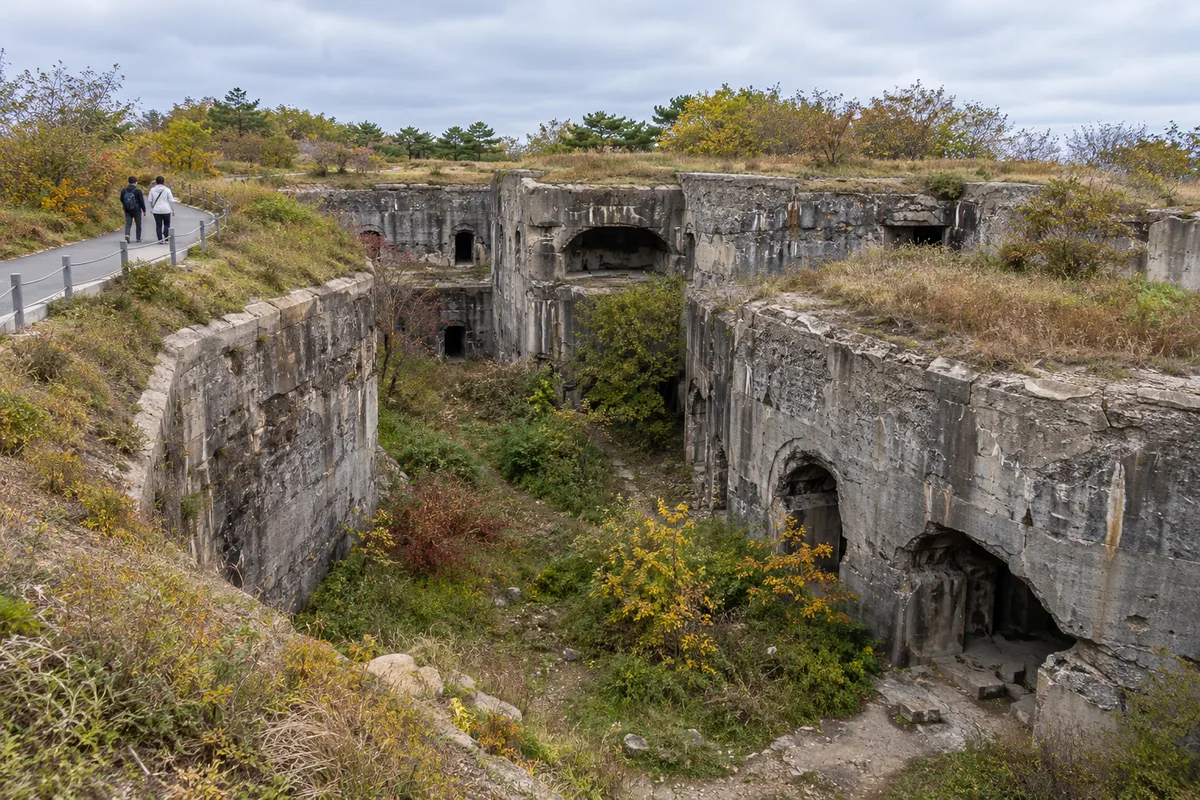
Dongjiguanshan is made up of the North Fort, the Wangtai Battery and other positions. The North Fort was first built under the Qing dynasty and expanded by Russia in 1900; it is a five-sided concrete fort with a perimeter of 496 metres. The Wangtai Battery, 1 km west of the fort at an elevation of 182 metres, was one of the last major battlefields of the Russo-Japanese War.
This is the place to understand what the siege looked like: you walk through broken concrete walls, tunnels and gun positions. It sits in the hills northeast of the old town. Allow about an hour, wear shoes with grip, and check the ticket price and hours at the entrance.
Shuishiying Meeting Place (水师营会见所)
Shuishiying is the house where the Russian and Japanese commanders met after the siege of Port Arthur ended. It is a short stop, usually 15 to 30 minutes, and it fits naturally between Dongjiguanshan and Hill 203 on a taxi loop. Ticket and opening details are posted on site; confirm them before you include it, as small sites can change their hours.
Wanzhong Tomb Memorial Hall (万忠墓纪念馆)
The Wanzhong Tomb is a mass grave of the people of Lushun who were killed during the First Sino-Japanese War of 1894. Its memorial hall, at 23 Jiusan Road (九三路23号), commemorates the events of 21 to 24 November 1894 known in English as the Port Arthur Massacre, and it is free to visit. It is in the eastern part of the old town and takes about 30 to 45 minutes.
Baiyu Mountain (白玉山)
Baiyu Mountain stands in the centre of Lushun town and has been a national 4A scenic area since October 2006. The hill is 130 metres high, and from the top you look over the naval port, the century-old dry dock and Huangjin Mountain. The tower on the summit, 66.8 metres tall, was built by the Japanese army between 1907 and 1909 under the name "Biaozhong Tower" (表忠塔, roughly "Tower of Loyalty") and has been called Baiyu Mountain Tower since 1986.
The 2018 Dalian price list set entry at 40 yuan per person, so check the current price at the gate. This is the best view in Lushun, but it is also where the photography rule matters most: enjoy the view of the harbour and take pictures of the tower and the town, not of the ships and naval facilities.
Lushun Museum and the Old Town
Lushun Museum (旅顺博物馆)
The Lushun Museum is a city-run museum of history and art, named one of China's first national first-grade museums in 2008. It is made up of a main hall completed in 1918 and an annex opened in 2001, holds more than 60,000 objects, and has been free since April 2013. The main hall is an early-20th-century building, and the collection goes far beyond local war history, into ancient Chinese art and archaeology.

The museum's official website lists opening hours of 9:00 to 16:30, with last entry at 16:00, and it closes on Mondays; holiday arrangements are announced separately. For winter it switches to shorter hours: the last published winter schedule, for 2023–24, ran from 1 November to 31 March at 9:00 to 16:00, with last entry at 15:30. Winter hours usually start in November, so check the Lushun Museum website before you go.
Booking: in April 2026 the museum said no booking was needed and visitors enter with an ID card at the gate, while visitors who don't have their ID card with them register on site through the museum's WeChat mini program (智慧旅博, "Smart Lushun Museum"); a media report says personal reservation returned from 21 July 2026 through another mini program, and that passport holders have been registering at the entrance without booking. Bring your passport and check the museum's latest notice before you go. If booking is required on your day, ask at the entrance.
Allow 1.5 to 2 hours for the main hall. Around the museum is the Lushun Museum Park, which includes the Sino-Soviet Friendship Tower, and it is also free under the 2023 list.
Taiyanggou and the old streets
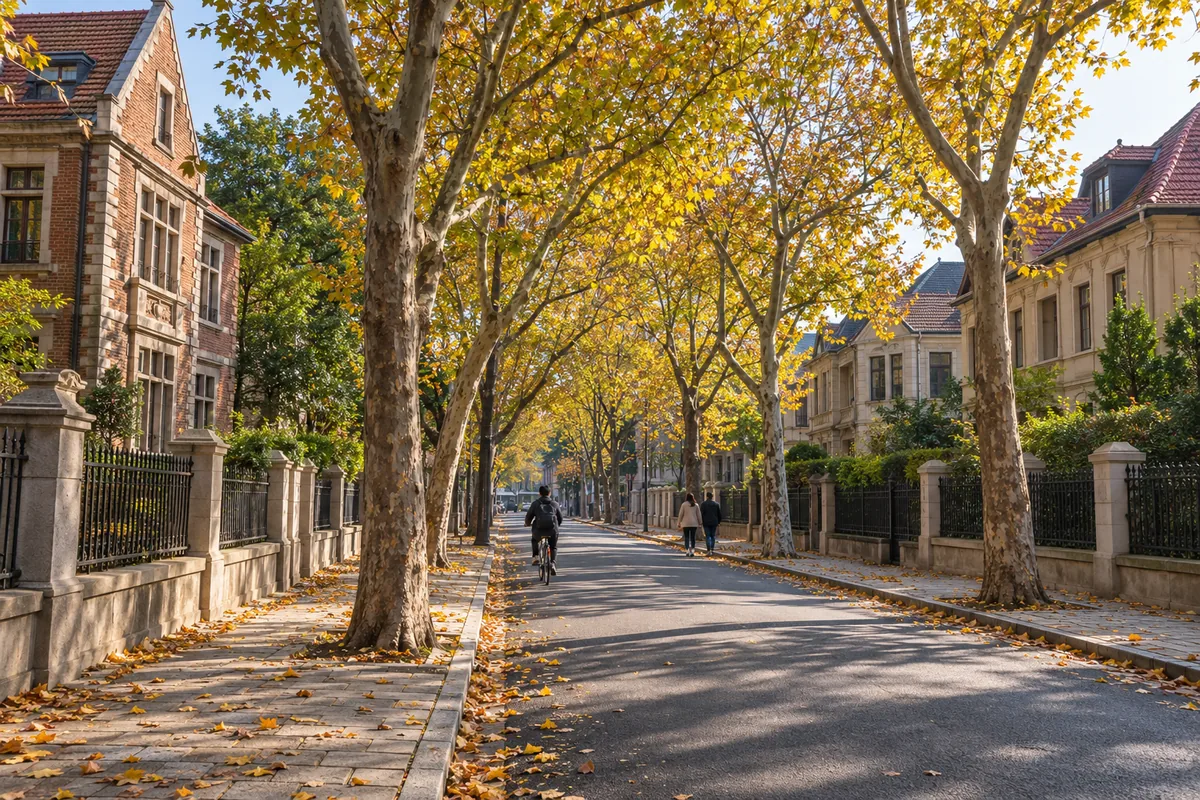
The museum sits in Taiyanggou (太阳沟, "Sun Valley"), the leafy western part of the old town with tree-lined streets and early-20th-century buildings. There is no ticket and nothing you have to see here; it is simply a pleasant place to walk for half an hour between sites, and in late spring and autumn it is one of the nicest parts of Lushun.
Lushun Railway Station (旅顺火车站)
The small Russian-style station building was built in 1903 as the end of the Chinese Eastern Railway branch line from Zhoushuizi. Passenger service ended in 2014, and the building is a nationally protected site; in October 2026 the district began works to improve the area around it. You can see it from outside, but parts of the area may be fenced during the works, so check what is open when you get there. It is near the foot of Baiyu Mountain, so the two fit together.
Lushunkou Scenic Area (the former Naval Port Park) and the coast
The Lushunkou Scenic Area, formerly called the Naval Port Park (军港游园), lies beside the naval port. It has the "Lushunkou" stone tablet, a bronze "Awakening Lion" statue and an exhibition hall, and a stone breakwater built in 1890 runs through it, with views of the harbour and the Laohuwei (Tiger's Tail) sandbar. Its entry was cut to 30 yuan in the official June 2023 price list, and the current price may differ, so check at the gate. This is where you are closest to the navy: you can see the ships, but do not photograph them.
Further out, the area around the nationally protected Laotieshan Lighthouse has been opened to the public, and the Yellow Sea–Bohai Sea boundary scenic area nearby is rated 3A. The boundary scenic area cost 20 yuan in the 2023 list, so confirm the current price before you go. It is a long drive from the old town, so only add it if you have a car for the day and time left.
Huangjin Mountain (黄金山, Golden Hill) sits at the harbour mouth opposite Baiyu Mountain. You will see it from Baiyu's summit; whether its own paths are open varies, so check on the day before you send a taxi there.
A One-Day Lushun Itinerary
Lushun's two big indoor sites, the prison museum and the Lushun Museum, both usually close on Mondays, so go Tuesday to Sunday. Start early: the metro ride takes time and the museum's last entry is mid-afternoon. Pick one of these two plans.
Plan A: The Russo-Japanese War sites
- Early morning: Line 1 to Hekou, then Line 12 to Lushun. Meet a driver or take a taxi from the station.
- Morning: Hill 203 (about 1 hour), then Shuishiying (20 minutes), then Dongjiguanshan North Fort (about 1 hour). This is the hill loop and needs a car.
- Lunch: in the old town.
- Early afternoon: the Japanese-Russian Prison Site Museum (1.5 to 2 hours).
- Late afternoon: Baiyu Mountain for the view, then the old railway station at its foot.
- Early evening: back on Line 12 toward Hekou.
Plan B: Museums and the old town
- Morning: the Lushun Museum as it opens, then a walk around Taiyanggou.
- Lunch: in the old town.
- Afternoon: the Prison Site Museum, then the Wanzhong Tomb Memorial Hall.
- Late afternoon: Baiyu Mountain and the old railway station, or the Lushunkou Scenic Area by the harbour.
- Early evening: back to Dalian.
Both plans are full days. If you try to do all of them in one day, you will spend most of it in taxis and rush the prison museum. With a second day, do Plan A one day and Plan B another.
If you want someone to explain the battle sites as you go, a guided day tour with an English-speaking guide is an alternative to the driver; you can browse options on GetYourGuide. Check whether the tour includes the prison museum, which some tours skip.
Combining with Dalian: Lushun takes a whole day, so do not plan Dalian city sights on the same day. A common three-day Dalian stay is one day in the city and on the coast, one day in Lushun, and one day at Jinshitan or a train onward. From Dalian, Shenyang is an easy next stop for the Qing palace and tombs: see our Shenyang guide.
FAQ
Can foreigners visit Lushun?
Yes. Lushunkou District was fully opened to foreign visitors on 21 November 2009, after a partial opening in 1996. You can go on your own by metro with your passport and no permit. Military areas around the naval port are still off limits, and photographing them is not allowed under the Military Installations Protection Law. Follow the signs and keep your camera off the warships and port facilities.
How long does it take to get from Dalian city to Lushun?
Lushun is 32 km from Dalian's city centre. By metro you take Line 1 to Hekou and change to Line 12; plan on roughly an hour to an hour and a half from central Dalian, and check the exact time in a map app for your starting station. A taxi is faster, depending on traffic. Line 12's last trains are earlier than the city lines, so check the last train time when you arrive.
Do the Lushun sights need booking?
No current official booking rule is published for the prison site or the forts, so carry your passport and check each site's notice the day before you go. The Lushun Museum said in April 2026 that no booking was needed, but a later media report says reservation returned in July 2026, with passport holders registering at the entrance; check the museum's latest notice the day before. Always carry your passport, because free sites in China usually ask for ID.
Practical Tips
- Walking: the old town is walkable, but the forts and Hill 203 involve paths, steps and uneven concrete. Wear comfortable shoes.
- Food: there are simple restaurants and noodle shops in the old town, but fewer choices near the hill sites. Have lunch in town, and carry water and a snack on the hill loop. Dalian's seafood dishes are found here too, such as Spanish mackerel dumplings (鲅鱼饺子, bàyú jiǎozi).
- Season: late spring and autumn are the most comfortable. Winter on the exposed hills and at the forts is cold and windy, and summer weekends are busy. See what to wear by season.
- Monday: the main museums usually close; plan another day.
- Emergencies: save the numbers in our emergency contacts guide before you go.
To sum up: go Tuesday to Sunday, start early on Line 1 and Line 12, carry your passport, choose either the war-sites loop or the museums-and-town plan, use a taxi or driver between the hill sites, keep your camera off the naval port, and be back on the train by early evening. For the rest of your Dalian stay, return to our Dalian guide.
Last updated: October 2026
Fact-checked sources
- Official Lushunkou District Government (Dalian) 9 pages
- Official Dalian Transport Bureau
- Official Dalian Municipal Government 10 pages
- Official Dalian Culture and Tourism Bureau 3 pages
- Official Ministry of National Defense
- Official Liaoning Foreign Affairs Office
- Official Chinese embassies and consulates
- Official National Immigration Administration
Show 5 more sources
- Official Dalian Development and Reform Commission 2 pages
- Official Yantai Municipal Government
- Official Lushun Museum
- Official mp.weixin.qq.com
- Tencent News
Last verified: 2026-10-25
Read in other languages
Last train times for 10 Chinese metro systems
Every line and station, checked by hand — the same data behind our offline route planner.
Get the WaysChina App
Offline guides, currency converter, essential phrases, and more — all in your pocket.

Related Articles

Shenyang Travel Guide: Mukden Palace, the Qing Tombs and Getting There
Plan one or two days in Shenyang: booking Mukden Palace with a passport, the two Qing tombs, Shenyang North vs...

Changbai Mountain Guide: North or West Slope, Winter, Tickets and Getting There
Changbai Mountain's north, west and south areas compared: seasons and winter opening, Tianchi weather, timed...

Dalian Travel Guide: How Many Days, Getting There, Lushun and the Coast
Plan 2–4 days in Dalian: when to go, trains to Dalian North and flights from Japan and Korea, the metro, Tiger Beach...

Harbin Winter Guide: Ice and Snow World Dates, Tickets, Cold and Getting There
When to go to Harbin for the ice season, how cold it really gets, trains from Beijing, buying Ice and Snow World...