

This article contains affiliate links. If you make a purchase through these links, we may earn a small commission at no extra cost to you. This helps support our work in creating free travel guides.
Shenyang (沈阳, Shěnyáng), once known as Mukden, is the capital of Liaoning province and the city where the Qing dynasty began: the government calls it "the birthplace of one dynasty and the capital of two generations of emperors". One full day covers the essentials and two days lets you add the outer sights. Mukden Palace and the two Qing tombs in the city, Zhaoling and Fuling, have been World Heritage sites since July 2004. The palace takes visitors by real-name booking only, and foreign visitors can book and enter with their passport.
Most high-speed trains from Beijing arrive at Shenyang North, and the fastest take 2 hours 29 minutes from Beijing Chaoyang. If you are heading on to Dalian, Shenyang Station has the most departures. Shenyang sits between Dalian, Harbin and Changbai Mountain, so it is usually one stop on a longer Northeast trip, or a place to break a train journey for a day.
How Many Days in Shenyang, and When to Go
One day is enough for the old city: Mukden Palace in the morning, Zhang's Mansion next door, then Zhongjie street and dinner. Two days lets you add Zhaoling in Beiling Park, the Liaoning Provincial Museum and either the 9.18 History Museum or the China Industrial Museum. Add a half day if you also want Fuling, the second tomb, which is on the eastern edge of the city. Shenyang is not a place for a week; most travelers pair it with Dalian, Harbin or Changbai Mountain.
Why the Qing story starts here
Before the Manchu rulers took Beijing in 1644, their capital was here. Nurhaci and his son Hong Taiji built and used the palace in Shenyang, then known as Shengjing (盛京); after the court moved to Beijing it became a secondary palace that later emperors such as Kangxi and Qianlong stayed in on tours of the northeast. Nurhaci is buried at Fuling and Hong Taiji at Zhaoling. That is why one city has a palace and two imperial tombs, and why Shenyang matters to anyone who has visited the Forbidden City in Beijing.
Seasons
Shenyang has long, cold winters and warm summers. July is the hottest month, with an average temperature of 24.6°C, and most of the year's rain falls in July and August; in winter even the average daytime high stays below freezing. Long-term records (1961–1990) put January at an average high of -5.2°C and an average low of -16.6°C.
In our view the most comfortable months are May, June, September and early October: mild days, long opening hours, and parks in leaf. Winter works too if you dress for it (see our guide to clothing by season): the palace and museums are indoors or compact, and the city is quieter. Note that many sights switch to shorter winter hours from October or November, so in winter plan your sightseeing for the middle of the day.
How far the neighbours are by train
On the sample travel day used in this guide, 5 November 2026, the fastest train from Shenyang to Dalian North takes 1 hour 25 minutes. From Harbin West to Shenyang North the fastest takes 2 hours 1 minute. Shenyang North to Changbaishan Station, for Changbai Mountain, takes 1 hour 53 minutes on the fastest train. Changchun West to Shenyang North can be as quick as 1 hour 3 minutes. For how these legs fit together, see our Northeast China route guide.
Getting to Shenyang: Trains, Airport and Visa-Free Transit
Most people arrive by high-speed train. The one thing to get right is the station: Shenyang has three high-speed stations, and the two big ones, Shenyang North (沈阳北) and Shenyang Station (沈阳站), both handle a lot of trains. Your ticket shows which one you use, and they are in different parts of the city.
Shenyang North, Shenyang Station and Shenyang South
- Shenyang North (沈阳北, Shěnyáng Běi). The main station for the Beijing–Harbin high-speed line. Of the 48 high-speed trains from Beijing on the sample day, 35 arrive here, and 33 of the trains from Harbin West do too. 34 of those Beijing trains start from Beijing Chaoyang. Metro Line 2 links it with the airport.
- Shenyang Station (沈阳站, Shěnyáng Zhàn). The old main station, still a major high-speed stop. It has the most trains to Dalian (30 on the sample day), 11 high-speed trains from Beijing, and the slower conventional trains.
- Shenyang South (沈阳南, Shěnyáng Nán). A newer station with only a few high-speed trains: 3 from Beijing, 6 to Dalian North and 5 from Harbin West on the sample day. You will rarely need it.
Both Shenyang North and Shenyang Station have metro stations, so whichever one your train uses, you can ride straight into the city. If you are leaving Shenyang on a different day, pick the departure station that is closest to your hotel when you book. Our train station guide explains how to get through ticket and ID checks with a passport.
The table below shows the main routes on the sample day: number of trains, fastest time and second-class fare range, by station.
| Route | Trains that day | First–last departure | Journey time | Sample fares: 2nd / 1st class |
|---|---|---|---|---|
| Beijing → Shenyang | 48 (G 48); 35 to Shenyang North (34 of them from Beijing Chaoyang), 11 to Shenyang Station (10 of them from Beijing Chaoyang), 3 to Shenyang South, G153 stops at both Shenyang Station and Shenyang South | 06:50–20:15 | fastest 2 h 29 min (G101 and others); conventional K/T/Z trains from Beijing Railway Station / Beijing Fengtai: 6 h 30 min or more | ¥290–378 / ¥463–605 |
| Shenyang → Dalian North | 43 (G 40 · D 2 · K 1); 30 from Shenyang Station, 13 from Shenyang North, 6 from Shenyang South, some trains stop at both Shenyang Station and Shenyang South | 06:38–21:33 | fastest 1 h 25 min (G730, from Shenyang Station) · typically 1 h 30 min–2 h; from Shenyang North: fastest 1 h 29 min; D7731 takes about 4 h | ¥146–190 / ¥233–303 |
| Harbin West → Shenyang North | 33 (G 32 · D 1); plus 10 conventional trains (Z/K/T); all Harbin stations → all Shenyang stations: 47 (G/D) | 06:10–18:15 | fastest 2 h 01 min (G520 and others); D566 takes 2 h 59 min | ¥235–279 / ¥376–447; D566 2nd class ¥199 |
| Changchun West → Shenyang North | 41 (G 40 · D 1) | 07:19–19:20 | fastest 1 h 03 min · typically 1 h 15 min | ¥139–148 / ¥223–236 |
| Changchun Station → Shenyang North | 55 (including 20 G) | – | fastest 1 h 10 min | – |
From Beijing
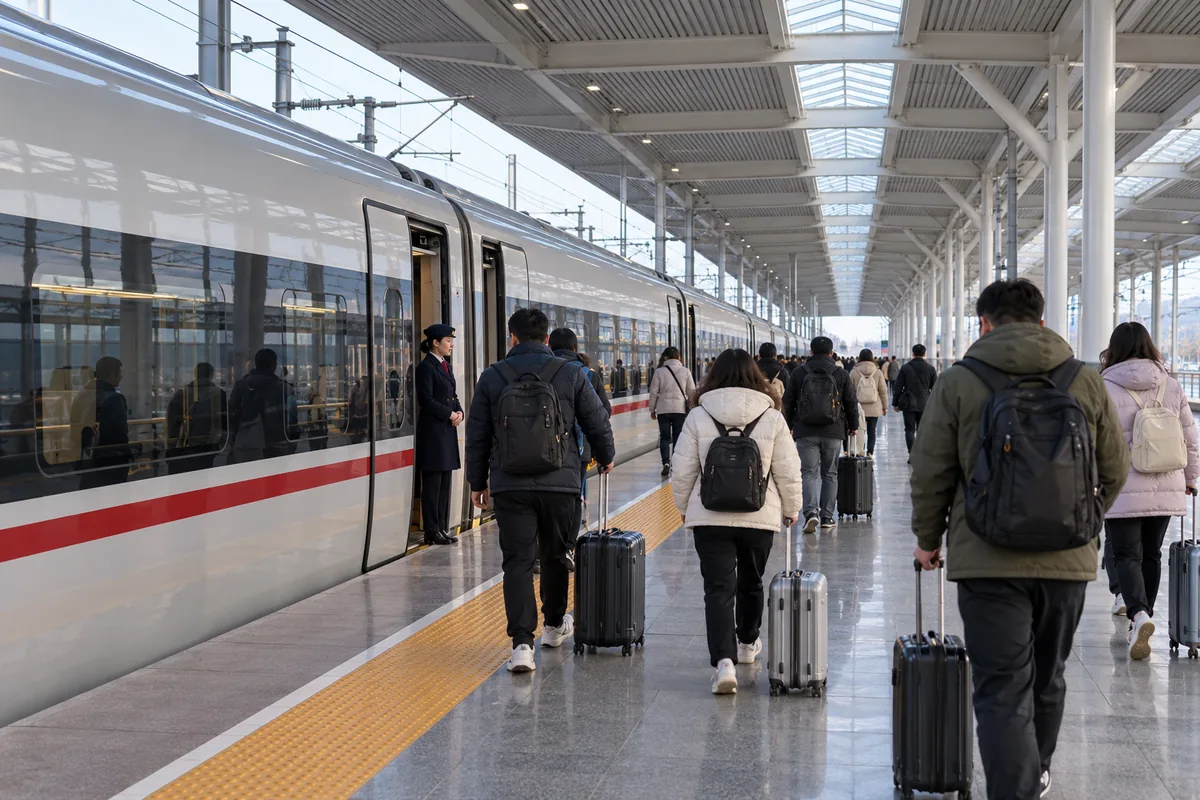
On 5 November 2026, 48 high-speed trains run from Beijing to Shenyang, and almost all leave from Beijing Chaoyang: 34 to Shenyang North and 10 to Shenyang Station. Departures are spread from 06:50 to 20:15, the fastest take 2 hours 29 minutes and slower ones about 3 to 4.5 hours. Second class costs 290 to 378 yuan depending on the train. Beijing Chaoyang is not Beijing's central station, so allow time to cross the city; our Beijing guide covers getting around there.
From Harbin and Changchun
From Harbin West to Shenyang North, about 33 high-speed and bullet trains are scheduled on the sample day, most taking 2 hours to 2 hours 40 minutes, with second class at 235 to 279 yuan depending on the train. If you are combining Shenyang with the ice festival, our Harbin winter guide covers that side of the trip. From Changchun West to Shenyang North, about 41 trains are scheduled, most taking about 1 hour 15 minutes, with second class at 139 to 148 yuan.
To and from Dalian
About 43 trains run from Shenyang to Dalian North on the sample day: 30 from Shenyang Station, 13 from Shenyang North and 6 from Shenyang South, with some trains stopping at more than one. Most take 1 hour 30 minutes to 2 hours, and second class costs 146 to 190 yuan depending on the train. Dalian, and the day trip to Lushun, are covered in our Dalian guide.
Booking
Train tickets are sold on China Railway 12306, which has an English website and app, and you register with your passport. Timetables and fares change, so check your actual date before you plan around a train. Our high-speed train guide explains seat classes and how boarding works.
Shenyang Taoxian International Airport
Taoxian Airport (桃仙机场) is Shenyang's airport. For the 2026–27 winter-spring season it schedules 154 routes to 97 cities, with international flights to seven cities including Seoul, Tokyo, Singapore and Frankfurt. Routes change by season, so check the current schedule with your airline.
The easiest way into the city is Metro Line 2: Taoxian Airport station connects to the terminal by an underground passage, and the same line runs to Shenyang North. Airport buses and the metro accept Chinese and foreign bank cards as well as cash for tickets. In winter the last metro trains run earlier, around 22:20 on the network and earlier still at the airport station, so if you land late, check the current last train or take a taxi.
240-hour visa-free transit
Shenyang Taoxian Airport is one of the three Liaoning ports for the 240-hour visa-free transit, and travelers entering this way may stay anywhere in Liaoning province, including Dalian. Jilin province is not part of the scheme, so on 240-hour transit you cannot go on to Changbai Mountain, Yanji or Changchun; in Heilongjiang only Harbin is allowed. This limit does not apply if you hold a Chinese visa or enter under the separate 30-day visa-free entry for ordinary passport holders of eligible countries, so check whether your nationality qualifies. For most of those countries that policy currently runs to 31 December 2026, so check the latest end date before you travel. See 240-hour visa-free transit for who qualifies, and the National Immigration Administration for the official rules.
World Heritage: Mukden Palace and the Two Qing Tombs
On 1 July 2004, Mukden Palace, Zhaoling, Fuling and Yongling (in nearby Fushun) were added to the World Heritage List together, known in Liaoning as "one palace, three tombs". The palace is listed as part of the Imperial Palaces of the Ming and Qing Dynasties in Beijing and Shenyang, together with the Forbidden City. The two Shenyang tombs are part of the Imperial Tombs of the Ming and Qing Dynasties. In practice that means three separate visits: the palace in the old city centre, Zhaoling in Beiling Park in the north of the city, and Fuling in the eastern suburbs.
The table below sums up prices, hours and booking for the three sites. After it, the details that matter for planning.
| Site | Ticket | Booking / entry | Hours |
|---|---|---|---|
| Mukden Palace (Shenyang Palace Museum) | Adult ¥50 · half price ¥25 for minors over 6, full-time students and seniors 60+ · free for children 6 and under or below 1.3 m, seniors 70+, persons with disabilities, active military and police · one parent may bring one minor free (valid ID required) | Required for every visitor, free tickets included (real-name). Official channels: the WeChat official account 沈阳故宫博物院 and Tongcheng (LY.com). Foreign visitors can book and enter with a passport; bring the original document you booked with. | Winter Oct 11, 2026–Apr 9, 2027: 09:00–16:30, last entry and ticket sales 15:45 · Summer Apr 10–Oct 10: 08:30–17:00, last entry 16:15 · closed Mondays (except public holidays) |
| Combo ticket: Mukden Palace + Zhang's Mansion + Shenyang Financial Museum | Adult ¥88 / half price ¥44 (eligible groups) · paid special exhibitions not included | Online only via Tongcheng, Trip.com (Ctrip) and Meituan, on sale since Aug 8, 2026; real-name, scan your ID at each gate (whether a passport works at all three gates is not stated) | — |
| Zhaoling Tomb and Beiling Park | Beiling Park ¥5 (half price ¥2) + tomb ¥40 peak / ¥20 off-peak (2019 price list; current price may differ) | The park is free before ticketing starts in the morning and after it stops in the evening; the tomb area needs its own ticket during opening hours | — |
| Fuling Tomb (Dongling) | tomb ¥30 peak / ¥20 off-peak · forest park ¥8 peak / ¥5 off-peak (2019 price list; current price may differ) | — | — |
Mukden Palace (沈阳故宫, Shěnyáng Gùgōng)
Mukden Palace stands in the middle of the old walled city. It covers more than 60,000 square metres in three sections, east, central and west, with 114 historic buildings and over 500 rooms; work began in 1625 and finished in 1783. It is much smaller than the Forbidden City, which makes it easy to see in two to three hours. Do not miss the east section: the Dazheng Hall (大政殿) and the ten pavilions lined up in front of it, one for each of the princes of the left and right wings and the Eight Banners (八旗, the Manchu military and social units), are unlike anything in Beijing. The central section holds the throne hall and the living quarters; the west section has the Wensu Pavilion (文溯阁), built to store one of the copies of the Qing imperial library.
Tickets. Entry costs 50 yuan per person, the price since 1 October 2019. Half price applies to children over 6 and under 18, full-time students and people aged 60 and over with valid ID, and children 6 and under or under 1.3 m enter free. The rules don't say whether a foreign passport qualifies for age discounts; if you are eligible by age, ask at the service window. Special exhibitions and evening openings are charged separately.
Booking. Every visitor must book under their real name, including those with free or discounted tickets. The official channels are the palace museum's WeChat account (沈阳故宫博物院) and the Chinese travel app Tongcheng (同程). Visitors from outside mainland China can book and pass the gate with a passport, and you must bring the same passport you booked with. The museum's visitor rules page (in Chinese) has the latest version. Book as soon as your date is fixed, because slots can run out, especially for weekends and Chinese holidays (see our Golden Week guide).
Hours. From 10 April to 10 October the palace opens 08:30–17:00, with last entry at 16:15. From 11 October to 9 April it opens 09:00–16:30, and ticket sales and entry stop at 15:45. It is closed on Mondays except public holidays. In summer and over holidays the museum often adds Monday openings and longer hours; check the official announcement for your dates.
Combo ticket. Since August 2026 an 88-yuan combo covers Mukden Palace, Zhang's Mansion and the Shenyang Financial Museum, sold online only through Tongcheng, Ctrip (携程) and Meituan (美团). You then enter each site by scanning your ID at the gate. If you only have a passport, book the palace on its own through the official channels, and ask the seller before buying the combo whether a passport works at all three gates.
💡 Tip: Go early on a weekday. Tour groups arrive mid-morning, and in winter the last entry is at 15:45, which comes sooner than you expect. The English pages of the Shenyang Palace Museum give background on the buildings.
Zhaoling and Beiling Park (昭陵 / 北陵公园)
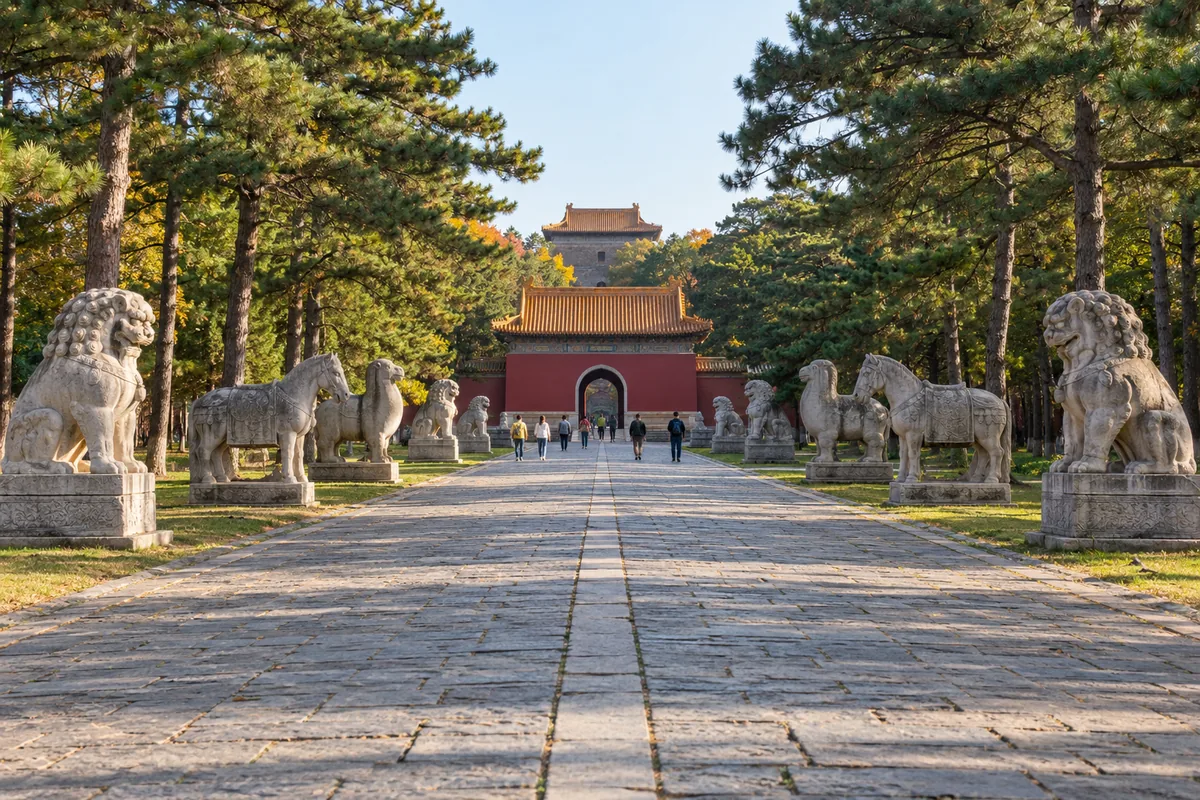
Zhaoling is the tomb of Hong Taiji and his empress Xiaoduanwen. It sits inside Beiling Park (北陵公园, "North Tomb Park") in the north of the city: the park covers 3.3 square kilometres, was a royal tomb before it opened as a park in 1927, and the protected tomb area has 38 historic buildings or groups. The walk in follows a long straight sacred way lined with stone animals, through gates to a walled square fortress with a tower, and behind it the round burial mound.
There are two tickets: one for the park and one for the tomb area. The 2019 official price list set the park at 5 yuan and the tomb at 40 yuan in peak season and 20 yuan in the low season; current prices may differ, so check at the gate. Online sellers often show different, discounted or bundled prices. The park is free in the early morning before ticketing starts and in the evening after it stops. That is a good time to walk the lake and see local people dancing and exercising, but plan to visit the tomb itself during normal hours. Opening hours aren't posted; check on the day. The metro reaches Beiling Park.
Fuling and Dongling Park (福陵 / 东陵)
Fuling is the tomb of Nurhaci, founder of the Qing state, and his empress Yehenara, and people in Shenyang call it Dongling (东陵, "East Tomb"). It stands on Tianzhu Mountain on the north bank of the Hun River, about 18 km from the city centre, with a forest park behind the tomb buildings. The 2019 official price list set the tomb ticket at 30 yuan in peak season and 20 yuan in the low season, and the forest park at 8 or 5 yuan; check the current price at the entrance.
Fuling sits on a hillside, with a stone stairway climbing up to the tomb, and is quieter than Zhaoling. Because it is far out, take a taxi or DiDi and give it half a day. If you only have time for one tomb, choose Zhaoling: it is in the city and easy to combine with the Liaoning Provincial Museum or a park walk.
Modern History and Museums
Four museums cover modern history, industry and art, all reachable in a day or two. Three of them are free, and two need no booking. Here are prices, hours and booking at a glance.
| Museum | Ticket | Booking / entry | Hours |
|---|---|---|---|
| Zhang's Mansion (Zhang Xueliang's Former Residence) | ¥18 (2019 price list; current price may differ) | — | Summer (Apr 10–Oct 9): 08:30–17:30, last entry 17:00 · no official winter hours or Monday closing found; check before you go |
| 9.18 History Museum | Free | Booking required on the official 易游沈阳 platform (scan the QR code); make sure your booking is confirmed before you go | Tue–Sun 09:00–17:00, last entry 16:30 · closed Mondays (except public holidays) |
| Liaoning Provincial Museum | Free (permanent galleries) | No booking: walk in through security; passport holders use a dedicated lane; entry is paused when the museum is at capacity | Tue–Sun 09:00–17:00, last entry 16:30 · closed Mondays (except public holidays) |
| China Industrial Museum | Free | No booking: scan a QR code to register on arrival | Apr–Oct: 09:00–17:00, last entry 16:30 · Nov–Mar: 09:00–16:30, last entry 16:00 · closed Mondays (except public holidays) |
Zhang's Mansion (张氏帅府, Zhāngshì Shuàifǔ)
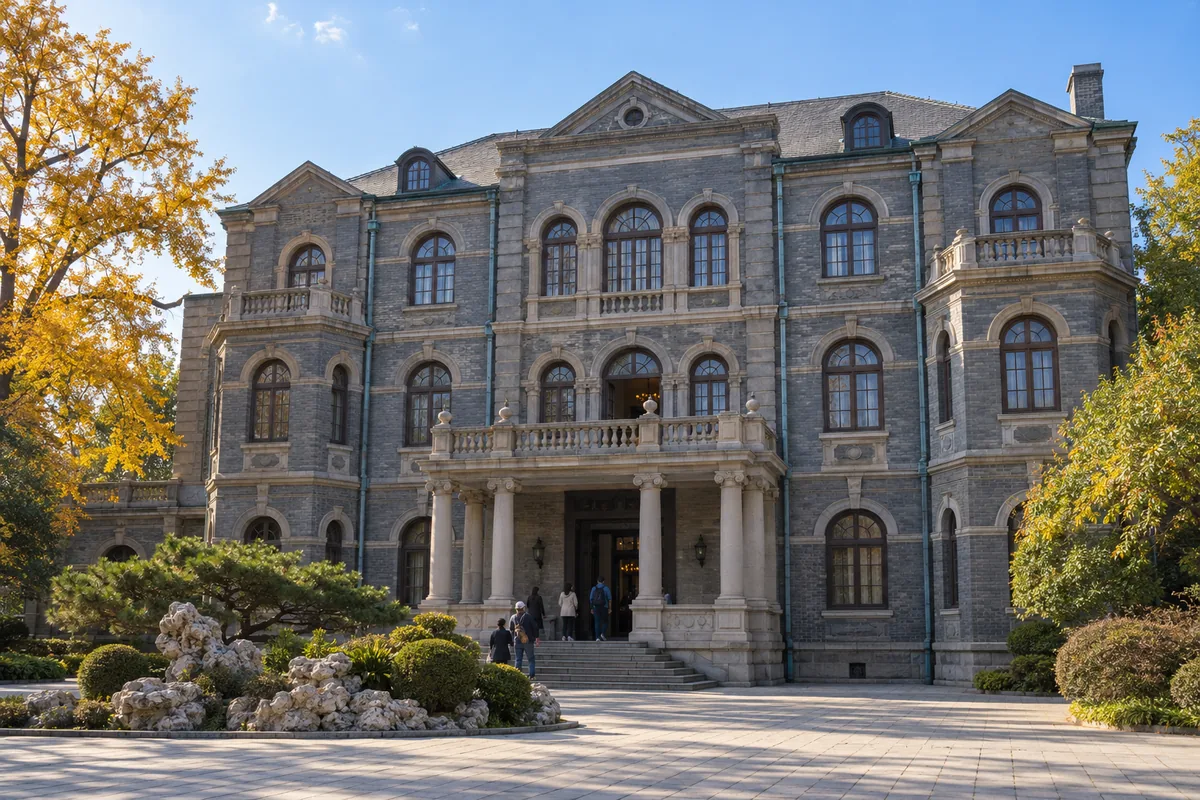
Officially the Zhang Xueliang Former Residence Museum, this compound a short walk from Mukden Palace was the official residence and private home of the Zhang family during the years Zhang Xueliang governed Northeast China. Building began in 1914, and the 53,000-square-metre site includes a three-courtyard traditional house, the grey-brick Da Qing Lou (大青楼, the large blue-grey brick building) and the smaller Xiao Qing Lou (小青楼), a Guandi temple, red-brick buildings, the former residence of Zhao Yidi and the former Frontier Bank. The mix of a Chinese courtyard house and Western-style mansions makes it different from the palace, and the two together fill a morning.
The 2019 official price list set the ticket at 18 yuan; the current price may differ, so check before you go. It is also part of the 88-yuan combo with the palace. Summer hours (10 April to 9 October) are 08:30–17:30 with last entry at 17:00. Winter hours are shorter and Monday closing rules can change, so check the official account before you go.
9.18 History Museum (九·一八历史博物馆)
The September 18th History Museum is in Dadong district, near the former Liutiaohu section of the South Manchuria Railway, where the September 18th Incident, also called the Mukden Incident, began in 1931. On the night of 18 September 1931, an explosion on the railway near Liutiaohu was used by Japan's Kwantung Army as the pretext to occupy Northeast China. It is a national first-grade museum, and its exhibitions cover the incident and its aftermath. The city has long kept it free to visit. It opens Tuesday to Sunday 09:00–17:00 with last entry at 16:30, is closed on Mondays except public holidays, and you book through the official "Yiyou Shenyang" (易游沈阳) platform by scanning its QR code. If you cannot use the platform yourself, ask your hotel to book it for you with your passport details.
Every 18 September since 1995 a commemoration is held here, and air-raid sirens sound across the whole city. If you are in Shenyang on that day, that is what the sirens are.
Liaoning Provincial Museum (辽宁省博物馆)
The provincial museum is the best single place in Shenyang for art and archaeology: the "Ancient Liaoning" galleries plus nine themed galleries including porcelain, jade, Buddhist sculpture, bronze mirrors, coins, seals and Manchu folk customs, all free. No booking is needed: walk in, pass security, and visitors with a passport use a separate entrance lane. It opens Tuesday to Sunday 09:00–17:00, last entry 16:30, and is closed on Mondays except public holidays. When the museum is full, staff hold people at the door for a while. Allow two to three hours. It has its own metro station.
China Industrial Museum (中国工业博物馆)
Shenyang was long one of China's main industrial cities, and this large museum in Tiexi district covers that history. Entry is free and needs no booking; you scan a code to register at the door. Registration may need a Chinese phone app, so have your passport ready in case staff register you by hand. It opens 09:00–17:00 from 1 April to 31 October and 09:00–16:30 from 1 November to 31 March, with last entry 30 minutes before closing, and is closed on Mondays except public holidays. It is a good choice for rail and engineering fans, and for a rainy or very cold afternoon.
Zhongjie, Xita and What to Eat
Zhongjie (中街, "Middle Street")
Zhongjie is the pedestrian shopping street just north of Mukden Palace. It dates from 1625, was named one of China's first pilot pedestrian streets for upgrading by the Ministry of Commerce in 2018, and keeps 8 historic buildings and 11 century-old shops, including Laobian Dumplings and Cuihualou. Most of it is modern chain stores now, but it is the natural place to walk after the palace, and the side lanes around it are where you find snack stalls and old restaurants. In the evening the street is lit and busy, and in winter it is a good place to warm up indoors.
Xita (西塔): the Korean quarter
Xita, in Heping district, is where Shenyang's Korean-Chinese (朝鲜族, Cháoxiǎnzú, ethnic Korean) and Korean restaurants are concentrated: barbecue, cold noodles and rice cakes. The district even holds a Korean food festival there. For most visitors, Xita is simply the best place in Shenyang for dinner: pick a busy restaurant, order grilled meat cooked at the table and a bowl of cold noodles. Signs are often in both Chinese and Korean. The metro reaches Xita.
What to eat in Shenyang
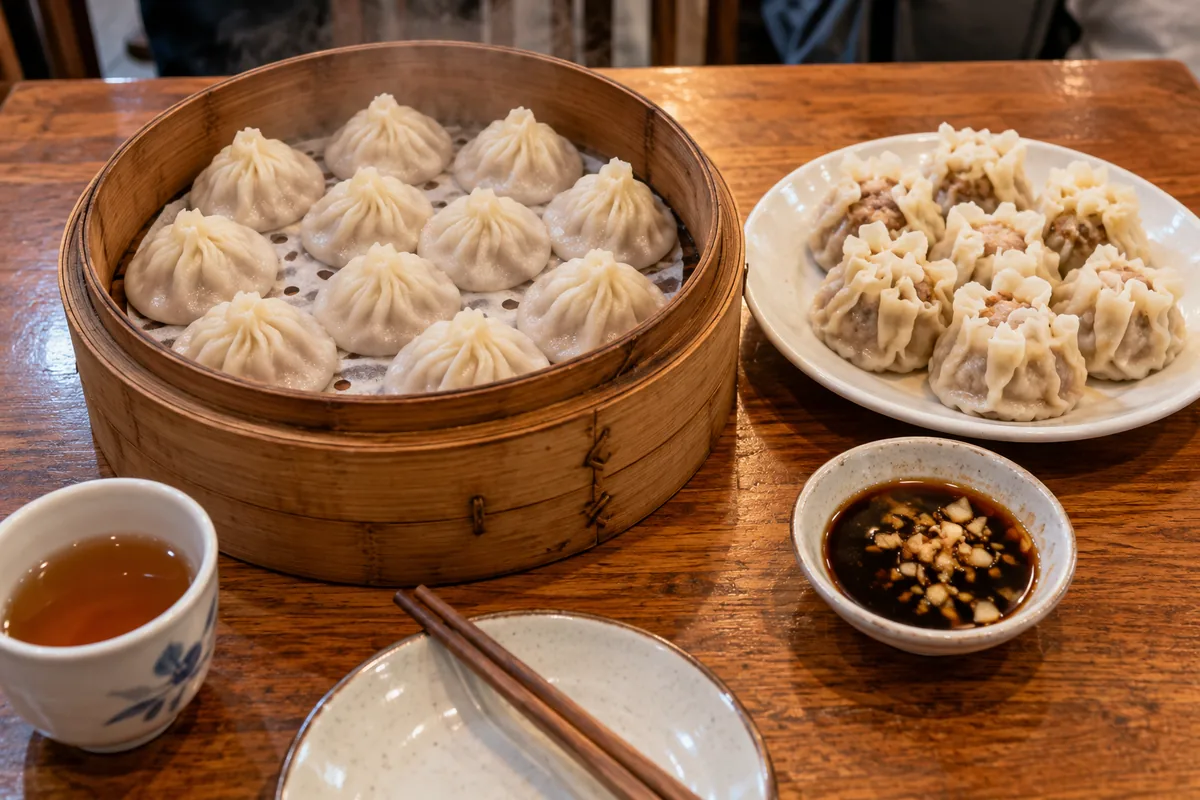
Liaoning cuisine (辽菜), Laobian dumplings (老边饺子, Lǎobiān jiǎozi) and Ma family shaomai (马家烧麦, Mǎjiā shāomai) are all on the provincial list of intangible cultural heritage.
- Laobian dumplings (老边饺子). Steamed dumplings whose filling is first stir-fried, which gives them a richer taste than ordinary boiled dumplings. Laobian Dumplings is one of the century-old shops on Zhongjie.
- Ma family shaomai (马家烧麦). Steamed open-topped dumplings, a Hui (Chinese Muslim) recipe, so the filling is beef or mutton rather than pork. Good for breakfast or lunch.
- Chicken rack (鸡架, jījià). The city's favourite cheap snack: the bony frame of a chicken, smoked, braised or fried, eaten with your hands, often with beer. You find it at small shops and night stalls across the city.
- Korean barbecue and cold noodles (烤肉 / 冷面). Best in Xita. Cold noodles in an icy, tangy broth are eaten all year, even in winter.
- Northeastern home cooking (东北菜). Big plates and hearty flavours: guobaorou (锅包肉, crispy sweet-and-sour pork), pork stewed with sauerkraut (酸菜白肉) and di san xian (地三鲜, potato, aubergine and pepper). Portions are large, so order fewer dishes than you think.
Most restaurants take Alipay and WeChat Pay; see our guide to using international cards in China to set up a foreign card before you arrive. For the bigger picture of food in the north, see Chinese cuisine by region.
Getting Around Shenyang
The metro is the easy option. At the end of 2025 it had 6 lines and 146 stations, and a new section of Line 3 opened on 30 June 2026. It reaches Mukden Palace, the Liaoning Provincial Museum, Beiling Park, the China Industrial Museum, Xita and the 9.18 History Museum. Fares go by distance, up to a maximum of 7 yuan.
About paying: you can buy single tickets with Alipay or WeChat, and 20 stations, including Shenyang Station, Shenyang North, Taoxian Airport, Zhongjie and the Provincial Museum, have card machines that take Visa, Mastercard, American Express, Diners Club and JCB. You cannot tap a foreign bank card at the gate. Either buy a single ticket (by card at those 20 stations, or with Alipay or WeChat) and use that ticket at the gate, or scan a metro ride code (乘车码, chéngchē mǎ) or UnionPay's QuickPass app at the gate. In practice, most visitors set up Alipay first; our guide to Alipay with a foreign card shows how.
From 1 November to 31 March the metro runs about 5:30–22:20, and from 1 April to 31 October until about 23:00. The table below covers airport routes, metro fares and hours.
| Topic | Details |
|---|---|
| Flights | Winter-spring schedule, Oct 25, 2026–Mar 27, 2027: 38 airlines, 154 routes to 97 cities, about 3,456 flights a week planned; international flights to 7 cities, including Seoul, Tokyo, Singapore and Frankfurt. China Southern, May 2025: Tokyo daily, Osaka 3 a week, Seoul 2 a day, Busan 2 a week. |
| Airport → city | Metro Line 2 from Taoxian Airport station, linked to the terminal by an underground passage; the same line runs to Shenyang North. Airport buses and the metro: tickets by Chinese or foreign bank card or cash. Airport station, Apr–Oct (2025 timetable): first train 06:00, last 23:00. Nov–Mar (2024 timetable): last train 22:00 from the airport station, around 22:20 on the rest of the network. |
| Metro fares | By distance, up to ¥7; stored-value card 10% off. By metro: Mukden Palace, the Liaoning Provincial Museum, Beiling Park, the China Industrial Museum, Xita and the 9.18 History Museum. |
| Metro hours | Apr–Oct: 05:30–23:00 · Nov–Mar: 05:30–22:20. Summer 2025 example: Shenyang North, Line 2 towards the airport, first train 06:04, last 23:30. |
| Paying on the metro | Card machines taking Visa, Mastercard, American Express, Diners Club and JCB at 20 stations, including Taoxian Airport, Shenyang North, Shenyang Station, Shenyang South, Zhongjie and Provincial Museum. At every station you can buy a ticket by scanning with WeChat or Alipay. Go through the gates with that ticket or by scanning the metro ride code or the UnionPay app (云闪付). The gates do not take a tap of a bank card. |
For Fuling, late evenings or bad weather, use taxis or DiDi, which works in English with a foreign card (see our DiDi guide). The palace, Zhang's Mansion and Zhongjie are within walking distance of each other; the provincial museum, Beiling Park and Xita are a short metro or taxi ride away.
A One-Day and Two-Day Shenyang Itinerary
One day
- Morning: Mukden Palace at opening time (booked ahead). Two to three hours.
- Lunch: Laobian dumplings or Ma family shaomai around Zhongjie.
- Early afternoon: walk over to Zhang's Mansion. About 1.5 hours.
- Late afternoon: Zhongjie and the lanes around it.
- Evening: metro or taxi to Xita for Korean barbecue and cold noodles.
Remember the palace is closed on Mondays except public holidays. If your one day is a Monday, swap in Zhang's Mansion, Zhongjie and Beiling Park, and check whether Zhang's Mansion is open that day.
Two days
Day 1 as above. Day 2: Liaoning Provincial Museum in the morning, then Zhaoling in Beiling Park in the afternoon. If you prefer modern history, swap the museum for the 9.18 History Museum (book ahead) or the China Industrial Museum. If you have a car or are happy with a long taxi ride, replace Beiling with Fuling. Most museums close on Mondays, so do not put day 2 on a Monday.
A half day between trains
If you are only changing trains, check which station you arrive at and which one you leave from. With four or five hours, go to Mukden Palace (booked ahead) and eat on Zhongjie, then take the metro or a taxi to your departure station. Leave at least an hour for the station, more if you have to cross the city between Shenyang North and Shenyang Station. Large stations usually have a left-luggage counter; ask at the information desk when you arrive.
Where to stay
For a short stay, the area around Zhongjie and the palace puts you within walking distance of the main sights and plenty of restaurants. If you arrive late or leave early by train, staying near Shenyang North or Shenyang Station (whichever your ticket uses) saves time. Hotels must register foreign guests, so book places that accept foreign passports; our guide to hotel booking and registration explains how. You can compare hotels in both areas on Booking.com.
Where to go next
Dalian is the usual next stop south, with the coast and Lushun. North and east, the high-speed line runs to Changbai Mountain; see our Changbai Mountain guide, and remember it is in Jilin province, which is outside the 240-hour transit area. On the sample day about 10 trains run from Shenyang North to Changbaishan Station, with second class at 196 to 275 yuan depending on the train. Book onward trains on 12306, or in English with a foreign card through Trip.com.
FAQ
Do I need to book Mukden Palace in advance, and how do foreigners buy tickets?
Yes. Every visitor must book under their real name through the palace museum's WeChat account or the Tongcheng app, and foreign visitors book and enter with their passport, which they must bring on the day. The ticket costs 50 yuan. If you do not use WeChat or Tongcheng, ask your hotel to book for you with your passport details. Book as soon as you know your date, and remember the palace is closed on Mondays except public holidays.
How many days should I spend in Shenyang?
One day covers Mukden Palace, Zhang's Mansion, Zhongjie and dinner in Xita. Two days lets you add Zhaoling in Beiling Park and the Liaoning Provincial Museum or the 9.18 History Museum. Add half a day for Fuling. If you are only changing trains, four or five hours is enough for the palace and lunch.
What is the difference between Shenyang Station and Shenyang North?
They are two separate stations in different parts of the city. Shenyang North is the main station for high-speed trains on the Beijing–Harbin line, and Shenyang Station has the most trains to Dalian as well as the slower conventional trains; a third station, Shenyang South, has only a few high-speed trains. Check the station name on your ticket, and allow extra time if you need to get from one to the other. Both have metro stations.
In short: give Shenyang one or two days; book Mukden Palace in advance with your passport and avoid Mondays; check whether your train uses Shenyang North or Shenyang Station; and set up Alipay for metro tickets. Then add Zhaoling, the provincial museum and dinner in Xita. For the rest of the trip, see our guides to Dalian, Harbin and Changbai Mountain.
Last updated: October 2026
Fact-checked sources
- Official Liaoning Provincial Government 2 pages
- Official Liaoning Department of Culture and Tourism 9 pages
- Official Shenyang Palace Museum 6 pages
- Official China Railway 12306 8 pages
- Official China Weather (China Meteorological Administration)
- Official WMO World Weather Information Service
- Official Shenyang Municipal Government 5 pages
- Official Liaoning Department of Transport
Show 10 more sources
- Official Liaoning Foreign Affairs Office
- Sina News
- Official Chinese embassies and consulates 2 pages
- Official National Immigration Administration
- Official China Visa Application Service Center
- Official Ministry of Foreign Affairs 2 pages
- Official Shenyang Culture, Tourism and Broadcasting Bureau 3 pages
- Official Liaoning Provincial Museum 2 pages
- Official China Industrial Museum 2 pages
- Official Shenyang Commerce Bureau
Last verified: 2026-10-25
Read in other languages
Last train times for 10 Chinese metro systems
Every line and station, checked by hand — the same data behind our offline route planner.
Get the WaysChina App
Offline guides, currency converter, essential phrases, and more — all in your pocket.

Related Articles

Lushun (Port Arthur) Day Trip from Dalian: Access, History Sites and Getting There
Lushun from Dalian in one day: open to foreigners, Metro Line 12 from Hekou, the prison site, Hill 203, the forts...

Changbai Mountain Guide: North or West Slope, Winter, Tickets and Getting There
Changbai Mountain's north, west and south areas compared: seasons and winter opening, Tianchi weather, timed...

Dalian Travel Guide: How Many Days, Getting There, Lushun and the Coast
Plan 2–4 days in Dalian: when to go, trains to Dalian North and flights from Japan and Korea, the metro, Tiger Beach...

Harbin Winter Guide: Ice and Snow World Dates, Tickets, Cold and Getting There
When to go to Harbin for the ice season, how cold it really gets, trains from Beijing, buying Ice and Snow World...