

This article contains affiliate links. If you make a purchase through these links, we may earn a small commission at no extra cost to you. This helps support our work in creating free travel guides.
Give Shanxi 5 days if you only want Datong and Pingyao, and 7 days if you add Mount Wutai and a stop in Taiyuan. Run the trip from north to south: high-speed train from Beijing (Qinghe or Beijing North station) to Datong South, a direct bus from Datong to Mount Wutai, a bus down to Taiyuan, a short train to Pingyao, and then a train on to Xi'an North. The same route works in reverse if you fly into Xi'an. Two things catch people out. First, there is no high-speed station at Mount Wutai; the last stretch is always a bus. Second, if you are entering China on 240-hour visa-free transit, only Taiyuan and Datong are inside Shanxi's permitted area, so Mount Wutai and Pingyao are off the table on that policy.
How many days, and which order
Shanxi (山西) is the province west of Beijing, beyond Hebei. It has a lot of very old Buddhist cave art and wooden buildings, and it holds three UNESCO World Heritage sites that sit neatly along one north–south rail line: the Yungang Grottoes in Datong, listed in 2001; the Ancient City of Pingyao, listed in 1997; and Mount Wutai, listed in 2009. UNESCO describes Mount Wutai as one of China's four sacred Buddhist mountains, known for its five flat-topped peaks.
Here is how we would size the trip:
- 5 days: Datong and Pingyao. Two nights in Datong, two nights in Pingyao, one travel day in between. There is a direct train from Datong South to Pingyao Gucheng, so you do not need to change in Taiyuan.
- 7 days: the full route. Two nights in Datong, one night at Mount Wutai, one night in Taiyuan, two nights in Pingyao. This is the version to choose if you have the time and the season is right.
- 8–9 days: the full route with two nights at Mount Wutai and a slower pace, or with day trips such as the Yingxian Wooden Pagoda from Datong or the family compounds near Pingyao.
The order matters more than the exact number of nights. North to south is the natural direction, for three reasons:
- Beijing connects best to Datong. The fastest high-speed trains from Qinghe and Beijing North reach Datong South in under 2 hours. Starting there means your first leg is short and frequent.
- Mount Wutai sits between Datong and Taiyuan. There is a scenic-area bus from Datong South station to the Mount Wutai visitor centre, and buses from Mount Wutai down to Taiyuan. You go in from one side and out the other, with no backtracking.
- Pingyao connects to Xi'an. High-speed trains run from Pingyao Gucheng to Xi'an North, so Pingyao is the natural last stop in Shanxi before you continue to Xi'an, the Terracotta Army and beyond.
Going the other way (Xi'an North → Pingyao → Taiyuan → Mount Wutai → Datong → Beijing) works just as well. Pick the direction that matches your flights: if you land in Beijing, go south; if you land in Xi'an, go north. An open-jaw ticket (into one city, out of another) saves you a long return leg.
Season decides whether Mount Wutai belongs in the plan at all. The temple valley is open all year, but the five terrace peaks are closed to visitors from 1 November 2026 to 15 May 2027. On the peaks, at about 2,900 metres, the January average is −17.3 °C. From November to mid-May, Mount Wutai becomes a temple visit only, and many travellers drop it and do the 5-day version instead. From late May to October, the full 7-day route is the better trip.
Entry and Shanxi's 240-hour visa-free rule
Most visitors do this route as part of a bigger China trip: in through Beijing, out through Xi'an or Shanghai. How you entered China decides whether all of Shanxi is open to you.
240-hour visa-free transit. This policy lets eligible nationals stay up to 240 hours (10 days) while travelling on to a third country. In Shanxi it comes with a tight map. The only Shanxi entry port is Taiyuan Wusu International Airport, and the permitted stay area is Taiyuan and Datong only — not the whole province. Mount Wutai is in Xinzhou and Pingyao is in Jinzhong, so both are outside the area.
You can cross between permitted areas in different provinces on the same entry, so a Beijing–Datong–Taiyuan trip is fine under the policy. The policy covers 65 entry ports in 24 provinces, including Beijing's airports. In practice, a 240-hour traveller can do Beijing → Datong → Taiyuan and fly out, but should leave out Pingyao and Mount Wutai. Our 240-hour visa-free transit guide explains the onward-ticket rule and how the border check works.
30-day visa-free entry or a visa. If your passport qualifies for China's 30-day visa-free entry, or you hold a regular tourist visa, the Shanxi map does not apply to you. You can go anywhere on this route, including Mount Wutai and Pingyao. Our guide to China's visa-free and transit policies shows which countries are on which list.
💡 Tip: The open-jaw plan (in through Beijing, out through Xi'an) suits travellers on 30-day visa-free entry or a visa. If you are on 240-hour transit, check the entry rules for your departure city as well before you book flights.
Every train leg, station by station
All the trains below are high-speed or bullet trains unless we say otherwise. The figures come from the 12306 timetable (China Railway's official booking system) for one sample travel day, Thursday 5 November 2026. Counts are "about this many trains that day", and fares are second-class ranges that vary by train. Timetables change a few times a year, so use these numbers to plan and the live timetable to book.
| Route | Trains that day | Departures | Journey time | Sample fares: 2nd / 1st class |
|---|---|---|---|---|
| Qinghe → Datong South | 24 (D 14 · G 10) | 07:04–20:16 | fastest 1 h 45 min (G2509) · typically 2 h 05 min | ¥146–157 / ¥235–252 |
| Beijing North → Datong South | 21 (G 20 · D 1) | 06:49–20:02 | fastest 1 h 46 min (G2531) · typically 2 h 04 min | ¥148–167 / ¥237–269 |
| Beijing West / Beijing Fengtai → Datong South | No direct trains | – | – | – |
| Beijing Fengtai → Datong Station | 11 (K 7 · Z 4) | – | fastest 5 h 36 min (Z351) | – |
| Route | Trains that day | Departures | Journey time | Sample fares: 2nd / 1st class |
|---|---|---|---|---|
| Datong South → Fanshi / Wutaishan North | No direct trains | – | – | – |
| Datong Station → Wutaishan North | No direct trains | – | – | – |
| Datong South → Yuanping West | 20 (D 17 · G 3) | 06:51–19:51 | fastest 51 min (D5363) · typically 1 h 09 min | ¥66–81 / ¥105–130 |
| Beijing West / Beijing Fengtai → Wutaishan North | 1 (K603, overnight) | 22:11 / 22:32 | arrives 04:44 next day; 6 h 12 min–6 h 33 min | hard seat ¥50.5 · hard sleeper ¥96.5 |
| Wutaishan North → Taiyuan Station | 2 (K603, 8817) | 04:48, 10:49 | 3 h 32 min (K603) · 5 h 11 min (8817) | hard seat ¥27.5–37.5 |
| Taiyuan Station → Wutaishan North | 2 | – | – | – |
| Fanshi → Taiyuan Station | 2 | – | – | – |
| Route | Trains that day | Departures | Journey time | Sample fares: 2nd / 1st class |
|---|---|---|---|---|
| Datong South → Taiyuan South | 43 (D 35 · G 8) | 06:33–21:35 | fastest 1 h 29 min (G2511) · typically 1 h 46 min | ¥99–134 / ¥157–214 |
| Datong South → Taiyuan Station | 12 (D 10 · G 2) | – | fastest 1 h 21 min (D2511) | ¥101–118 / ¥161–188 |
| Datong Station → Taiyuan Station | 3 (K 3) | – | fastest 3 h 37 min | – |
| Route | Trains that day | Departures | Journey time | Sample fares: 2nd / 1st class |
|---|---|---|---|---|
| Datong South → Pingyao Gucheng | 8 (D 7 · G 1) | 06:33–18:46 | fastest 2 h 28 min (D1037) · typically 2 h 42 min | ¥132–146 / ¥211–234 |
| Datong Station → Pingyao Station | 2 (K 2) | – | fastest 6 h 05 min | – |
| Route | Trains that day | Departures | Journey time | Sample fares: 2nd / 1st class |
|---|---|---|---|---|
| Beijing Fengtai → Taiyuan South | 17 (G 16 · D 1) | 07:12–20:02 | fastest 2 h 18 min (G379) · typically 2 h 53 min; plus 1 slower D269: 5 h 11 min, 2nd class ¥127 | ¥182–224 / ¥291–357 |
| Beijing West → Taiyuan South | 1 (G613) | – | 2 h 49 min | ¥220 (2nd class) |
| Beijing West → Taiyuan Station | 10 (D 4 · G 2 · Z 2 · T 1 · K 1) | – | 2 h 30 min–2 h 38 min (G605 / G613); the rest are overnight D and conventional trains | G trains: 2nd class ¥218 |
| Qinghe → Taiyuan South | 12 (D 12) | – | fastest 3 h 31 min; runs via Datong: slower and dearer | ¥248–259 (2nd class) |
| Beijing North → Taiyuan South | 4 | – | fastest 3 h 35 min; runs via Datong: slower and dearer | ¥264–280 (2nd class) |
| Route | Trains that day | Departures | Journey time | Sample fares: 2nd / 1st class |
|---|---|---|---|---|
| Taiyuan South → Pingyao Gucheng | 25 (D 22 · G 3) | 06:59–20:59 | fastest 31 min · typically 39 min | ¥28–31 / ¥46–50 |
| Taiyuan Station → Pingyao Gucheng | 4 | – | 51 min–1 h 01 min | ¥34–37 (2nd class) |
| Taiyuan Station → Pingyao Station | 4 (K 4) | – | fastest 1 h 16 min (K237) | hard seat ¥16.5 |
| Taiyuan South → Pingyao Station | 2 | – | fastest 1 h 20 min | – |
| Route | Trains that day | Departures | Journey time | Sample fares: 2nd / 1st class |
|---|---|---|---|---|
| Beijing Fengtai → Pingyao Gucheng | 2 (G 2) | 07:12, 10:38 | 3 h 35 min–3 h 42 min | ¥251 / ¥402 |
| Qinghe → Pingyao Gucheng | 2 (D 2) | 14:52, 16:07 | 4 h 49 min–5 h 23 min | ¥290 (2nd class) |
| Beijing West → Pingyao Gucheng | No direct trains | – | – | – |
| Beijing West / Beijing Fengtai → Pingyao Station | 1 (K603, overnight) | 22:11 / 22:32 | about 11 h 30 min–11 h 51 min | – |
| Route | Trains that day | Departures | Journey time | Sample fares: 2nd / 1st class |
|---|---|---|---|---|
| Pingyao Gucheng → Xi'an North | 12 (D 11 · G 1) | 08:50–18:32 | fastest 2 h 27 min (D2799) · typically 2 h 55 min | ¥150–159 / ¥241–256 |
| Xi'an North → Pingyao Gucheng | 10 (D 9 · G 1) | 07:45–17:25 | fastest 2 h 25 min (G2456) | ¥159 (2nd class) |
| Pingyao Station → Xi'an Station | 1 (K2095) | – | 8 h 44 min | – |
Beijing → Datong South
Go to the right Beijing station. High-speed trains to Datong South leave only from Qinghe and Beijing North; Beijing West and Beijing Fengtai have no trains to Datong South. Qinghe has about 24 trains to Datong South that day, leaving 07:04–20:16, and the fastest takes 1 hour 45 minutes. Beijing North has about 21, leaving 06:49–20:02, fastest 1 hour 46 minutes. Second class is 146–167 yuan on the sampled trains, first class 235–269 yuan.
The two stations are in different parts of the city, so pick whichever is easier to reach from your hotel. Beijing Fengtai also has slow trains to the old Datong Station, but the fastest takes 5 hours 36 minutes, so ignore them unless everything else is sold out.
Datong has two stations. Datong South is the high-speed station, and Datong Station is the old station in the city, served only by slow trains. Every train on this route uses Datong South.
Datong South → Mount Wutai (there is no high-speed station)
This is the leg that confuses people. High-speed trains south from Datong run through stations such as Yingxian West, Shanyin South and Shuozhou East to Yuanping West, and none of their stops is called "Wutaishan". There are no direct trains from Datong to Wutaishan North at all.
The practical way up is the scenic-area bus. From Datong South station you can take the "Datong scenic-area direct bus" (大同景区直通车) straight to the Mount Wutai visitor centre. The same operator runs 21 lines to sights around Datong, Mount Wutai among them. The Mount Wutai section below covers the other ways up and how to check fares and times.
If you would rather ride a train part of the way, Datong South to Yuanping West has about 20 trains that day, leaving 06:51–19:51, the fastest taking 51 minutes, second class 66–81 yuan. Only do this if you have confirmed a bus from Yuanping West or arranged a car for the last stretch.
Beijing → Wutaishan North by overnight train
Wutaishan North is a small slow-train station on the old Beijing–Yuanping line. The K603 overnight train leaves Beijing West at 22:11 (Beijing Fengtai at 22:32) and reaches Wutaishan North at 04:44; a hard seat costs 50.5 yuan and a hard sleeper 96.5 yuan. We do not recommend it for a first trip: you arrive before dawn and still have to arrange your own transport from the station to the Taihuai temple area. The bus from a high-speed station is simpler.
Datong South → Taiyuan South
This is the busiest leg on the route. About 43 trains run that day, leaving 06:33–21:35; the fastest takes 1 hour 29 minutes and a typical one about 1 hour 46 minutes, with second class at 99–134 yuan. About 12 more trains go to the old Taiyuan Station instead, the fastest in 1 hour 21 minutes. Both Taiyuan stations are on metro Line 1, so either works; just read the station name on your ticket.
Datong South → Pingyao Gucheng (skipping Taiyuan)
If you are doing the 5-day version, you do not need to change trains. About 8 direct trains run from Datong South to Pingyao Gucheng that day, leaving 06:33–18:46; the fastest takes 2 hours 28 minutes, and second class is 132–146 yuan. With only a handful of trains, book this leg early.
Taiyuan → Pingyao Gucheng
Taiyuan South to Pingyao Gucheng is a short hop: about 25 trains that day, leaving 06:59–20:59, the fastest in 31 minutes, second class 28–31 yuan. About 4 more leave from the old Taiyuan Station. With this many trains you can usually buy a ticket a day ahead.
Pingyao also has two stations. Pingyao Gucheng is the high-speed station southwest of the old town, with bus 108 to the town and to Shuanglin Temple; Pingyao Station is the slow-train station, about a 20-minute walk from the old town.
Beijing → Taiyuan South and Beijing → Pingyao Gucheng
If you skip Datong, or come back to Beijing from the south, the main Beijing station for Taiyuan is Beijing Fengtai. About 17 trains run from Fengtai to Taiyuan South that day; the fastest takes 2 hours 18 minutes and second class is mostly 182–224 yuan. Beijing West has only one train to Taiyuan South that day, but about 10 to the old Taiyuan Station, including G trains that take about 2.5 hours. The trains from Qinghe go via Datong and take 3.5 hours or more.
Direct trains from Beijing to Pingyao Gucheng are few: two from Beijing Fengtai at about 3 hours 35–42 minutes (251 yuan in second class) and two from Qinghe at about 5 hours. Most people change at Taiyuan South, which is easy given the number of Taiyuan–Pingyao trains.
Pingyao Gucheng ⇄ Xi'an North
About 12 trains run from Pingyao Gucheng to Xi'an North that day, leaving 08:50–18:32; the fastest takes 2 hours 27 minutes, and second class is 150–159 yuan. In the other direction, about 10 trains leave Xi'an North for Pingyao Gucheng between 07:45 and 17:25, the fastest in 2 hours 25 minutes. The last of them leaves in the early evening, so do not plan a full day of sightseeing in Pingyao followed by a night train to Xi'an.
Booking the tickets
Tickets go on sale 15 days ahead, counting the travel day. The official 12306 English website accepts foreign passports, so you can book every leg yourself on the 12306 English site. If the 12306 account check or payment is giving you trouble, Trip.com sells the same trains in English and takes foreign cards. Our guides to China's high-speed trains and finding your way through a Chinese train station cover seat classes, passport gates and boarding.
💡 Tip: Book the thin legs first: Datong South → Pingyao Gucheng (about 8 trains) and any direct Beijing → Pingyao train. The Datong–Taiyuan and Taiyuan–Pingyao legs have so many trains that they rarely sell out outside holidays.
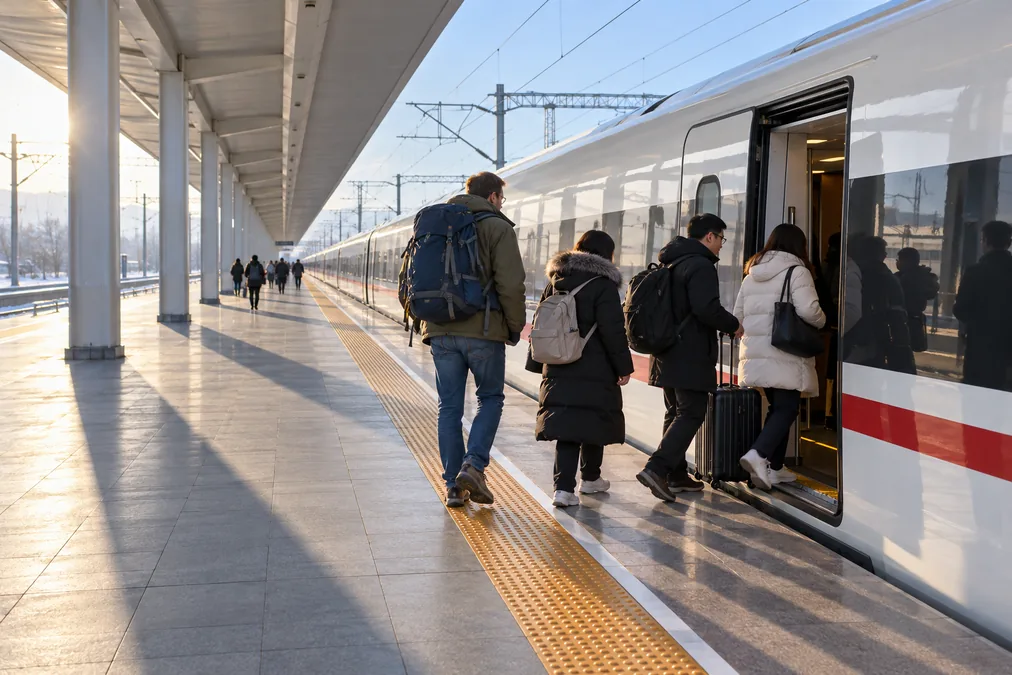
Mount Wutai: getting there, tickets and winter
Mount Wutai (五台山, Wǔtái Shān, "Five Terrace Mountain") is a range of five flat-topped peaks with a cluster of Buddhist temples in the valley between them. The temple area is the town of Taihuai (台怀镇), about 240 km from Taiyuan. Most visitors stay in or near Taihuai for one or two nights and walk between temples, using the free shuttle buses for longer hops.
| Item | Details |
|---|---|
| Getting there | No high-speed rail station at Mount Wutai: every route ends by bus Direct buses to the Mount Wutai visitor centre from Taiyuan Wusu Airport, Wutaishan Airport, Taiyuan South station, Xinzhou West station and Taiyuan Station, both directions, departures 06:00–18:00; tickets in the WeChat mini program “山西文旅行” From Datong South station: the “大同景区直通车” bus to the same visitor centre Tourist bus lines also run from Xinzhou Ancient City and Pingyao Ancient City Fares and journey times aren’t published: check them, and the last bus back, in the mini program the day before |
| Booking | Required since Mar 13, 2025: real-name, timed entry slots, up to 5 days ahead, on the official “五台山游客服务中心” platform (WeChat). Daily caps of 40,000 visitors and 2,000 private vehicles; booking closes when full Official sources don’t say whether the form takes a foreign passport: try a few days ahead, and if it fails, ask at the visitor centre counter |
| Mountain entry ticket | Off-season (Nov–Mar): ¥118 full / ¥60 half, as listed in a 2018 reply; not confirmed as current ¥135 full / ¥70 half in the 2022 notice (no season stated); half price for everyone on May 19 and Sep 27 Half-price and free entry follow Chinese ID rules: plan on the full fare with a foreign passport |
| Temple tickets | Xiantong Temple, Tayuan Temple, Pusading and Dailuoding: each sells its own small ticket on top of the mountain ticket (prices not officially published) Nanshan Temple and Wanfo Pavilion, plus the other temples asked about: no ticket (2022 reply) |
| Buses inside the scenic area | Free, 24 hours: 3 trunk lines link the entrances and meet at the Dailuoding transfer area; 9 branch lines go to sights such as Fomu Cave and the East Terrace; waits under 5 minutes No vehicle slot? Park free outside the south, north or west gate and ride in Reports of paid sightseeing buses are out of date |
| Winter closure | Nov 1, 2026 – May 15, 2027: the five terrace peaks and the area around them are closed — no hiking, camping or other outdoor activities, no unauthorised vehicles. The notice cites lows of −44 °C, winds above force 13 and visibility under 10 m on the peaks at this time of year The temples in the Taihuai valley are not part of the closure |
| Weather | Peaks (about 2,900 m): annual mean −3.8 °C, January mean −17.3 °C, July–August means no higher than 10 °C · Taihuai valley (about 1,700 m): summer highs around 27 °C · about 760 mm of precipitation a year |
How to get there
All the realistic routes end with a bus. The Mount Wutai scenic area runs direct buses to its visitor centre from Taiyuan Wusu airport, Wutaishan airport, Taiyuan South station, Xinzhou West station and Taiyuan Station, with departures in both directions between 6:00 and 18:00. Tickets are sold in the "山西文旅行" (Shanxi Culture and Tourism Travel) WeChat mini-program. From the north, the Datong scenic-area direct bus goes from Datong South station to the same visitor centre.
Check fares, journey times and the last bus back in the mini-program the day before you travel, especially in midwinter. A simple plan for the full route:
- Coming from Datong: morning bus from Datong South to the visitor centre, check into a hotel in Taihuai, temples in the afternoon.
- Leaving for Taiyuan: bus from the visitor centre to Taiyuan South (or Taiyuan Station, or the airport). From Taiyuan South you can continue straight to Pingyao the same evening, since trains run until about 21:00.
- From Beijing directly: high-speed train to Taiyuan South, then the bus up. This takes most of a day.
Booking and the entry ticket
Since 13 March 2025, every visitor must book a real-name, timed entry slot up to 5 days ahead through the "Wutaishan Tourist Service Center" official platform, and the scenic area caps visitors at 40,000 a day. Try the booking with your passport a few days before; if the form will not take it, go to the visitor centre counter with your passport and ask there.
The 2018 reply listed an off-season ticket (November to March) of 118 yuan (60 half price); the later 2022 notice lists 135 yuan (70 half price) without a seasonal split — check the current price when you book. Half-price and free rules are tied to Chinese ID documents, so plan on the full fare with a foreign passport. Ask whether your ticket also covers the next day.
Getting around inside the scenic area
Inside the scenic area, the buses are free and run 24 hours a day. Three main lines link the entrances and meet at the Dailuoding transfer area, nine branch lines go out to sights such as Fomu Cave and the East Terrace, and waits are kept under 5 minutes. If you have read about paid sightseeing buses at Mount Wutai, that information is out of date.
Which temples to see
The core temples are close together in Taihuai and easy to walk between. Four of them charge their own small entry fee: Xiantong Temple (显通寺), Tayuan Temple (塔院寺, the one with the large white pagoda), Pusading (菩萨顶, the hilltop temple) and Dailuoding (黛螺顶). Others, including Nanshan Temple and Wanfo Pavilion, do not charge. Carry a little cash or a working mobile payment for each of these gates.
For one day, a good loop is Tayuan Temple and Xiantong Temple in the morning, then the climb to Pusading for the view over the valley. With a second day, add Dailuoding, which looks back across the whole temple area, and Nanshan Temple on the southern edge of the valley. Active temples are places of worship: dress modestly, walk around (not across) prayer cushions, and ask before photographing monks or people at prayer. Our pages on visiting religious sites and Chinese etiquette have the details.

Foguang and Nanchan: the Tang-dynasty timber halls
Two temples outside Taihuai are worth a half-day by car if you care about old buildings. Nanchan Temple's main hall is the oldest surviving Tang-dynasty timber building in China; in 2017 the provincial government listed it at 10 yuan, open 8:00–18:00 — check the current price and hours before you go. Foguang Temple, which the architect Liang Sicheng called "China's first national treasure", was listed at 15 yuan, open 7:00–19:00, in the same 2017 information — confirm before you travel. Neither is on the free bus network. They are in different townships well outside the temple valley, so you need a hired car and most of a day for both.
Winter at Mount Wutai
From 1 November 2026 to 15 May 2027, the five terrace peaks and the area around them are closed: no hiking, camping or other outdoor trips, and no private vehicles. The scenic area gives the reason plainly: the peaks can drop below −40 °C at this time of year, with hurricane-force winds and visibility under 10 metres. The closure covers the peaks only. The temples in the Taihuai valley stay open, and the valley sits much lower, at about 1,700 metres.
Even in summer, the peaks are cold: at about 2,900 metres, the warmest months average under 10 °C. Bring a warm layer for any trip to Mount Wutai, whatever the month.
Is Taiyuan worth a stop?
Taiyuan (太原) is Shanxi's capital, a big modern city at about 800 metres above sea level. It does not have the old-town feel of Datong or Pingyao, but it has two sights that fit this route well: the Shanxi Museum and the Jinci temple complex. Our answer: yes for one night on the 7-day route, no on the 5-day route. On the full route you pass through Taiyuan anyway, coming down from Mount Wutai, so a night there costs you almost nothing. On the 5-day route, the direct Datong–Pingyao train lets you skip it.
Shanxi Museum (山西博物院) is one of China's top national museums, strong in bronzes, ceramics, stone carving, Buddhist sculpture and murals. If you have just seen Yungang and Mount Wutai, the galleries fill in the history behind them. Entry is free but needs a real-name booking through the museum's official WeChat account, up to 3 days ahead. Since 1 September 2026 there is no entry QR code: you go in at your booked time slot by showing the original ID you booked with, and a passport is on the accepted list. Try the WeChat booking with your passport number a day or two ahead. The museum opens 9:00–17:00 (last entry 16:00) and is closed on Mondays. Give it two to three hours. See our guide to museums in China for how booking usually works.
Jinci (晋祠) is a temple-and-garden complex in the southwest of the city, with the Song-dynasty statues of maids in the Hall of the Holy Mother, the Nanlao spring, the cross-shaped Fish Pond Flying Bridge and an ancient Zhou cypress. A full ticket is 80 yuan (40 yuan half price), and it is open all year, 8:30–17:30. On public holidays you must book ahead through its official WeChat accounts, and bookings close when the day's limit is reached. Give it half a day.
| Sight | Ticket | Booking | Hours |
|---|---|---|---|
| Shanxi Museum | Free | Required, real-name, free: only through the museum’s official WeChat account “山西博物院” (no third-party sellers), up to 3 days ahead, not counting the visit day; in the summer peak, slots open at 07:00 Since Sep 1, 2026 there is no QR entry code: show the original ID you booked with at your time slot. A passport is accepted; the name must match the booking Military, firefighters, people with disabilities and visitors aged 60+ may enter without booking on valid ID (passports not mentioned) | 09:00–17:00, last entry 16:00 · closed Mondays Summer extension in 2025 (Aug 9–31): 09:00–18:00, last entry 17:00 |
| Jinci Museum (Jin Ancestral Temple) | ¥80 full / ¥40 half (who qualifies for half price isn’t stated) | Public holidays: booking required on the official WeChat accounts “中国晋祠” / “晋祠天龙山景区官微”; closes once the day’s limit is reached. Rules for ordinary days aren’t stated | 08:30–17:30 · open all year Holiday hours can differ, e.g. Mid-Autumn holiday 2026 (Sep 25–27): 08:00–19:00, ticket check until 18:30 |
One night is enough: museum on the afternoon you arrive (not a Monday), Jinci the next morning, then the train to Pingyao. A handy extra: the "山西文旅行" shuttle buses leave from the Shanxi Museum for Pingyao Ancient City (40 yuan one way), the Qiao Family Compound (35 yuan) and Jinci (15 yuan), booked in the same WeChat mini-program.
Getting around Taiyuan
Metro Line 1 links Taiyuan Wusu airport, Taiyuan South station and the old Taiyuan Station, so it is the way in from both railway stations. It crosses Line 2 at Dananmen. Fares start at 2 yuan for the first 5 km and rise with distance. All 23 Line 2 stations accept foreign bank cards, though it is best to check at the counter; for Line 1, ask at the counter whether cards are accepted. Taiyuan Wusu airport, Taiyuan South and Datong South all have ATMs that take foreign cards. If you arrive late, check the last metro train at the station before you rely on it, and have a taxi as your fallback.
| Item | Details |
|---|---|
| Railway stations | Taiyuan South: the main high-speed station — most bullet trains to and from Beijing Fengtai and Datong South, and all 25 to Pingyao Gucheng on the 12306 sample day (Nov 5, 2026) Taiyuan Station: the old station, with conventional trains and some bullet trains (sample day: 12 from Datong South, 10 from Beijing West) Both are on metro Line 1; check which station is printed on your ticket |
| Airport | Taiyuan Wusu International Airport: metro Line 1 from Wusu T1/T2 station (opened Feb 22, 2025) runs straight to Taiyuan South, Taiyuan Station and the city centre; change to Line 2 at Dananmen. Journey times and first/last trains aren’t published — check at the station |
| Metro | 2 lines. Line 1: Helongwan – Wusu T1/T2, 28.737 km, 24 stations, opened Feb 22, 2025. Line 2 runs north–south. The two meet at Dananmen |
| Fares | By distance, no cap: 0–5 km ¥2 · 5–10 km ¥3 · 10–15 km ¥4 · 15–21 km ¥5 · 21–27 km ¥6 · 27–34 km ¥7 10% off with a metro card (physical or electronic) · free for 65+ with valid ID (passports not mentioned) |
| Paying | Foreign bank cards are accepted at all 23 Line 2 stations; nothing is published for Line 1, or on whether cards work at the gates or only at the counter — ask at the ticket counter Payment-service points for foreign visitors: Taiyuan Wusu Airport, Taiyuan South station, Taiyuan Ancient County Town, Zhonglou Street and Jinci |
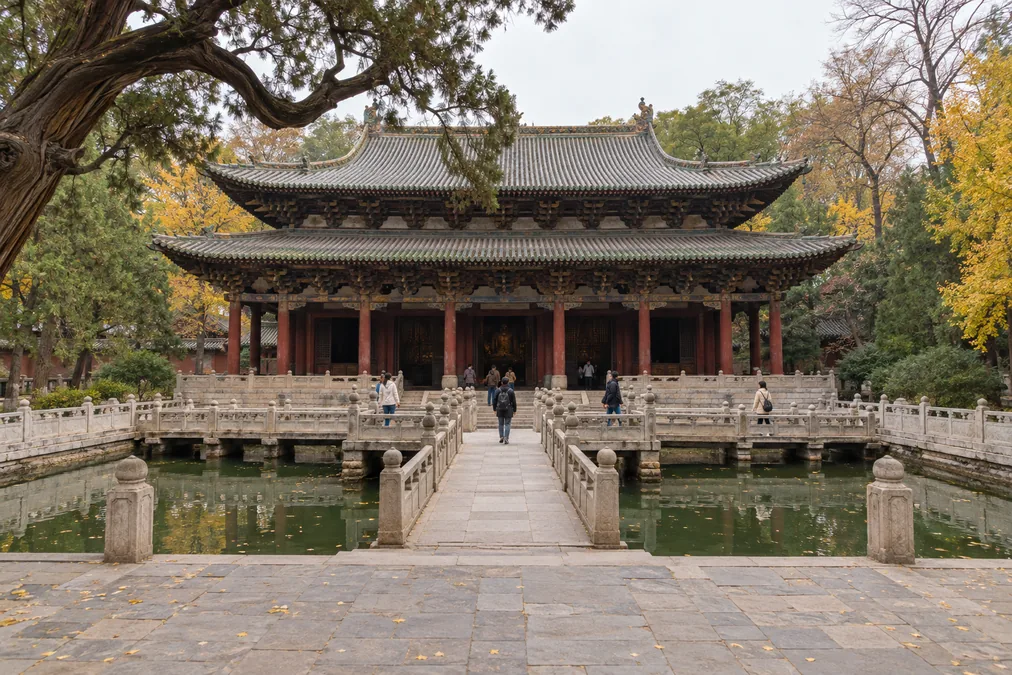
How long to stay at each stop
Here is the short version for each city. The city guides have the ticket tables, opening hours and local transport.
Beijing: 3–4 days before you leave. Most people start the route after a few days in Beijing. Book your Datong train from Qinghe or Beijing North, and stay somewhere with easy metro access to those stations. See our Beijing travel guide.
Datong: 2 nights. Datong (大同) has the Yungang Grottoes (云冈石窟), a long cliff of Buddhist cave temples just west of the city; the Hanging Temple (悬空寺), a wooden temple fixed to a cliff face near Mount Heng (恒山) in Hunyuan (浑源) county; and a walled old town with Huayan Temple (华严寺), Shanhua Temple (善化寺) and the Nine Dragon Screen (九龙壁). Plan one day for Yungang and the old town and one day for the Hanging Temple. Two rules matter. Yungang has no ticket window: you must book online with your real name 1–15 days ahead, and there are no same-day tickets. For Yungang, an English online booking page exists; multilingual self-service machines at the visitor centre may also be available, but do not rely on them. At the Hanging Temple, the climbing ticket is separate, and passport holders must buy it at the ticket window. The window sells same-day tickets only, in a morning and an afternoon batch, until they run out, and climbing is capped at about 2,500 people a day — check the day's notice and arrive early. The Yingxian Wooden Pagoda (应县木塔) is a good extra day trip, though you cannot climb it. All of this, including prices and buses, is in our Datong travel guide.
Mount Wutai: 1–2 nights. One night is enough for the main temples; two if you want Dailuoding, a slower pace, or (late May to October) a trip up to the terraces. Covered above.
Taiyuan: 1 night or none. One night on the 7-day route; skip it on the 5-day route. Covered above.
Pingyao: 2 nights. Pingyao (平遥) is a walled town that UNESCO lists as an outstanding example of a Ming and Qing Chinese city, and people still live and work inside the walls. Stay inside the walls if you can. You do not need a ticket to walk the streets, eat or stay in the old town; the combined ticket is only for the walls, the Rishengchang (日昇昌) bank museum and the other ticketed sights. That combined ticket is 125 yuan. Shuanglin Temple (双林寺) and Zhenguo Temple (镇国寺) outside the walls are both under part-closure for repairs (the work on one hall at Zhenguo is planned to run until 31 August 2027, and on one at Shuanglin until 31 August 2028), while their other halls stay open. A second night gives you time for these temples or the Wang Family Compound (王家大院) and Qiao Family Compound (乔家大院). See our Pingyao Ancient City guide for the full plan.
Xi'an: 2–3 days after. The fastest trains from Pingyao Gucheng reach Xi'an North in about 2.5 hours. Most people continue to Xi'an for the Terracotta Army and the city wall, then fly home or go on along the Silk Road. See our Xi'an travel guide, and for onward trips, the Silk Road route from Xi'an to Dunhuang or Luoyang, which has the Longmen Grottoes. If you want to fit Shanxi into a broader trip, our Beijing, Xi'an and Shanghai route uses the same two end cities, and Shanxi slots in between them.

Sample itineraries
Each plan below uses only trains and buses. Train times are from the sample day above; book against the live timetable.
5 days: Beijing – Datong – Pingyao – Xi'an
- Day 1: Early train from Qinghe or Beijing North to Datong South (about 1 hour 45 minutes at best). Yungang Grottoes in the afternoon (booked in advance), then the old town and the city wall in the evening.
- Day 2: Hanging Temple and Mount Heng, a full day out by bus or hired car. With a passport, buy the climbing ticket at the window; it sells morning and afternoon batches until they run out, so arrive early. If you are back early, see Huayan Temple and the Nine Dragon Screen.
- Day 3: Morning direct train from Datong South to Pingyao Gucheng (fastest 2 hours 28 minutes). Afternoon walking the streets inside the walls.
- Day 4: Full day in Pingyao: the walls, Rishengchang and the other sights on the combined ticket, or a half-day out to Shuanglin Temple.
- Day 5: Morning in Pingyao, then an afternoon train to Xi'an North (fastest 2 hours 27 minutes).
Night count: Datong 2, Pingyao 2, then Xi'an. If Day 1 feels too full, take the night before in Datong instead, or swap Yungang to the morning of Day 3 and catch a later train to Pingyao.
7 days: Beijing – Datong – Mount Wutai – Taiyuan – Pingyao – Xi'an
- Day 1: Early train from Beijing to Datong South. Yungang Grottoes in the afternoon, old town in the evening.
- Day 2: Hanging Temple and Mount Heng, back to Datong for the night. Passport holders buy the climbing ticket at the window on the day, so arrive early.
- Day 3: Morning bus from Datong South to the Mount Wutai visitor centre. Check into Taihuai, then Tayuan and Xiantong temples.
- Day 4: Pusading and Dailuoding in the morning. Afternoon bus from the visitor centre to Taiyuan South. Night in Taiyuan.
- Day 5: Shanxi Museum when it opens (not a Monday), Jinci in the afternoon. Evening train to Pingyao Gucheng (about 25 trains a day, the last around 21:00).
- Day 6: Full day in Pingyao.
- Day 7: Morning in Pingyao, afternoon train to Xi'an North.
Night count: Datong 2, Mount Wutai 1, Taiyuan 1, Pingyao 2, then Xi'an. Between November and mid-May, when the terraces are closed and the mountain is very cold, consider swapping the Wutai nights for a second night in Taiyuan or a third in Pingyao.
For hotels, stay near the old town in Datong (it is a short bus or taxi ride from Datong South), in Taihuai village at Mount Wutai so you can walk to the temples, and inside the walls in Pingyao, where many guesthouses are restored courtyard houses. You can compare options on Booking.com. In the cold months, check that a courtyard guesthouse has proper heating before you book.
Reverse: from Xi'an north to Beijing
If you are already in Xi'an, run the 7-day plan backwards. Take a morning train from Xi'an North to Pingyao Gucheng (about 10 trains, 07:45–17:25) and spend two nights in Pingyao. Continue to Taiyuan South, then take the bus to Mount Wutai from Taiyuan South or Taiyuan Station. From Mount Wutai, take the Datong scenic-area bus to Datong South (check that it runs in that direction on your day), spend two nights in Datong, and finish with the train to Qinghe or Beijing North.
For a shorter reverse version, go Xi'an → Pingyao (2 nights) → Datong (2 nights) on the direct Pingyao Gucheng–Datong South trains, then on to Beijing. That is the 5-day route in reverse. If you need ideas for the rest of a longer trip, our 10-day China plan and 2-week China itinerary show where Shanxi can fit.
Seasons and practical tips
Best time: late May to October for the full route, with Mount Wutai's terraces open. September and October are usually the most pleasant months for walking around Datong and Pingyao. Summer in Datong is cool by Chinese standards, averaging 19–22 °C.
Winter: Datong's winter lasts more than four months, with averages of −7 to −12 °C and strong northwest winds. Taiyuan averages 3.3 °C in November and −4.6 °C in January. Pingyao is similar: the nearby Jiexiu weather station averages 4.8 °C in November and −3.1 °C in January. Indoor heating in northern China is strong, so you will be warm inside and cold outside. Dress in layers you can take off on the train. Some Shanxi sights switch to lower off-season prices from 1 November — for example, Yungang's off-season full ticket last winter (2025–26) was 100 yuan, against 120 yuan from April to October, so check this winter's notice. Our winter travel guide covers clothing and what changes in the cold months.
Holidays: avoid the National Day holiday that starts on 1 October, which usually runs 7 days, and the Spring Festival week if you can. Trains sell out and the big sights hit their daily limits. If you must travel then, book trains as soon as the 15-day sales window opens and book Yungang and Mount Wutai on the first day you can. Our Golden Week survival guide has more.
Luggage: the bus legs to and from Mount Wutai are the awkward part with a big suitcase. Travel with one bag you can lift onto a bus, and leave the rest at your Datong or Taiyuan hotel if you are coming back through. Pingyao's old town is mostly stone streets, so wheels are slow there too.
Money and phones: carry a working mobile payment (Alipay or WeChat Pay with your foreign card linked) plus some cash for small temple gates and buses. Most bookings on this route — Yungang, Mount Wutai, the Shanxi Museum, the shuttle buses — run through a WeChat mini-program or account, so set up WeChat before you leave home.
FAQ
How many days do you need in Shanxi?
Five days covers Datong and Pingyao: two nights in each, plus one travel day, using the direct Datong South–Pingyao Gucheng train. Seven days covers the full route with Mount Wutai and a night in Taiyuan. From November to mid-May, when the Mount Wutai terraces are closed, the 5-day version is usually the better choice.
How do you get from Datong to Mount Wutai?
By bus. There is no high-speed station at Mount Wutai, and no direct train from Datong to Wutaishan North. The Datong scenic-area direct bus runs from Datong South station to the Mount Wutai visitor centre; check fares and the last bus in its WeChat mini-program the day before. From the visitor centre, the free scenic-area buses take you to the temples in Taihuai. Remember to book your Mount Wutai entry slot up to 5 days ahead.
Can you do the Shanxi route on 240-hour visa-free transit?
Only part of it. In Shanxi the permitted area is Taiyuan and Datong only, and the Shanxi entry port is Taiyuan Wusu airport; Mount Wutai and Pingyao are outside the area. You can combine Datong and Taiyuan with Beijing on one entry. To include Mount Wutai or Pingyao, you need 30-day visa-free entry or a visa. See our 240-hour transit guide for the full rules.
To put it together: decide between the 5-day and 7-day versions by season (Mount Wutai's terraces are closed from November to mid-May), choose your direction by your flights, and check your entry status against Shanxi's 240-hour map before you include Mount Wutai or Pingyao. Book Yungang and your Mount Wutai entry slot first, then the thin train legs (Datong South–Pingyao Gucheng, any direct Beijing–Pingyao train) as soon as sales open, and the busy legs a few days ahead. For the official word on the winter closure, see the Mount Wutai scenic area's closure notice; for Mount Wutai's World Heritage listing, see the UNESCO decision.
Last updated: October 2026
Fact-checked sources
- Official UNESCO 3 pages
- Official dt.gov.cn 10 pages
- Official wlt.shanxi.gov.cn
- Official China Railway 12306 12 pages
- news.xz0350.cn
- Official shanxi.gov.cn 6 pages
- Official wlj.taiyuan.gov.cn 4 pages
- Official wts.sxxz.gov.cn 4 pages
Show 12 more sources
- Official China Weather (China Meteorological Administration) 4 pages
- Official National Immigration Administration 3 pages
- Official Chinese embassies and consulates
- Official shanxi.chinadaily.com.cn 2 pages
- Official mp.weixin.qq.com
- Official taiyuan.gov.cn 2 pages
- Official wwj.shanxi.gov.cn 4 pages
- Official The Paper (thepaper.cn)
- sxrb.com 2 pages
- Official shuozhou.gov.cn
- Official data.jma.go.jp 2 pages
- Official Chinese central government (gov.cn)
Last verified: 2026-10-27
Read in other languages
Last train times for 10 Chinese metro systems
Every line and station, checked by hand — the same data behind our offline route planner.
Get the WaysChina App
Offline guides, currency converter, essential phrases, and more — all in your pocket.

Related Articles
Northeast China Route: Harbin, Changbai Mountain, Shenyang and Dalian by Train
Plan Northeast China in 7–10 days: Harbin to Changbai Mountain, Shenyang and Dalian by direct train, winter or...

Central China Route: Wuhan-Changsha-Zhangjiajie
A practical 7-8 day Central China itinerary linking Wuhan, Changsha, Zhangjiajie, and Fenghuang by high-speed rail,...

Jiangnan Water Towns Route: Shanghai, Suzhou, Wuzhen and Hangzhou in 5 to 7 Days
Shanghai → Suzhou → a night in Wuzhen or Xitang → Hangzhou: the order, nights per stop, which water town to pick,...

Yunnan Circuit: Kunming, Dali, Lijiang and Shangri-La by Train in 7 to 10 Days
Kunming to Dali, Lijiang and Shangri-La by train: which Kunming station to use, what to book 15 and 7 days ahead, a...