This article contains affiliate links. If you make a purchase through these links, we may earn a small commission at no extra cost to you. This helps support our work in creating free travel guides.
Shopping in China spans two very different worlds. On one side you have gleaming malls and brand stores where prices are fixed and you pay with a tap. On the other you have sprawling wholesale and "copy" markets where the sticker price is just the opening bid and haggling is expected. Knowing which is which — and how to handle each — saves you money and a lot of confusion.
This guide covers where to shop, what's actually worth buying, how to bargain without overpaying, how to spot fakes, and how to claim a tax refund (退税, tuìshuì) when you leave. Prices and policies shift, so treat numbers here as ballpark figures and confirm at the counter.
How payment works before you buy anything
Almost everything in China runs on mobile payment via QR code, even at small market stalls. Set up Alipay (支付宝, Zhīfùbǎo) or WeChat Pay (微信支付, Wēixìn Zhīfù) with a foreign card before you arrive — both now accept international Visa and Mastercard. Cash still works at most shops and is genuinely useful at street markets, where some elderly vendors prefer it, but you'll rarely need large amounts.
For the full setup walkthrough, see our guides on using Alipay with foreign cards and using WeChat Pay with foreign cards.
What to buy in China
The best souvenirs are things China genuinely does well and sells cheaper than you'd find at home. Skip the mass-produced trinkets near major attractions and focus on these.
Tea
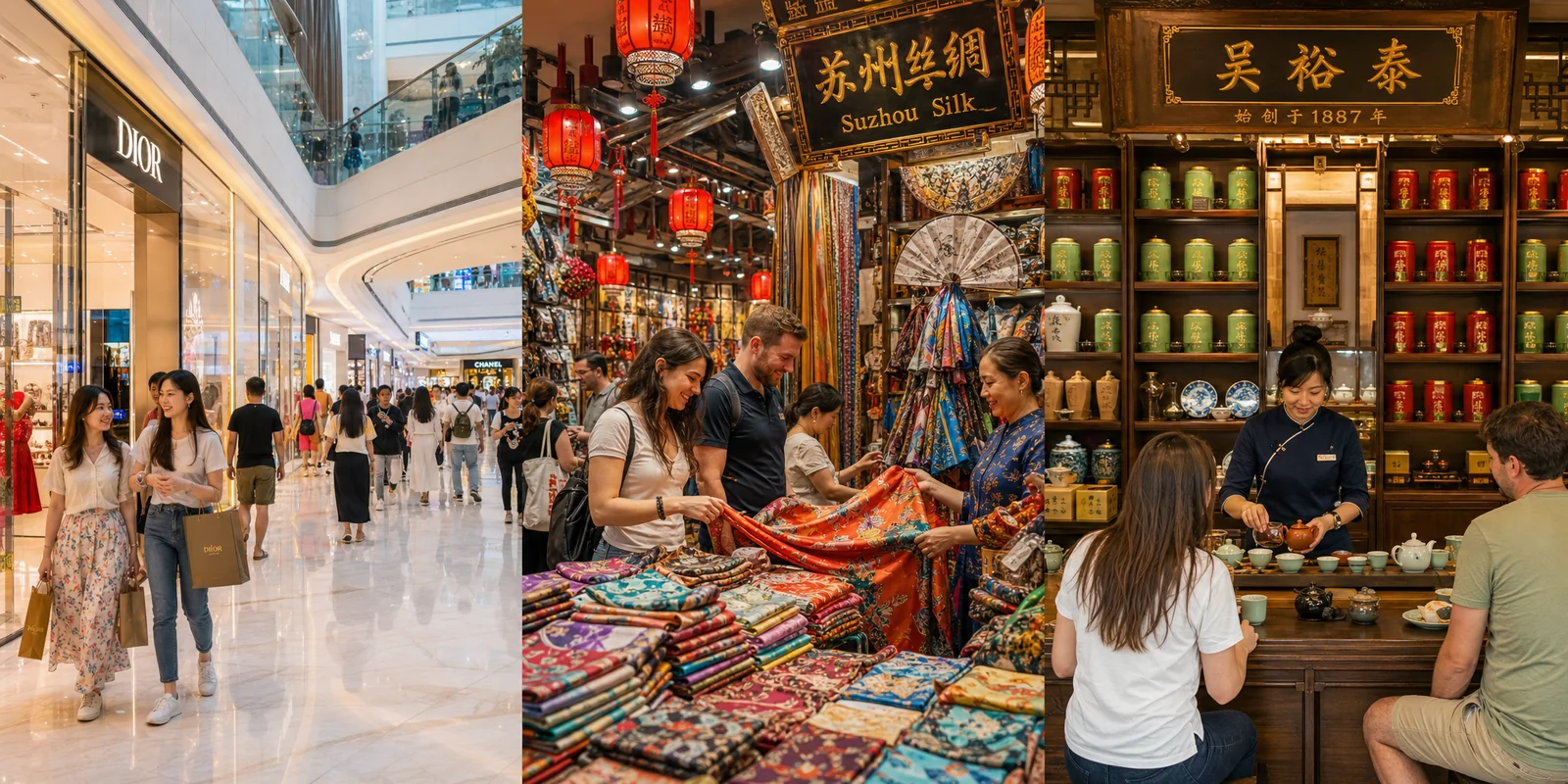
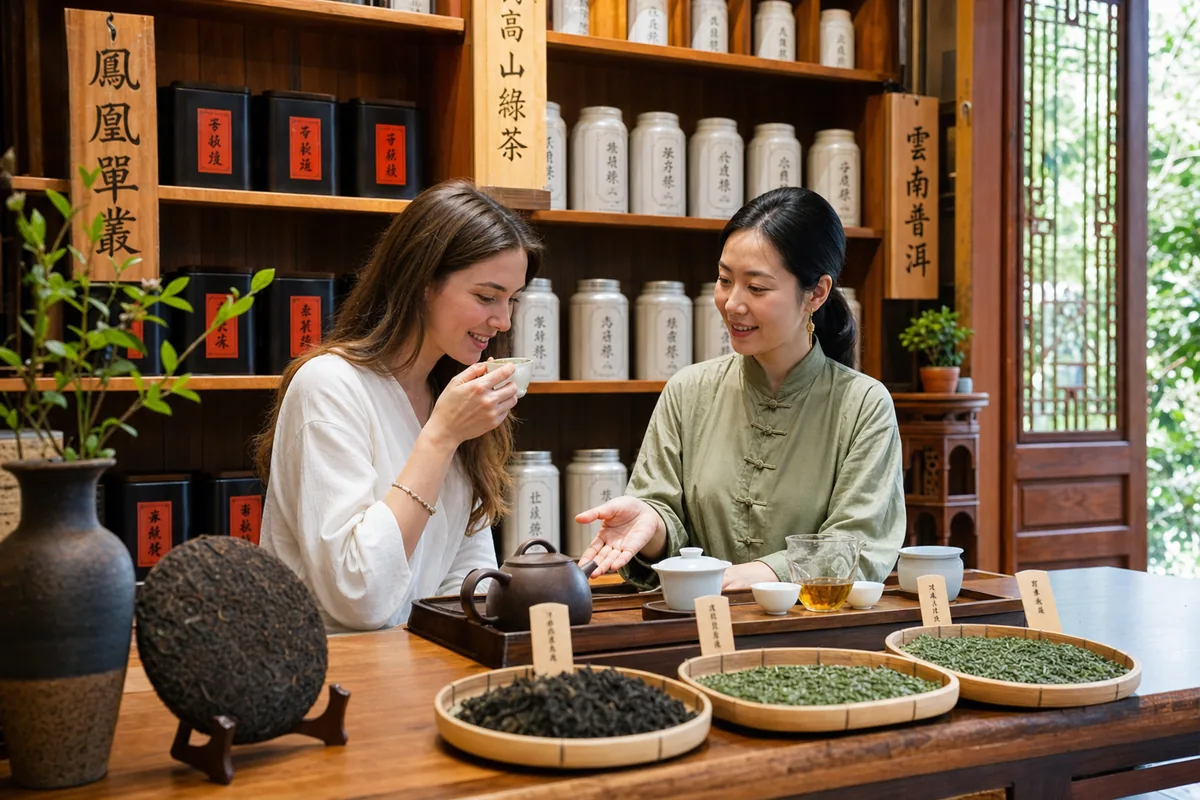
Loose-leaf tea is one of the most rewarding things to bring home — lightweight, long-lasting, and available in huge variety. Look for green tea (Longjing from Hangzhou), pu'er (compressed discs from Yunnan), oolong (Tieguanyin from Fujian), and jasmine. Buy from a proper tea shop where you can taste before buying, not from souvenir stands. Expect to pay anywhere from ¥50 to several hundred yuan per 100g depending on grade.
Silk
Silk scarves, bedding, and clothing are good value, especially in Suzhou and Hangzhou. Real mulberry silk feels cool and smooth and has a soft sheen; cheap polyester blends feel slippery and slightly squeaky. Burn-testing a thread (silk smells like burnt hair and turns to ash) is the classic check, but most vendors won't let you. Buy from established shops if authenticity matters.
Electronics and gadgets
China is a great place to pick up phone accessories, power banks, smart-home gadgets, drones, and cables — often newer models than what's sold abroad. Shenzhen's Huaqiangbei (华强北) is the famous electronics district. Prices on genuine branded electronics are competitive but not always dramatically cheaper than online stores back home, so compare before you buy.
Other worthwhile buys
- Porcelain and ceramics — Jingdezhen is the historic center; markets in most cities sell decent pieces.
- Chopsticks, tea sets, and seals (印章, yìnzhāng) — a carved stone name seal makes a personal, inexpensive gift.
- Traditional crafts — paper-cutting, calligraphy supplies, embroidery, cloisonné.
- Snacks and spices — Sichuan peppercorns, dried fruit, specialty candies. Check your home country's customs rules on food imports.
- Pearls and jade — buy only from reputable dealers; this is a market full of fakes and inflated "jade."
Where to shop
Malls and department stores
Every major city has modern malls with fixed prices, international brands, and air conditioning. Prices here are non-negotiable. These are your safest bet for genuine branded goods, cosmetics, and reliable electronics.
Markets and bargaining zones
This is where China shopping gets fun. Tourist markets sell souvenirs, clothing, accessories, electronics, and "brand-name" goods at prices that start absurdly high and come down through negotiation. Well-known examples:
- Beijing — Silk Street Market (秀水街) and the Pearl Market (红桥市场) near the Temple of Heaven.
- Shanghai — the AP Plaza fake market near Science & Technology Museum metro station, and the Qipu Road clothing wholesale market.
- Shenzhen — Huaqiangbei for electronics, Luohu Commercial City near the Hong Kong border.
- Guangzhou — massive wholesale markets for clothing, leather, and accessories.
Wholesale markets
If you want quantity, cities like Yiwu, Guangzhou, and Shenzhen have enormous wholesale districts. These are aimed at bulk buyers, but they'll often sell to individuals. Prices are low if you buy several of an item.
Online: Taobao for tourists
Taobao (淘宝) and its sister app Tmall are China's dominant shopping platforms, with prices far below what tourists pay in markets. The catch: the apps are mostly in Chinese, and delivery to a hotel can be tricky if you don't read addresses. If your trip is long enough and you have a Chinese-speaking friend or a hotel willing to receive packages, it's worth exploring. For short trips, markets and physical stores are more practical.
How to bargain in China
Bargaining is expected at markets, street stalls, and small independent shops — but never at malls, supermarkets, chain stores, or restaurants. At fake and tourist markets, the first price quoted can be five to ten times what the vendor will actually accept.
The basic approach
- Don't show too much interest. The moment a vendor knows you love something, your leverage drops.
- Ask the price, then counter low. A common rule of thumb at tourist markets: start at 20–30% of the opening price and meet somewhere in the middle.
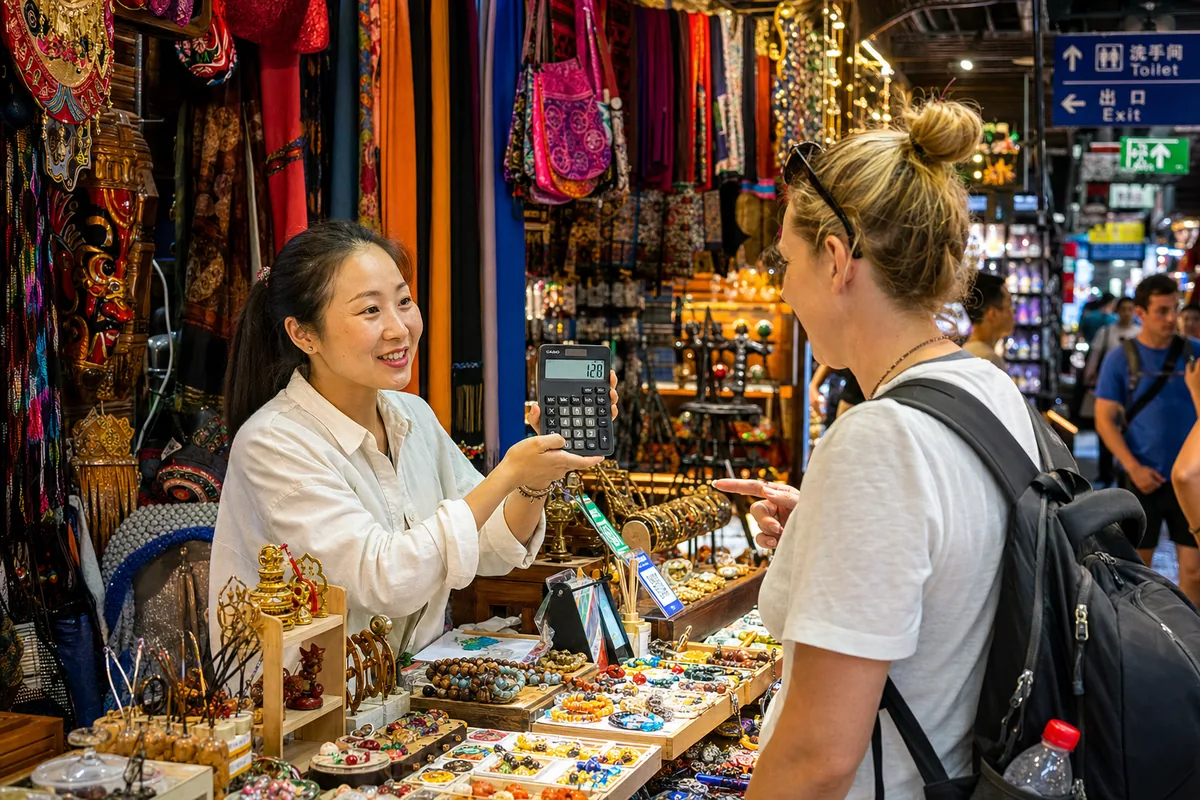
- Use the calculator. Vendors will type numbers on a calculator and hand it to you; type your counter-offer back. This sidesteps the language barrier entirely.
- Be willing to walk away. Walking out the door is the single most powerful tactic. Often the vendor will chase you with a lower price. If they don't, the price was probably real.
- Stay friendly. Bargaining is a normal, often good-humored transaction, not a fight. Smiling gets you further than aggression.
Fake markets: what you're really buying
China's "copy" or "fake" markets sell counterfeit luxury goods — handbags, watches, sneakers, sunglasses — at a fraction of retail. Quality ranges from obvious junk to convincing replicas. A few honest points:
- These are counterfeits, not bargains on real brands. Anyone telling you a ¥200 "Rolex" is genuine is lying.
- Buying small quantities for personal use is common among tourists, but importing counterfeits is illegal in many countries, including the US and EU. Customs can seize them, and in rare cases fine you.
- Don't believe "original quality" or "factory" claims. The grading is marketing.
If you go, treat it as a curiosity and bargain hard. Just know what you're carrying home and the rules at your destination.
Tax refunds for tourists
China offers a VAT refund (退税, tuìshuì) on eligible purchases for visitors leaving the country. The system has expanded significantly and now covers many cities and a growing number of stores.
How it works
- Shop at a designated tax-refund store. Look for a "Tax Free" sign or ask staff. There's usually a minimum spend per store per day (commonly around ¥200 at the same store on the same day).
- Get the refund form. Show your passport at checkout and ask for the tax-refund application form plus the official invoice.
- Claim at the airport. At your departure airport, go to the tax-refund counter before security in many cases, with the goods unused, the forms, invoices, and your passport. Customs may inspect the items, so keep them accessible, not buried in checked luggage.
- Receive the refund. The rebate is a percentage of the purchase value (the refund rate is set by policy; verify the current rate). You can take it as cash or back to your card.
Some major cities are piloting "refund on departure" and even instant in-store refunds. Because the rules and participating cities are expanding, confirm the current process at the store and check signage at your departure airport.
Shipping things home
If you buy more than your luggage can handle, China's postal service (China Post / EMS) and private couriers can ship internationally. Many larger markets and shops will arrange shipping for you, but get a clear price and tracking number first. For fragile items like porcelain, pay for proper packing. Be aware that shipped goods may attract import duty when they reach your country.
Cultural experiences worth adding
Shopping is more meaningful when you understand what you're buying. A tea-tasting session or a market food tour turns a shopping trip into something you'll remember. Platforms like Klook list guided market tours and tea ceremony experiences in major cities, which can be a relaxed way to learn what's worth buying before you spend. Our Chinese tea ceremony guide is a good primer.
Common questions
Can I use my credit card for shopping?
At malls and large stores, increasingly yes — many now accept foreign Visa and Mastercard. At markets and small shops, you'll need Alipay, WeChat Pay, or cash. See using international cards in China.
Is bargaining rude?
Not at markets and independent stalls — it's expected. It would be odd at a mall, supermarket, or restaurant, where prices are fixed.
Are the fake goods illegal to take home?
Importing counterfeits is illegal in many countries. Small personal-use quantities are often overlooked, but it's a real risk, and you should know your home country's rules.
How much should I bargain down?
At tourist markets, opening prices can be inflated five to ten times. Starting around 20–30% of the asking price and walking away when needed usually lands you a fair deal.
Quick reference
| Where | Bargain? | Best for | Payment |
|---|---|---|---|
| Malls / department stores | No | Genuine brands, cosmetics, electronics | Card, Alipay, WeChat Pay |
| Tourist / fake markets | Yes, hard | Souvenirs, replicas, accessories | Alipay, WeChat Pay, cash |
| Wholesale markets | Some | Bulk clothing, electronics, goods | Alipay, WeChat Pay, cash |
| Tea / silk specialty shops | A little | Quality tea, real silk | Alipay, WeChat Pay, card |
| Taobao (online) | No | Cheapest prices, huge selection | Alipay / WeChat Pay in-app |
The bottom line
The smartest approach to shopping in China is matching the place to the purchase. Buy genuine electronics, cosmetics, and brands at malls where prices are fixed and goods are real. Save your bargaining energy for souvenirs, crafts, and market finds, where the opening price is just a starting point and walking away is your best tool. Focus on what China does uniquely well — tea, silk, porcelain, ceramics — and keep your receipts for a tax refund on the way out. Set up mobile payments before you arrive, carry a little cash for markets, and confirm current tax-refund rules at the store and airport.
Next, sort out your payments and your exit logistics so the buying and refunding go smoothly.
Related reading
- How to Use Alipay with Foreign Cards
- Where to Exchange Money
- Tourist Scams in China
- Departing China Guide
- Hong Kong Shopping Guide
Last updated: June 2026
Read in other languages
Last train times for 10 Chinese metro systems
Every line and station, checked by hand — the same data behind our offline route planner.
Get the WaysChina App
Offline guides, currency converter, essential phrases, and more — all in your pocket.