
This article contains affiliate links. If you make a purchase through these links, we may earn a small commission at no extra cost to you. This helps support our work in creating free travel guides.
Packing for China isn't that different from packing for any long trip, with three big exceptions: your phone won't work the way you expect, your bank card won't be accepted in most places, and many of the apps you rely on (Google Maps, Gmail, WhatsApp, Instagram) are blocked. Get those three things sorted before you fly and the rest is just clothes and toiletries. This guide walks through everything worth bringing, what's genuinely essential versus nice-to-have, and a few things you should leave at home. For full item-by-item lists, we link to dedicated checklists throughout.
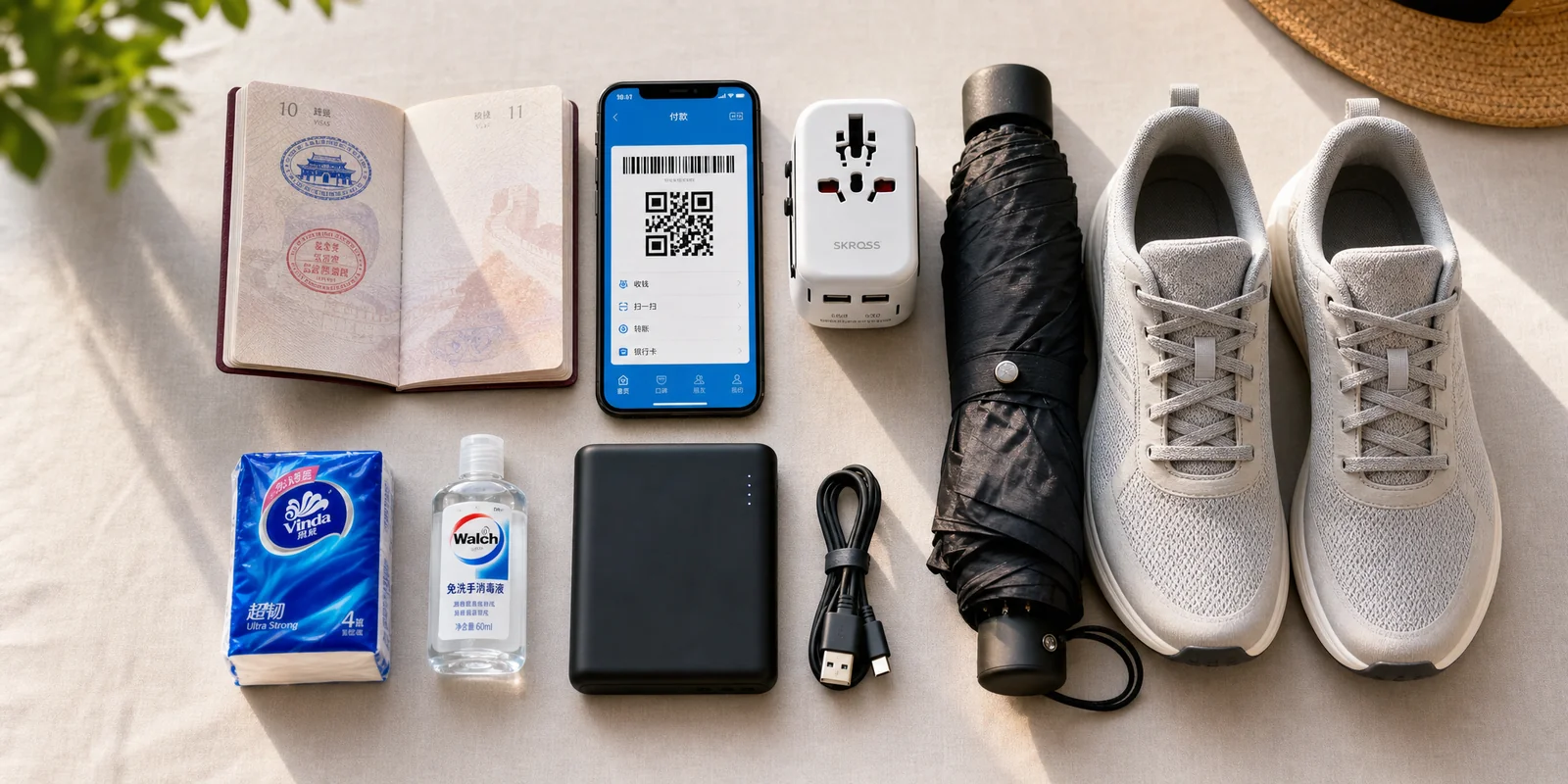
Start With the Three Things That Actually Matter
Most packing problems in China aren't about forgetting socks. They're about arriving unprepared for how the country runs digitally. Before you worry about anything else, handle these:
- Mobile payments. Almost everything runs on QR codes — street food, taxis, convenience stores, vending machines, temple entry. Set up Alipay (支付宝, Zhīfùbǎo) or WeChat Pay (微信支付, Wēixìn Zhīfù) and link a foreign card before you go. It takes about 10 minutes and saves you a lot of friction. Cash still works at hotels and larger shops, so bring some as backup, but don't plan to rely on it.
- A VPN. If you want Google, Instagram, WhatsApp, or your home email, you need a VPN installed and tested before you arrive. VPN provider websites are often blocked inside China, so you can't easily download one once you land.
- The right power setup. China runs on 220V and uses mainly Type A and Type I sockets. If you're coming from the US, Japan, or anywhere on 110V, check that your devices handle 220V (most phone and laptop chargers do; hair dryers and curling irons often don't).
Sort those three and you've solved 80% of what makes China feel intimidating. The rest of this guide covers the physical packing.
Documents and Money
This is the category where a mistake actually ruins your day, so pack it carefully.
- Passport with at least six months of validity and your Chinese visa (or proof you qualify for visa-free entry). Carry your passport on you at all times — it's your legal ID, and hotels require it at check-in for police registration (住宿登记, zhùsù dēngjì).
- Printed copies of your passport photo page, visa, hotel bookings, and return flight. Border officers occasionally ask, and a printout is faster than digging through your phone.
- A small amount of cash. A few hundred RMB covers you for the rare cash-only vendor, tips for tour guides, or a dead phone battery.
- A backup card kept separate from your main wallet, in case one is lost or your bank flags a transaction.
Electronics and Adapters
Your phone is your single most important tool in China — it's your wallet, map, translator, and train ticket. Build your electronics around keeping it charged and connected.
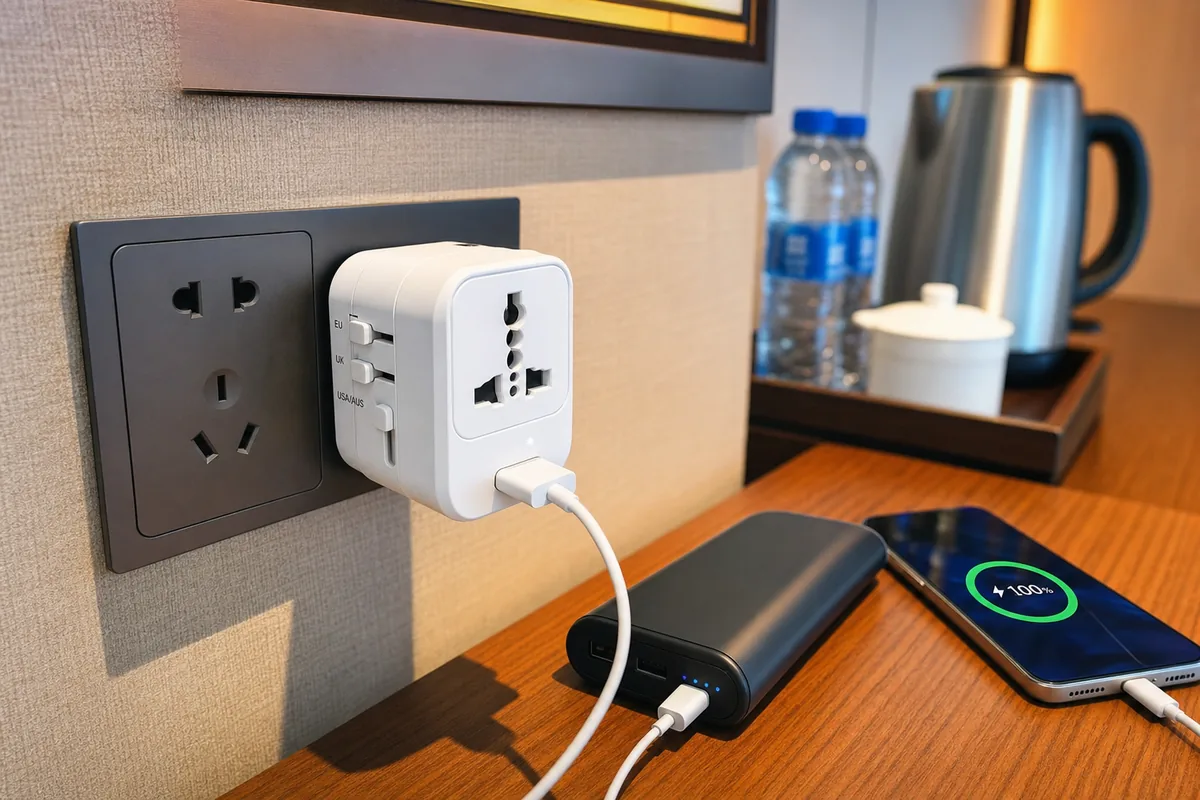
- Power adapter. A universal travel adapter covers China's Type A/I sockets. Many Chinese hotel rooms have multi-standard sockets that already accept US and EU plugs, but don't count on it.
- Power bank. Heavy phone use — payments, maps, translation, photos — drains batteries fast. A 10,000–20,000 mAh bank gets you through a full day. Note for flights: power banks must go in carry-on, never checked luggage, and Chinese airlines have tightened rules on banks without a clear capacity marking.
- Connectivity. An eSIM or a China SIM keeps you online from the moment you land. Pair it with your tested VPN. Some travel eSIMs route through servers outside China, which can let you reach blocked sites without a separate VPN — worth checking before you buy.
- Voltage-sensitive items. Leave the US hair dryer at home; buy a cheap local one or use the hotel's. Laptops, cameras, and phone chargers are almost always dual-voltage (check the fine print: "100–240V" means you're fine).
For a full breakdown of plugs, voltage, and which gadgets are worth the suitcase space, see our Tech & Adapters guide. A reliable universal adapter with multiple USB ports is a worthwhile buy before you travel — you can find well-reviewed options online for under $25.
Clothing: Pack for the Region and Season
China spans five geographic time zones' worth of territory and nearly every climate. A spring trip to Harbin and a spring trip to Sanya require completely different bags. The short version:
- Summer (Jun–Aug): Hot and humid across most of the east and south. Light, breathable layers, plus something for fierce air-conditioning indoors. A compact umbrella doubles for rain and sun.
- Winter (Dec–Feb): The north (Beijing, Harbin, Xi'an) gets genuinely cold — well below freezing. Layers, a real coat, hat, and gloves. The south stays mild but indoor heating is often absent below the Yangtze, so it can feel colder inside than out.
- Spring and Autumn: The most comfortable seasons in most regions. Pack layers and a light jacket.
Across all seasons, bring comfortable walking shoes — sightseeing days routinely top 15,000 steps, and the Great Wall, temple complexes, and old towns mean stairs and uneven stone. For region-by-region detail, check Clothing by Season and Weather by Region before you finalize your bag.
Health, Toiletries, and Small Comforts
Basic toiletries are easy to buy in China, so don't overpack. But a few items are worth bringing from home:
- Pocket tissues and hand sanitizer. Many public toilets don't supply toilet paper or soap. This is the single most common thing travelers wish they'd brought.
- Prescription medication in original packaging, with enough for the whole trip plus a buffer. Bring a copy of the prescription. Some medications common elsewhere are controlled or unavailable in China.
- A small first-aid kit with your preferred painkillers, anti-diarrheal, and motion-sickness tablets. Pharmacy staff rarely speak English, and brand names differ.
- Specific toiletries you're attached to. Western deodorant and certain skincare can be hard to find or pricey; standard shampoo, soap, and toothpaste are everywhere.
For deeper guidance on medications, pharmacies, and finding care, see Health & Medical Care.
What to Bring vs. What to Skip
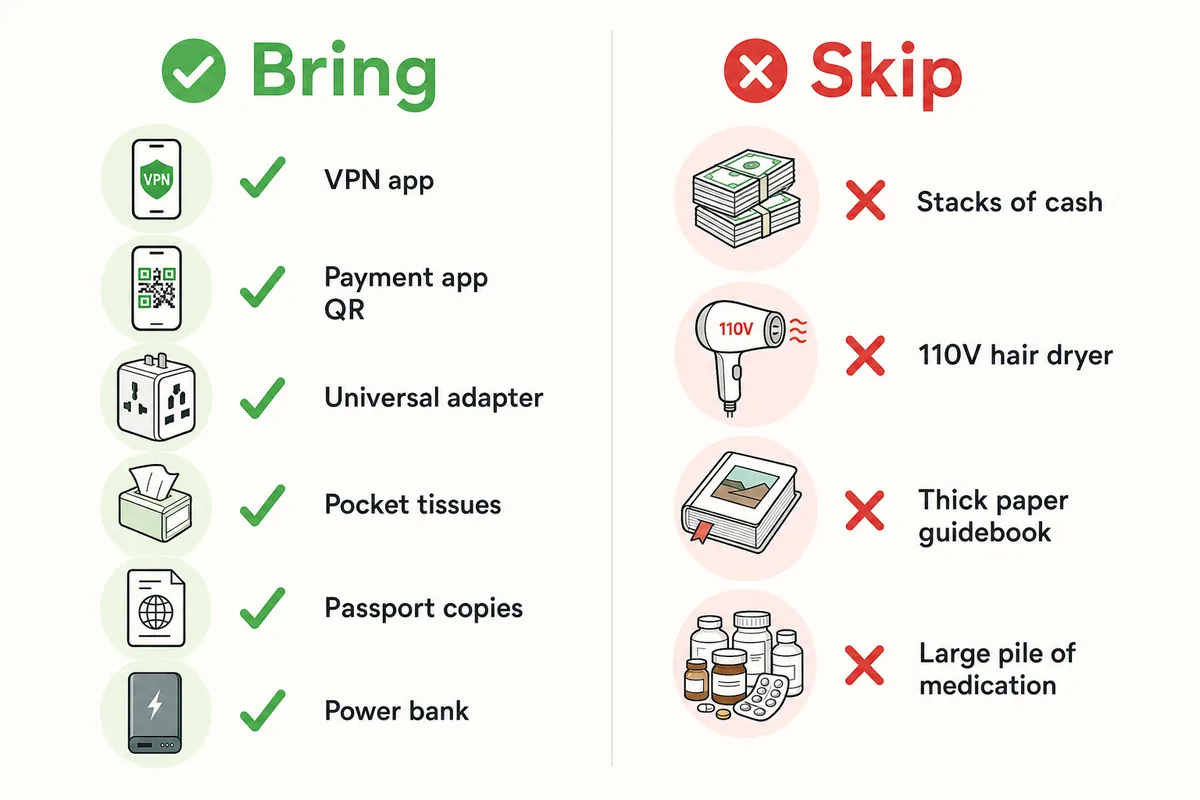
A quick reference for the items travelers most often get wrong:
| Category | Bring | Skip |
|---|---|---|
| Connectivity | Pre-installed VPN, eSIM/SIM, offline maps | Assuming hotel Wi-Fi gives uncensored access |
| Payments | Alipay/WeChat Pay set up in advance, some cash | Stacks of cash as your main method |
| Power | Universal adapter, power bank, dual-voltage chargers | 110V-only hair dryers and styling tools |
| Toiletries | Tissues, hand sanitizer, your meds | Months of shampoo/soap (buy locally) |
| Documents | Passport, printed copies, backup card | Heavy paper guidebooks (use apps) |
What Not to Bring
A few things are restricted, regulated, or simply pointless to pack.
- Drones are allowed but heavily regulated — many cities and nearly all major attractions ban flying, and registration may be required. If you're not committed to using one carefully, leave it home.
- Walkie-talkies and satellite phones can be confiscated at customs.
- Large quantities of any medication, especially anything containing controlled substances. Some common sleep aids, ADHD medications, and strong painkillers are restricted. Check before you pack.
- Politically or religiously sensitive printed material in bulk can cause delays at the border. A personal book or two is fine; cartons are not.
China Customs publishes the official lists of prohibited and restricted items; when in doubt, the General Administration of Customs of China is the authoritative source. For baggage allowances on flights and trains within China, see our Luggage Rules in China guide.
Our Recommendation
If you do nothing else, do this: set up mobile payments, install and test a VPN, and confirm your chargers handle 220V. Those three steps prevent the problems that genuinely derail trips. Everything else — clothes, toiletries, gadgets — you can adjust on the ground, since Chinese cities are full of convenience stores, pharmacies, and shops selling anything you forgot.
Pack light, lean on your phone, and resist the urge to bring "just in case" items you can buy locally for a few RMB. A carry-on and a daypack are plenty for most two-week trips. A solid 20,000 mAh power bank is the one piece of gear we'd never travel without here — a well-rated model costs around $30 and earns its space.
The Bottom Line
Packing for China is less about the suitcase and more about the setup. The clothes follow the season and region, the toiletries are mostly buyable on arrival, and the documents are common sense. What's genuinely different is the digital side: payments, connectivity, and power. Handle those before you fly, bring tissues and your own medication, leave the 110V appliances and the drone at home, and you're ready. From here, dig into the detailed checklists below to fine-tune your bag for your specific route and season.
Related Reading
- Essential Items Checklist — the full printable list of everything to pack.
- Tech & Adapters — plugs, voltage, and which gadgets are worth bringing.
- Clothing by Season — what to wear region by region, month by month.
- Internet & VPN Guide — how to stay connected to the apps you use at home.
- Understanding Chinese Payment Systems — set up Alipay and WeChat Pay before you go.
Last updated: June 2026
Read in other languages
Last train times for 10 Chinese metro systems
Every line and station, checked by hand — the same data behind our offline route planner.
Get the WaysChina App
Offline guides, currency converter, essential phrases, and more — all in your pocket.

Related Articles

Clothing by Season
What to wear in China depends heavily on when and where you go. This season-by-season packing guide covers summer...
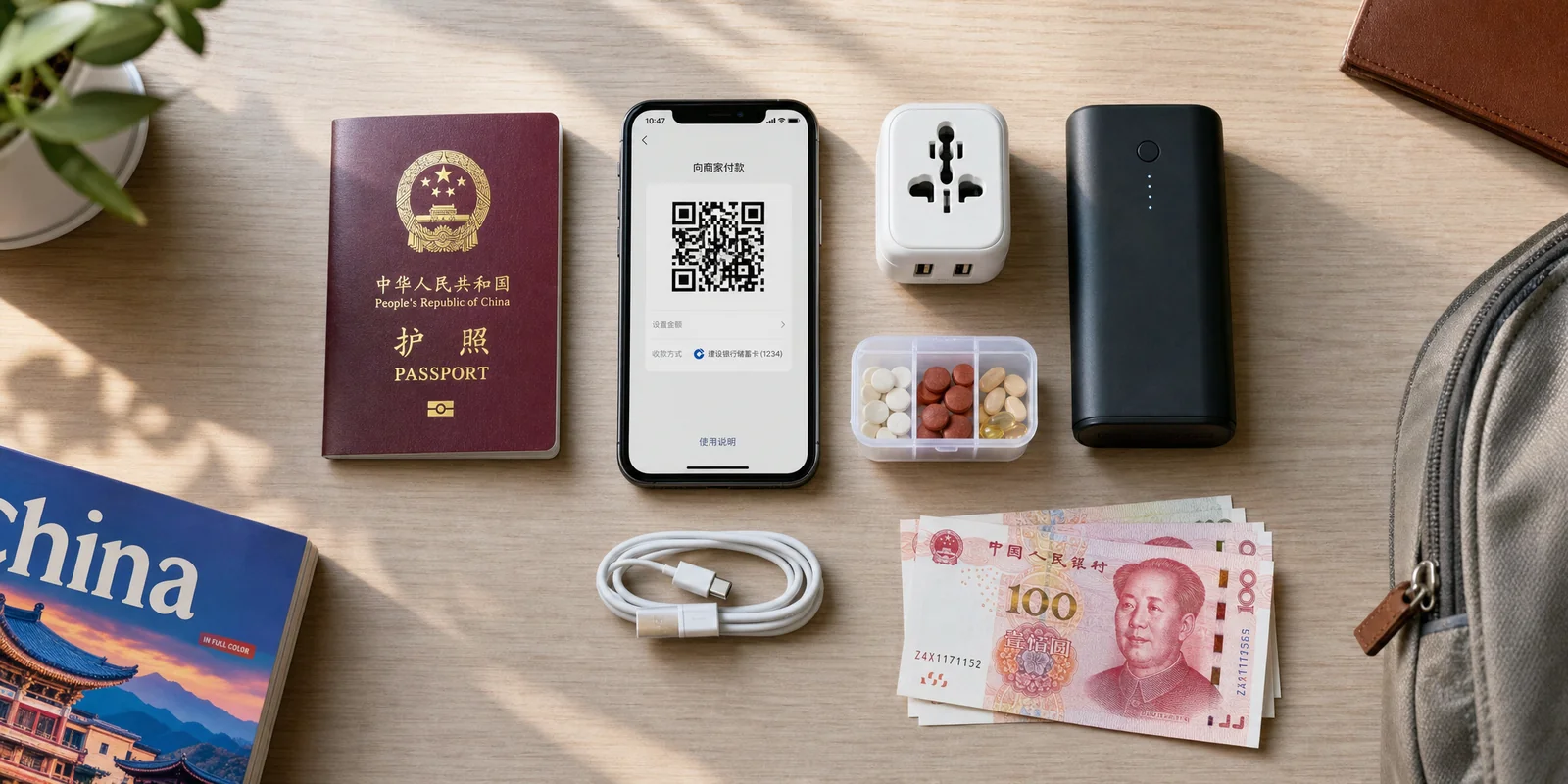
Essential Items Checklist for China
A practical, category-by-category packing checklist for China — documents, payments, phone setup, plugs, medication,...
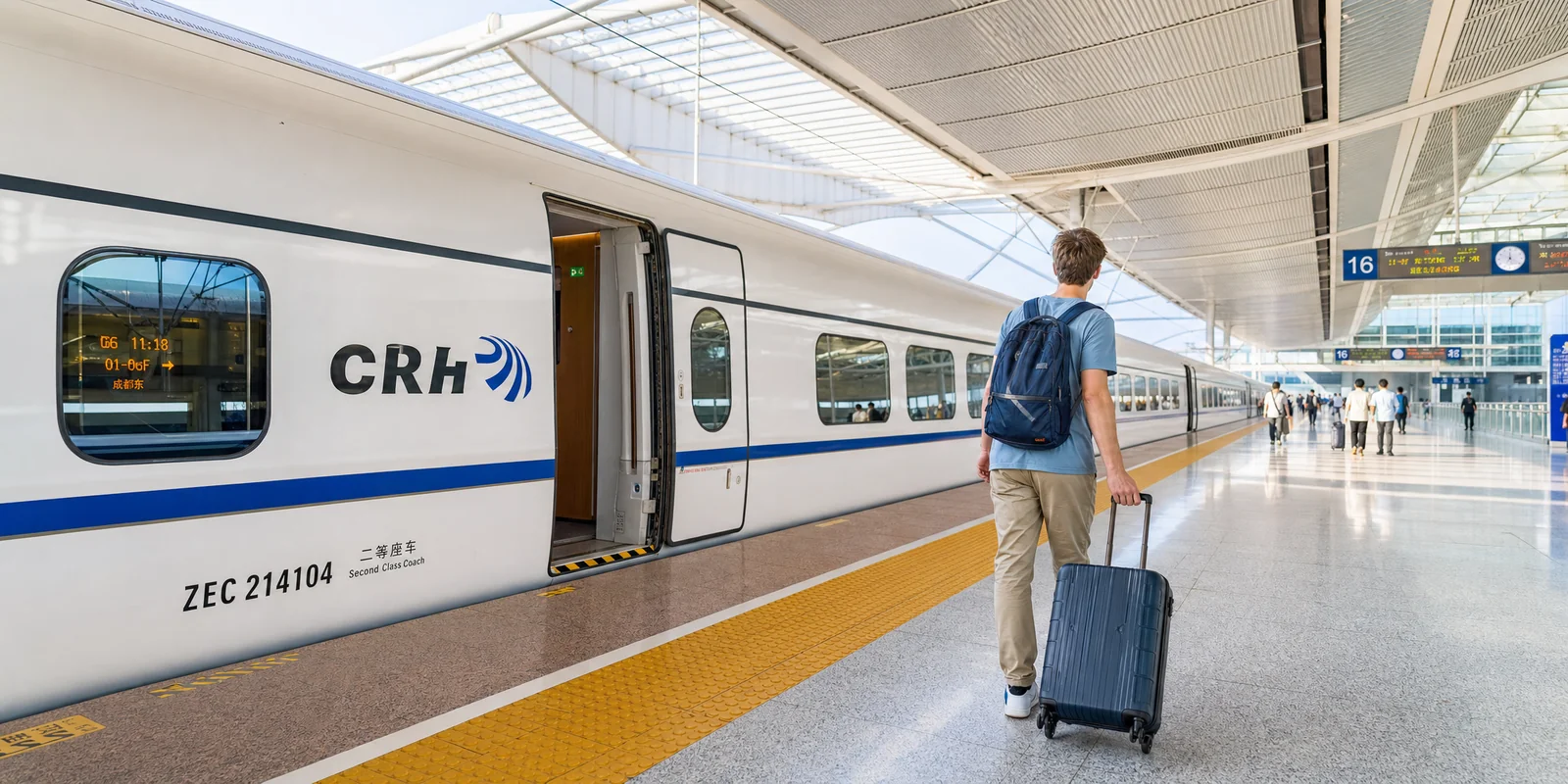
Luggage Rules in China
What you can carry on China's high-speed trains, domestic flights, and metro systems, plus prohibited items, weight...
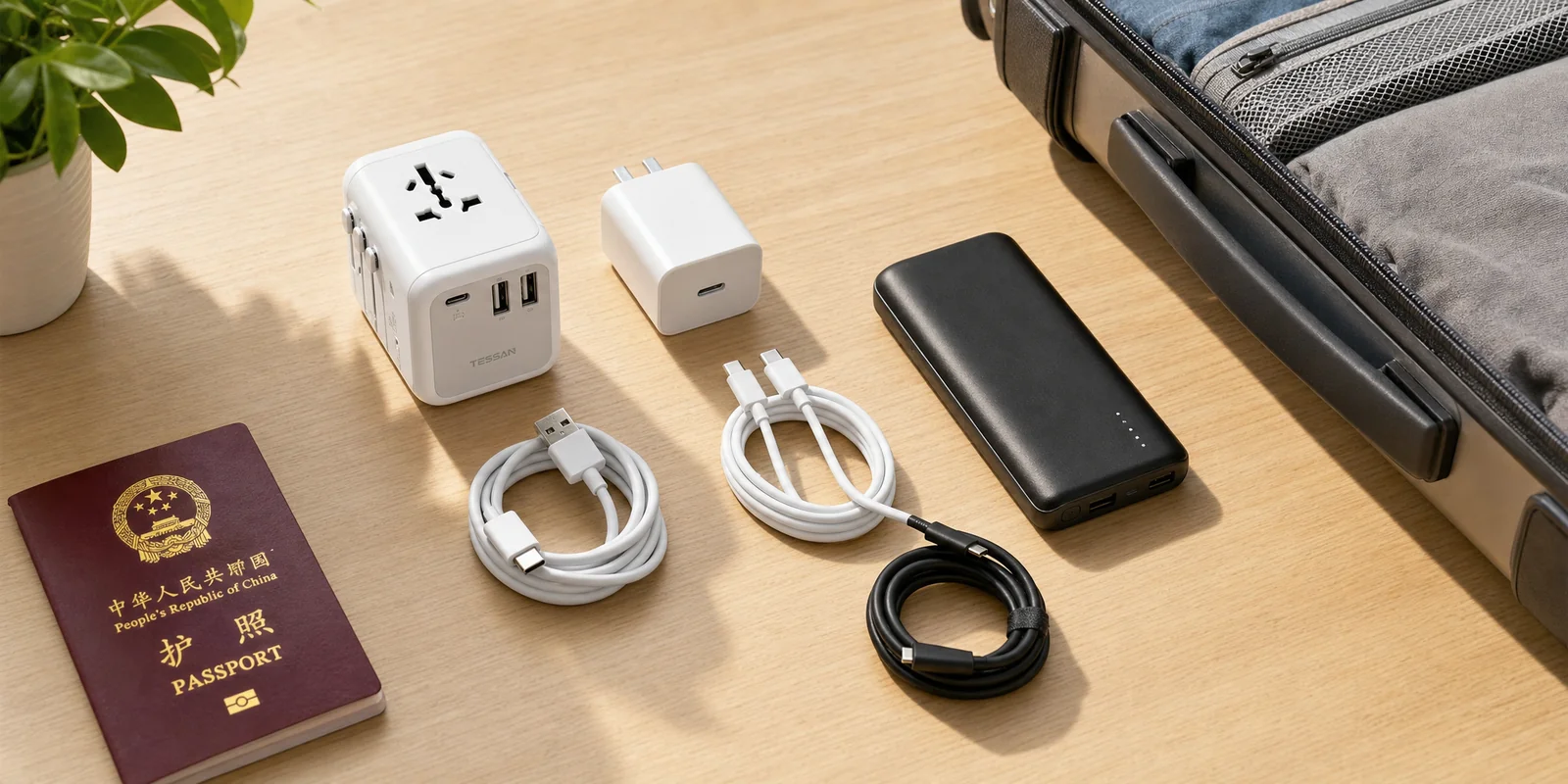
Tech & Adapters: What Electronics to Pack for China
Mainland China runs on 220V, 50Hz with Type A and Type I sockets. Here's exactly what adapters, chargers, and power...