
This article contains affiliate links. If you make a purchase through these links, we may earn a small commission at no extra cost to you. This helps support our work in creating free travel guides.
Northeast China — known locally as Dongbei (东北, Dōngběi) and historically as Manchuria — gives you two very different trips depending on when you visit. Come in winter and you get Harbin's ice festival, a snow-covered crater lake, and outdoor hot springs in sub-zero air. Come in summer and the same region becomes one of the country's best escapes from the heat, with alpine hiking and a breezy coastline. This route connects three anchors: Harbin in the far north, Changbaishan (Changbai Mountain) on the Korean border, and the seaside city of Dalian to the south, with Shenyang as a handy transit hub. Plan on 7 to 8 days. Below is a day-by-day plan for both seasons, how to link the cities, and what it actually costs.
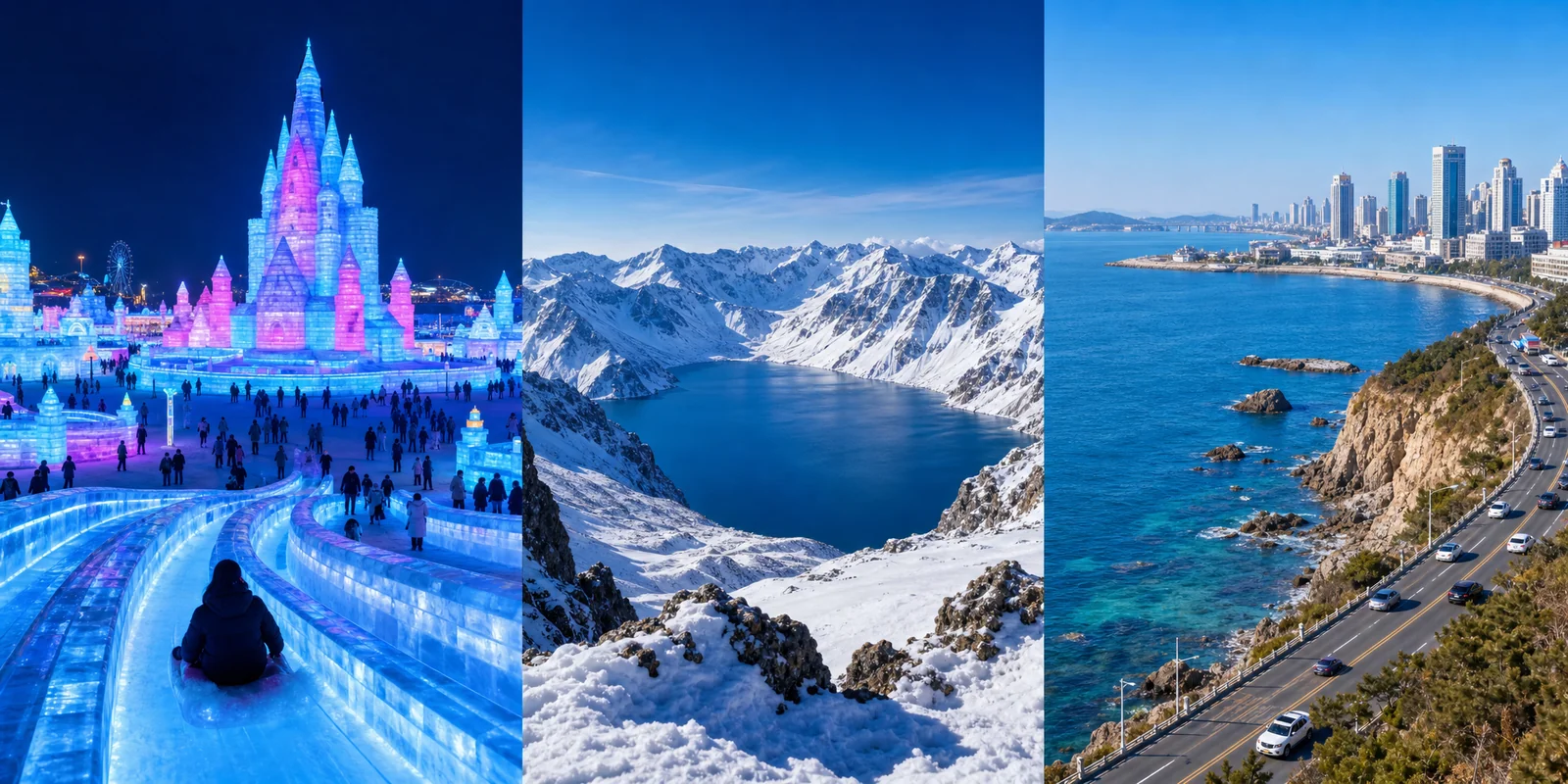
Route overview: two seasons, one loop
The geography runs north to south: Harbin sits in Heilongjiang province, Changbaishan is on the Jilin–North Korea border, and Dalian is at the southern tip of the Liaodong Peninsula in Liaoning. You'll generally travel in that order, ending in Dalian, which has the best onward flight connections to Beijing, Shanghai, and Seoul.
The two seasons are genuinely different products, not just warmer or colder versions of the same trip:
- Winter (December–February): Harbin Ice and Snow World, Tianchi (天池, Tiānchí, "Heaven Lake") frozen and ringed in snow, hot springs and skiing at Changbaishan, then warming up over seafood in Dalian. This is the headline season and the reason most people come.
- Summer (June–August): Dongbei stays cool while the rest of China bakes. Changbaishan turns green for hiking, Harbin is pleasant for riverside walks, and Dalian works as a proper beach-and-seafood holiday. Shenyang fits naturally as a one-night stop for its history.
Spring and autumn are short and underrated, but the infrastructure (festivals, ski lifts, beach facilities) is built around these two windows, so this guide focuses on winter and summer.
Winter itinerary (7-8 days)
This version assumes you fly into Harbin and out of Dalian.
Days 1-3: Harbin
Harbin earns two full days, three if you want a relaxed pace. The big draw is Ice and Snow World (冰雪大世界, Bīngxuě Dàshìjiè), a sprawling park of illuminated ice buildings, slides, and sculptures that opens after dark. Go in the late afternoon so you see it both in daylight and lit up, and dress for standing around in deep cold for two to three hours.
During the day, walk Central Street (中央大街, Zhōngyāng Dàjiē), a cobblestone pedestrian avenue lined with early-1900s Russian and European architecture — a reminder that Harbin grew up around the Russian-built railway. Stop at St. Sophia Cathedral, the green-domed former Orthodox church, and try Harbin's Russian-influenced food: red sausage, Modern-brand ice cream eaten outdoors in winter (yes, really), and hearty stews. If the Songhua River is fully frozen, you can walk on it and watch locals ice-sledding.
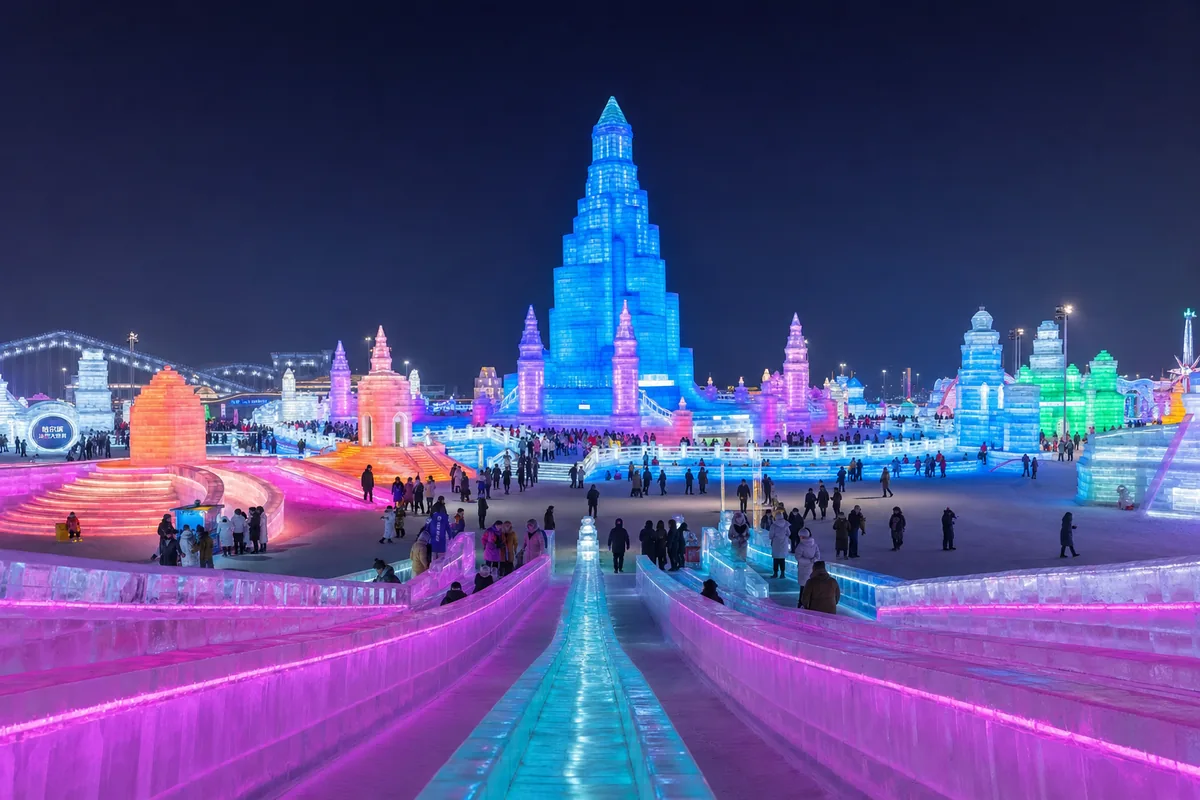
For a half-day add-on, the Snow Sculpture Expo on Sun Island features large-scale carved snow rather than ice. It's a different look and worth it if you have the third day.
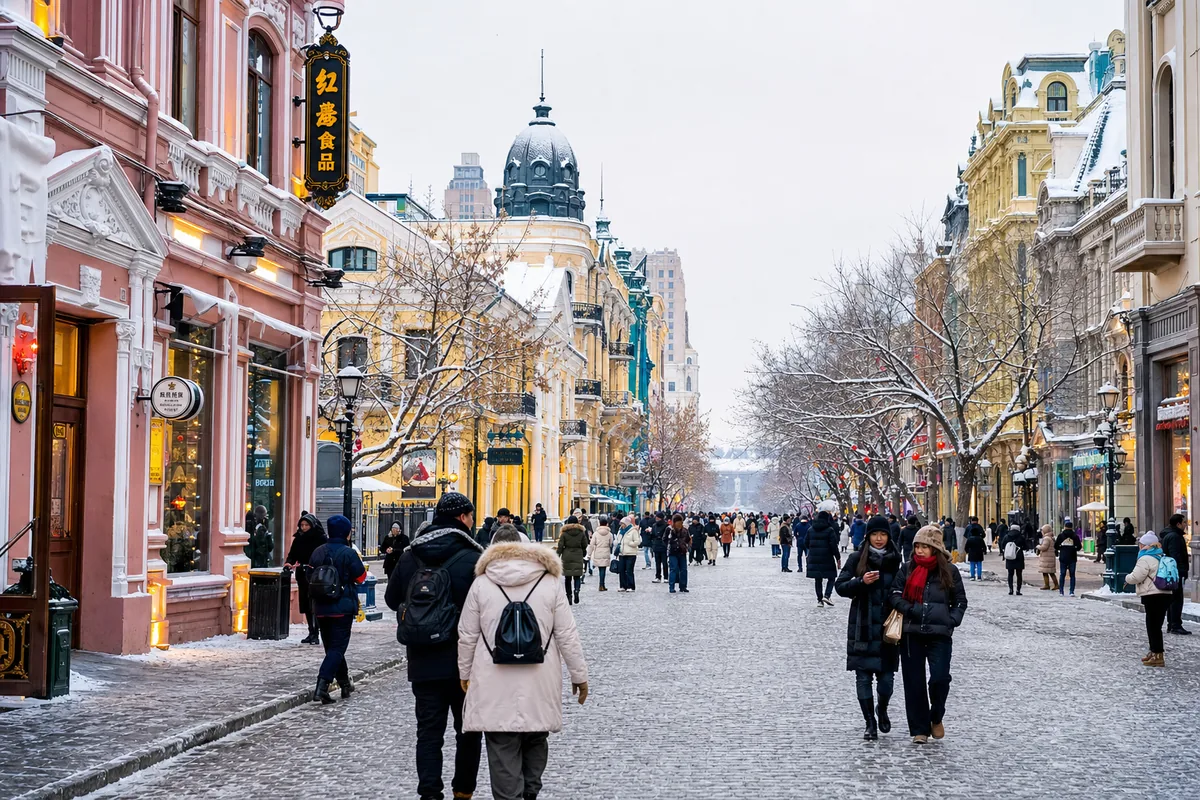
Days 4-5: Changbaishan
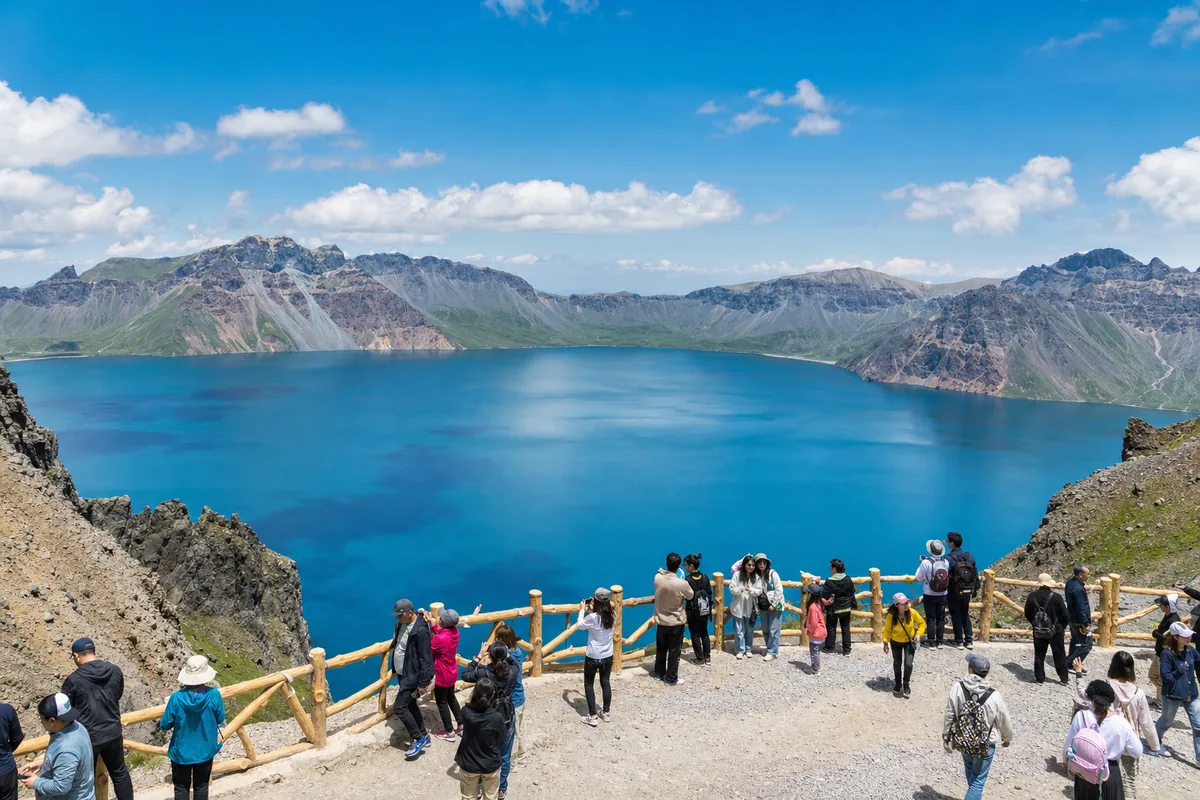
From Harbin, head to the Changbaishan area (the gateway towns are Baihe and the resort zone around it). The mountain's signature sight is Tianchi, a deep volcanic crater lake straddling the China–North Korea border. In winter it's frozen and snow-covered, with the surrounding peaks glazed white. The catch: the summit is frequently fogged in or closed for wind, and you can be turned back at short notice. Build in a buffer day if you can, and treat a clear Tianchi view as a bonus rather than a guarantee.
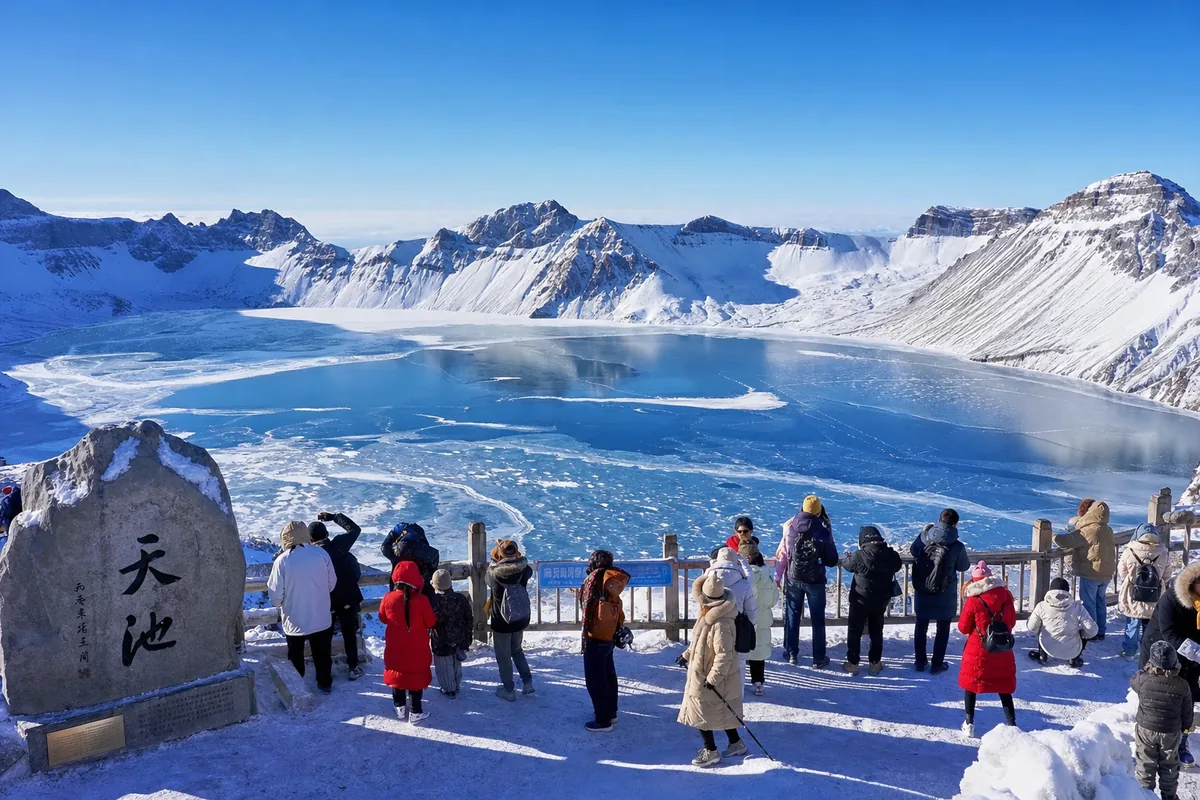
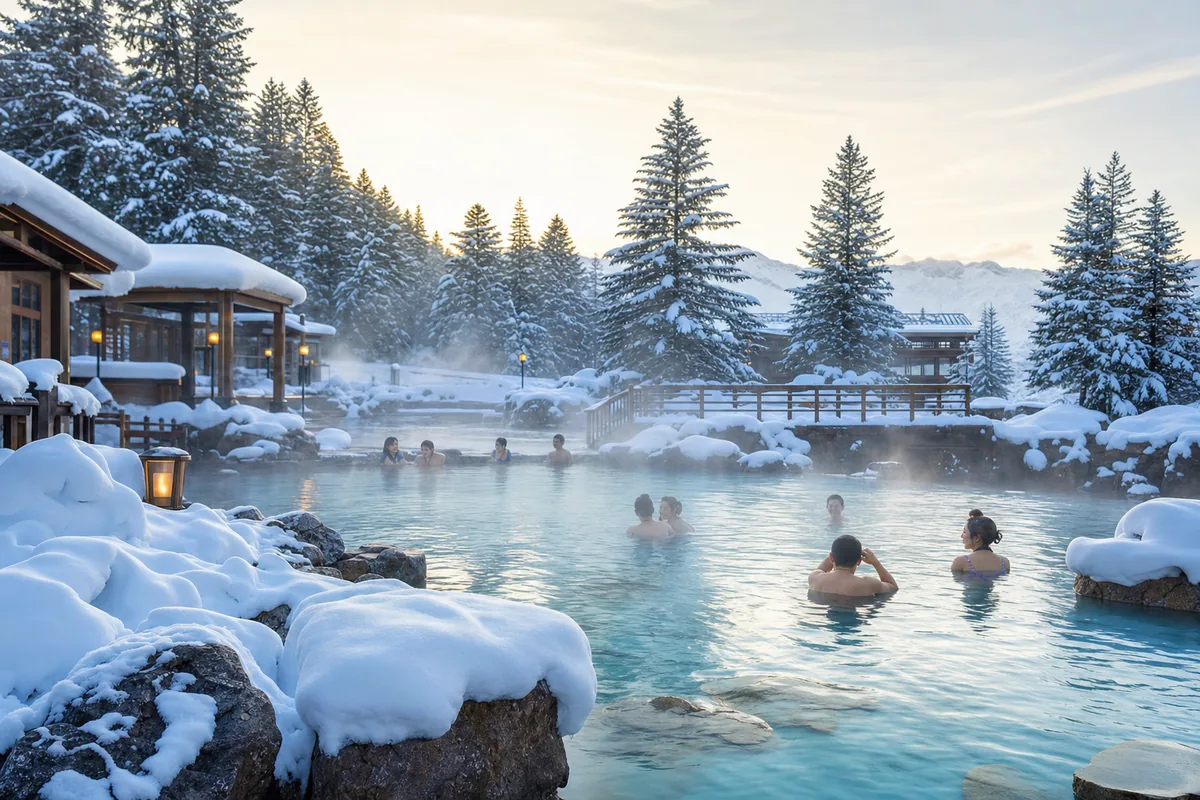
Beyond the lake, winter here is about two things. First, hot springs — soaking outdoors while snow falls is the classic Changbaishan experience, and several resorts pipe natural geothermal water into open-air pools. Second, skiing: the area has grown into a serious ski destination, with international-standard resorts and reliable powder. Even non-skiers can ride gondolas for the views.
Days 6-8: Dalian (via Shenyang)
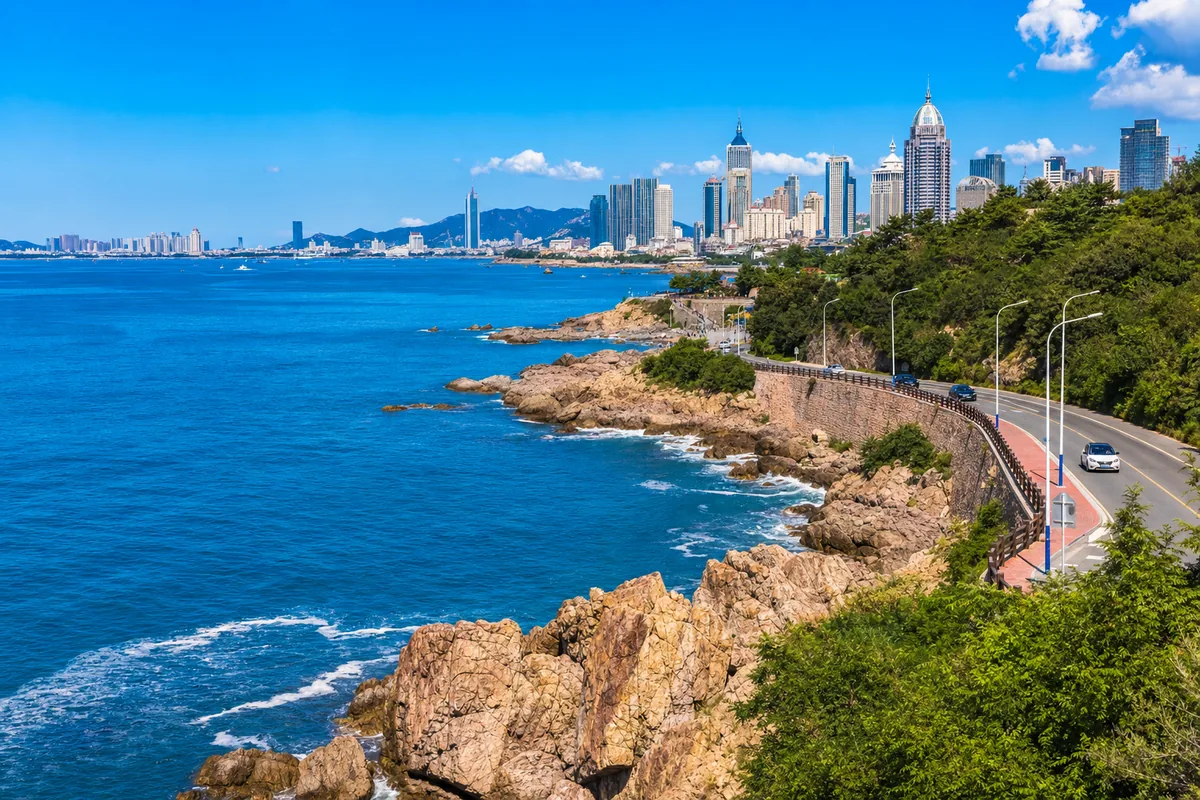
From Changbaishan you'll route south toward Dalian, usually through Shenyang. In winter, Dalian is the warm-up at the end — milder than the interior thanks to the sea, and built around seafood. Walk Binhai Road along the cliffs, see Xinghai Square (one of the largest city squares in the country), and wander the Russian Street and old Zhongshan Square with its ring of historic banks and hotels.
The real reason to end here is the food. Dalian does cold-water seafood as well as anywhere in China — sea cucumber, abalone, scallops, and just-caught fish, often sold by weight and cooked simply. Two relaxed days let you eat well and recover before flying out.
Summer itinerary (7-8 days)
The summer order is the same, but the experiences flip. Here Shenyang earns a proper overnight rather than just a transfer.
- Days 1-2 Harbin: Riverside parks, Central Street and the cathedral without the deep freeze, and Sun Island as a green space. Summer evenings along the Songhua River are lively and warm.
- Days 3-5 Changbaishan: The headline shifts to hiking and the crater lake reflecting blue sky. Summer is the best window for a clear Tianchi view, plus waterfalls, the "underground forest," and alpine meadows. Mornings are cool, so still pack a fleece.
- Day 6 Shenyang: Break the journey south with a night here for the Mukden Palace (沈阳故宫, Shěnyáng Gùgōng), the Qing dynasty's first imperial palace, and the imperial tombs on the city's outskirts.
- Days 7-8 Dalian: Now a beach holiday — swimming beaches, coastal walks, seafood, and a slower pace to close out the trip.
Connecting the cities
Distances up here are large, and the Changbaishan leg is the tricky one. Your options:
| Leg | Best option | Rough time | Notes |
|---|---|---|---|
| Harbin → Changbaishan | Flight or train via Changchun | Flight ~1.5h; rail half a day+ | Seasonal direct flights to Changbaishan Airport; otherwise rail to Baihe |
| Changbaishan → Shenyang | High-speed rail (from Baihe) or flight | HSR ~3-4h | The Shenyang–Baihe high-speed line makes this far easier than it used to be |
| Shenyang → Dalian | High-speed rail | ~2h | Frequent departures; the easy, reliable leg |
| Harbin → Dalian (direct) | Flight or HSR | Flight ~1.5h; HSR ~4-5h | Useful if you skip Changbaishan |
The Changbaishan connection is the part most worth booking early, especially in peak winter and summer when seats and seasonal flights fill up. You can compare trains and flights and book on platforms like Trip Com, which handles foreign passport bookings and English-language support. If you want to understand how the rail system works first, see our guide below.
For the official source of truth on train schedules and seat availability, China's national rail operator runs 12306.cn, the only authorized ticketing system.
Where to stay
Each base has a clear best neighborhood:
- Harbin: Stay near Central Street or the railway station. You'll be walking distance to the old town and have easy transfers to Ice and Snow World.
- Changbaishan: Stay in the resort zone near Baihe, ideally at a property with its own hot spring. Note that getting to the park entrance still takes time from town.
- Dalian: Around Zhongshan Square or near the coast. Central enough for the squares and seafood, with metro and bus access.
Winter is high season in Harbin and Changbaishan, so book well ahead — the best hot-spring resorts sell out. Comparing options on a site like Booking Com makes it easy to filter for things that matter here, like on-site hot springs or proximity to the ice park.
Budget reference
Northeast China is mid-range by Chinese standards — cheaper than Shanghai, but winter peak pricing in Harbin and Changbaishan pushes costs up. Rough per-person daily estimates, excluding international flights:
| Style | Per day (excl. intercity transport) | What it looks like |
|---|---|---|
| Budget | ¥350-550 (~$50-75) | Hostels/2-star, street food and local restaurants, public transport |
| Mid-range | ¥700-1,200 (~$95-165) | 3-4 star or hot-spring hotel, sit-down seafood, some taxis, paid attractions |
| Comfort | ¥1,500+ (~$210+) | 4-5 star resorts, private transfers, skiing, premium seafood |
Budget separately for big-ticket items: Ice and Snow World admission, ski passes, hot-spring entry, and the Changbaishan park-plus-shuttle ticket all add up. Intercity transport (the flights and HSR above) is the other major line item. For a fuller breakdown of costs across the country, see our budget guide below.
What to pack (winter especially)
This is where a Dongbei winter trip lives or dies. Harbin and Changbaishan are genuinely cold, and you'll be outdoors for hours at the ice park and on the mountain.
- A proper down jacket rated for sub-zero temperatures, plus thermal base layers
- Insulated, waterproof boots with grip — pavements and the frozen river get icy
- Hat, gloves (with a thin liner pair so you can use your phone), and a face covering for the ice park
- Hand and foot warmers, and a power bank kept warm inside your coat (cold drains batteries fast)
If you're flying in without gear, it's easier to bring the essentials than to source heavy-duty cold-weather clothing on arrival. Reliable down jackets, thermal layers, and reusable warmers are easy to order ahead on Amazon before you fly. For a full season-by-season list, see our packing guides.
Booking activities
Most of this route you can arrange independently, but a few experiences are smoother pre-booked — Ice and Snow World entry on busy nights, ski passes, and guided day trips up Changbaishan where transport and timing get complicated. Activity platforms like Klook list these with English information and skip-the-counter tickets, which helps when ticket windows are crowded and signage is limited.
How to adjust this route
- Short on time (5 days): Drop Changbaishan and do Harbin + Dalian by direct flight or HSR. You lose the mountain but keep the contrast of ice city and coast.
- Winter spectacle only: Spend all your time between Harbin and Changbaishan and skip Dalian — the coast is quieter and colder out of summer.
- Adding it to a bigger trip: Dalian connects easily to Beijing, making this a natural extension of a wider China itinerary. See our longer multi-region plans below.
- Korean/Japanese travelers: Dalian and Shenyang both have direct flights to Seoul and Tokyo, so you can enter or exit the loop from either end.
Final thoughts
The Harbin–Changbaishan–Dalian route works because the three stops are genuinely different: a frozen-or-festive river city, a volcanic mountain with a crater lake, and a relaxed seafood coast. Pick your season first, since winter and summer here are almost two separate trips. Book the Changbaishan leg and your peak-season hotels early, pack for real cold if you're going in winter, and leave a buffer day for the mountain summit, which doesn't always cooperate. Seven to eight days is enough to do all three at a comfortable pace. From there, your next move is choosing dates around the ice festival's opening window or the summer hiking season, then locking in transport between the cities.
Related reading
- Harbin Winter Guide — the ice festival and old town in detail
- Changbaishan Nature Guide — the mountain, Tianchi, and hot springs
- Dalian Coastal City Guide — beaches, squares, and seafood
- How to Book Train Tickets — booking HSR seats as a foreign visitor
- China Travel Budget Guide — costs across regions and trip styles
Last updated: June 2026
Read in other languages
Last train times for 10 Chinese metro systems
Every line and station, checked by hand — the same data behind our offline route planner.
Get the WaysChina App
Offline guides, currency converter, essential phrases, and more — all in your pocket.

Related Articles
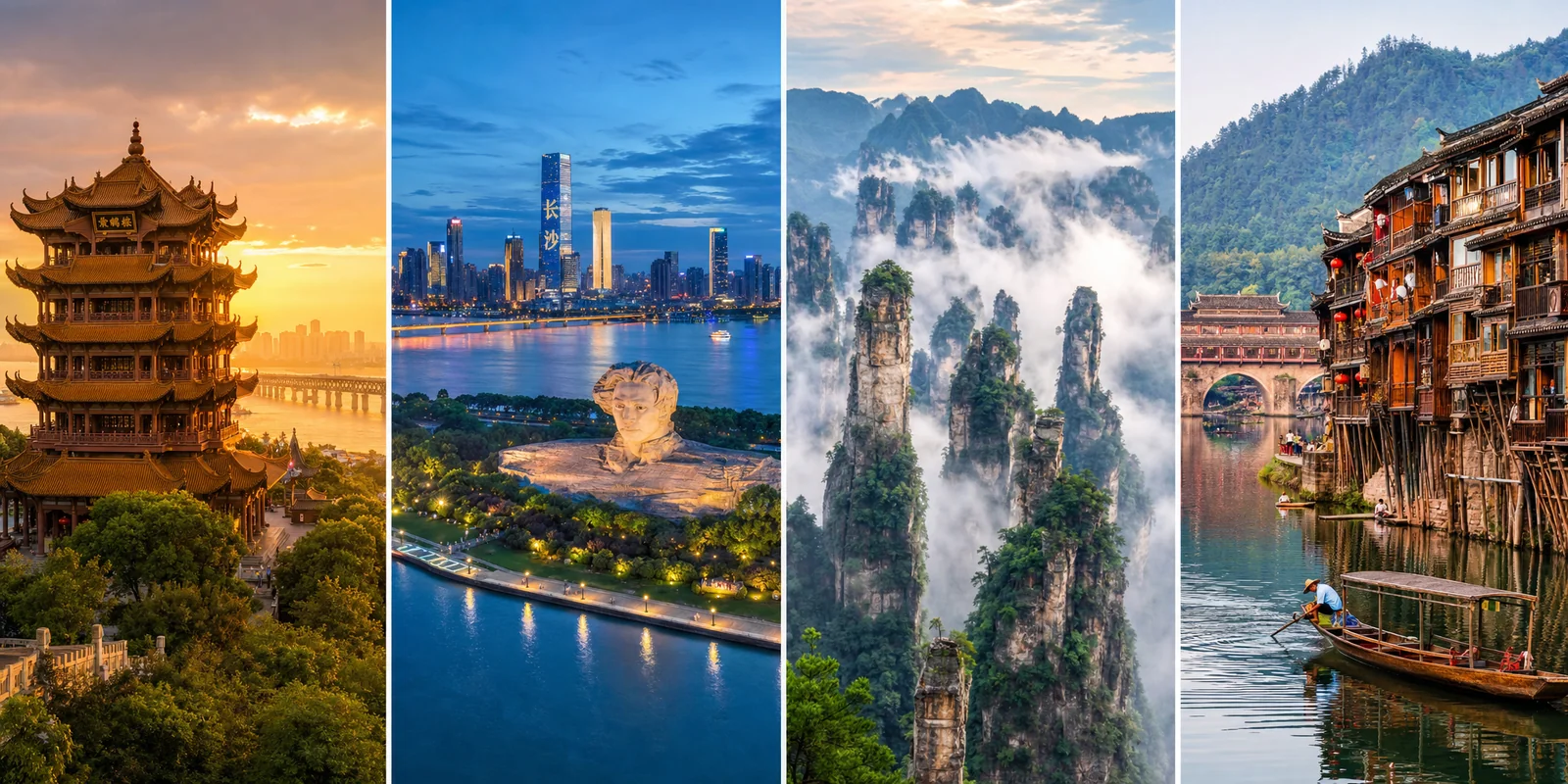
Central China Route: Wuhan-Changsha-Zhangjiajie
A practical 7-8 day Central China itinerary linking Wuhan, Changsha, Zhangjiajie, and Fenghuang by high-speed rail,...

Jiangnan Water Towns Route: Shanghai, Suzhou, Wuzhen and Hangzhou in 5 to 7 Days
Shanghai → Suzhou → a night in Wuzhen or Xitang → Hangzhou: the order, nights per stop, which water town to pick,...
Silk Road Route: Xi'an to Dunhuang
A practical 7-8 day Silk Road itinerary from Xi'an through Lanzhou and Zhangye to Dunhuang, with day-by-day plans,...
Yunnan Circuit: Kunming-Dali-Lijiang-Shangri-La
A practical 7-10 day Yunnan itinerary covering Kunming, Dali, Lijiang, and Shangri-La — with daily plans, transport...