
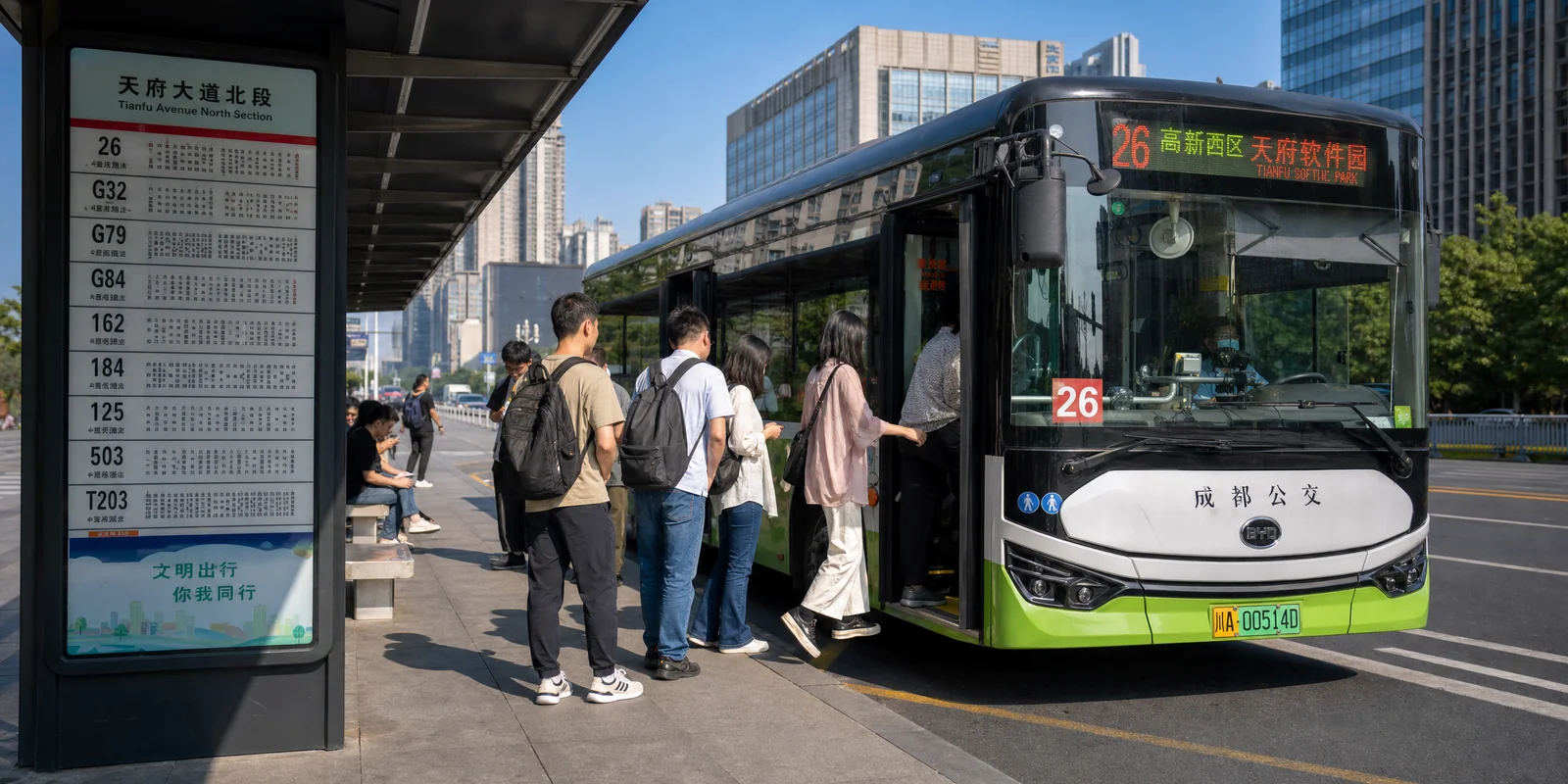
City buses in China are cheap, frequent, and reach places the metro doesn't — but they can feel intimidating if you don't read Chinese and aren't sure how to pay. The good news is that since 2024, foreign visitors can pay for buses with a QR code in Alipay or WeChat, often using a foreign phone number and a foreign card, with no Chinese bank account required. Fares are usually 1–3 RMB per ride. This guide walks through the payment methods that actually work for tourists, how boarding and fares work, what to expect on board, and the practical habits that make the whole thing painless.
How payment works on Chinese public buses
There are four main ways to pay for a city bus in China. According to the official guidance for foreigners living and working in China published on the government information service for foreigners (GNIS), these are: the Alipay transit code, the WeChat transit code, a city transport card (physical or phone NFC), and cash. Mobile payment is by far the most common and the easiest for visitors.
One thing to understand up front: the bus payment system is run city by city. The methods below work nationwide, but the exact fare rules — flat fare versus distance-based, whether you tap once or twice — depend on the city. We'll cover the common patterns and use Beijing and Shanghai as concrete examples.
Option 1: Alipay transit code (easiest for most visitors)
If you only set up one payment method, make it this. The Alipay (支付宝, Zhīfùbǎo) transit code is a QR code you scan when you board (and, in some cities, when you get off).
To set it up: open the Alipay app, tap Transport (出行), choose the city you're in, complete a quick identity check, and you'll get a bus QR code. When boarding, hold the code up to the scanner; you'll hear a beep when it goes through.
What changed for tourists is significant. As of May 2024, Alipay added support for foreign visitors to claim the transit code using a foreign 9-digit phone number, on top of the passport and residence-permit options it already supported. This rolled out in key inbound-tourism cities including Beijing, Shanghai, Guangzhou, Shenzhen, Hangzhou, Nanjing, Chengdu, Suzhou, Kunming, Wuhan, and Qingdao, and it supports "ride now, pay later" so the fare settles after your trip.

Option 2: WeChat transit code
WeChat (微信, Wēixìn) works the same way and is a solid backup if you already use WeChat Pay. Set it up by going to Me > Services > Wallet and linking a card, then go to Services > Travel Services, find the Transit Code, pick your city, and complete identity verification to generate the code. When you board, open Me > Services > Transit Code, hold the QR code to the scanner, and wait for the beep or the "payment successful" confirmation.
Option 3: Physical transport card
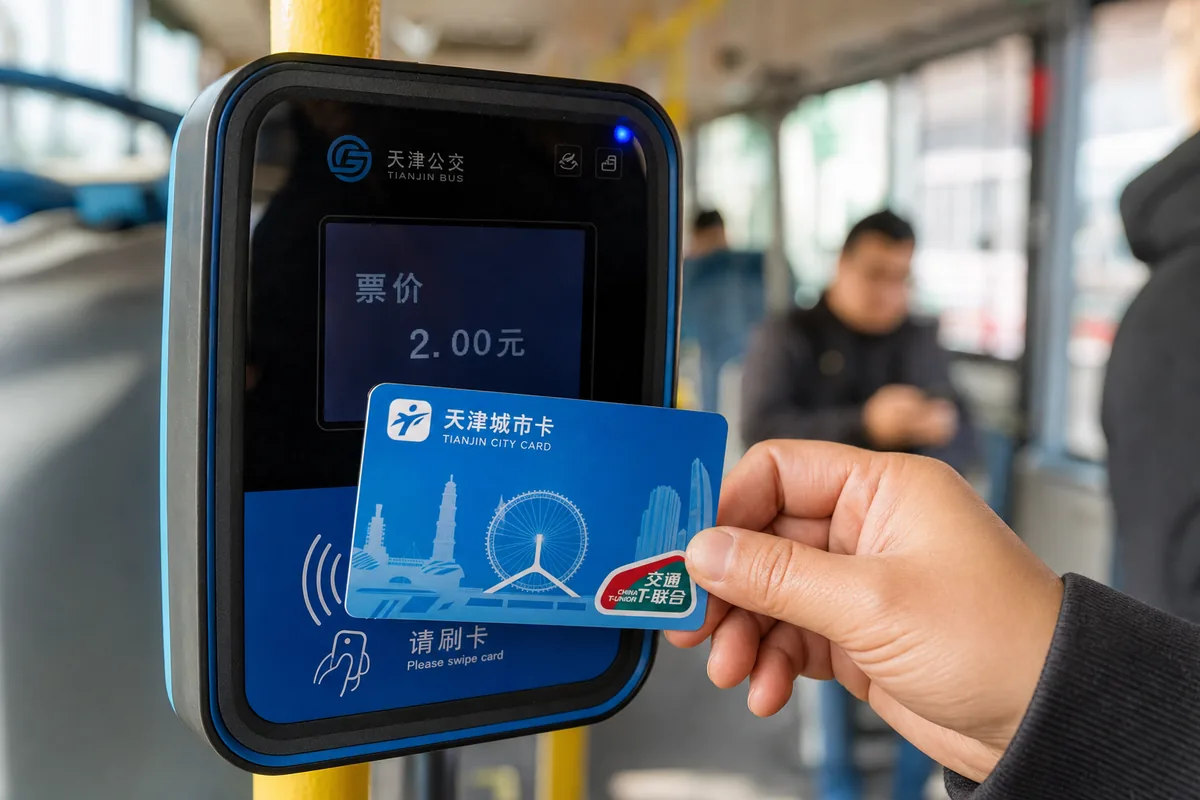
A physical card makes sense if you're staying a while, traveling with kids, or simply prefer not to pull out your phone every ride. You can get one with your passport — just bring it to a bus company service point, where you can pay for the card with cash, WeChat, or Alipay.
Cards are issued per city, but many are part of the national interoperable network. A card carrying the Transport Union (交通联合, Jiāotōng Liánhé) logo works across hundreds of cities — Shanghai's Transport Union card, for example, is usable in over 300 connected cities. The catch: you can usually only top up a card in the city that issued it, and refunds/deposits are typically handled only at the issuing city.
For visitors specifically, Beijing offers the BEIJING PASS, a reloadable travel card aimed at foreigners. It works on public transport in 300+ Chinese cities plus designated retail and cultural venues in Beijing. You buy it with a valid travel document (foreign passport, or Hong Kong/Macau/Taiwan permit) at Beijing Capital Airport, Daxing Airport, or designated metro and transport-card service halls. Note that it's sold rather than "issued" — once sold it can't be returned or reported lost, though remaining balance can be refunded (balance must be ≤200 RMB to refund). Top-ups are in 10 RMB increments, with a maximum stored balance of 1,000 RMB.
Option 4: Apple Pay transit card and other phone NFC
If you have an iPhone, you can add a Chinese transit card directly to Apple Wallet and tap with your phone or Apple Watch — no separate app to open. According to Apple's official transit page for mainland China, supported cities include Beijing, Shanghai, Guangzhou, Chongqing, Hangzhou, Shenzhen, Suzhou, Xiamen, Xi'an, and Nanjing, among others. A nice safety detail: even if your iPhone shuts down on low battery, it keeps about five hours of reserve power for tapping in.
Option 5: Cash (the fallback)
Cash still works, and under China's national payment-convenience policy it has to. In 2024 the State Council issued guidance establishing the principle of "cards for large amounts, QR codes for small amounts, cash as the backstop," requiring major transport hubs to accept mobile payment, bank cards, and cash. You can read the policy on the official State Council document.
Setting up foreign cards: what you need to know
You do not need a Chinese bank account or a Chinese phone number to use mobile payment on buses. Since around 2024, foreigners can link an overseas credit card to Alipay or WeChat and pay for buses, metro, and ride-hailing.
A few practical details, drawn from the official Q&A published by Guangdong's overseas-affairs office:
- Fees: Single transactions of 200 RMB or less carry no fee; above 200 RMB, a 3% fee applies. Bus fares are tiny, so you'll basically never hit the fee threshold on a bus.
- Supported cards: Visa, Mastercard, Diners Club, and Discover work on both apps; WeChat also supports JCB.
- Verification documents: WeChat Pay can be set up with one of six documents, including a foreign passport. The verification phone number does not have to be a mainland Chinese number — it just needs to receive the SMS code.
One thing to keep in mind on limits: Alipay caps single transactions at 3,000 RMB and WeChat at 6,000 RMB, and on Alipay, once your cumulative spending reaches around USD 500 you may be asked to upload identity information to keep using it. For bus rides this rarely matters, but if Alipay is your main payment app for the whole trip, set up verification early so a small bus fare doesn't get unexpectedly blocked.
For the full walkthrough of linking cards, see our guides on using Alipay with foreign cards and using WeChat Pay with foreign cards.
How to actually ride the bus
Once you can pay, the mechanics are straightforward. Here's the typical flow.
- Find your stop and route. Use a map app to find which bus number you need and which stop. More on apps below.
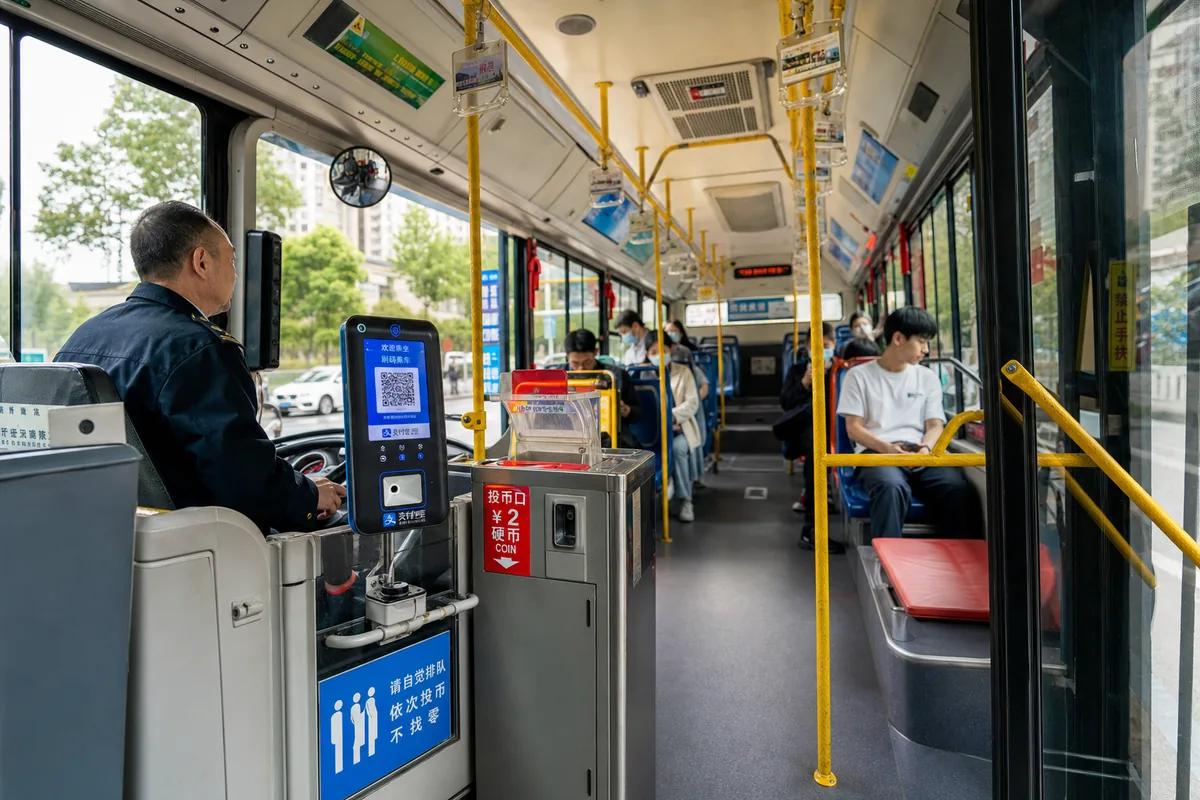
- Board at the front door. On most buses you board through the front door and exit through the rear. Each door has a scanner.
- Pay as you board. Tap your card, scan your QR code, or drop your coins. Listen for the beep.
- Watch for your stop. Stops are announced — usually in Mandarin, with English announcements on some routes in larger cities. Following along on your map app's live location is the most reliable way to know when to get off.
- Tap again if required. In distance-based-fare cities, you must scan or tap a second time when you exit, so the system can calculate your fare.
Flat fare vs. distance-based fare
This is the single most important thing to get right. Some cities charge a flat fare — you pay once when you board and you're done. Others charge by distance, which means you tap or scan both when you board and when you get off.
Beijing is a clear example of distance-based pricing. Per the official Beijing Public Transport fare rules, the fare is 2 RMB for the first 10 km, then 1 RMB more for each additional 5 km. Card and QR-code users get a discount within the city. Critically, you must tap both on entry and on exit. If you forget to tap on exit, the system treats it as an incomplete trip and charges you the full undiscounted maximum fare for that route next time you ride. Also, the gap between your boarding and exit taps on the same route can't exceed four hours.
Traveling with children
China prices children's transport by height, not age — which surprises a lot of visitors. Children 1.3 meters tall or under generally ride free (and must be accompanied by an adult); above 1.3 meters, they pay full fare. Beijing's official rules confirm the 1.3-meter threshold, and the same standard applies broadly on buses and metro across the country. If you're traveling with kids, see our guide to traveling with kids in China.
Dealing with the language barrier
This is the part that worries most travelers, and honestly, it's manageable but does take a little preparation. Most onboard signage, route maps, and stop announcements are in Mandarin Chinese. Tier-one cities have bilingual signs and announcements on many routes, but coverage isn't consistent across the network, so don't count on English on every bus.
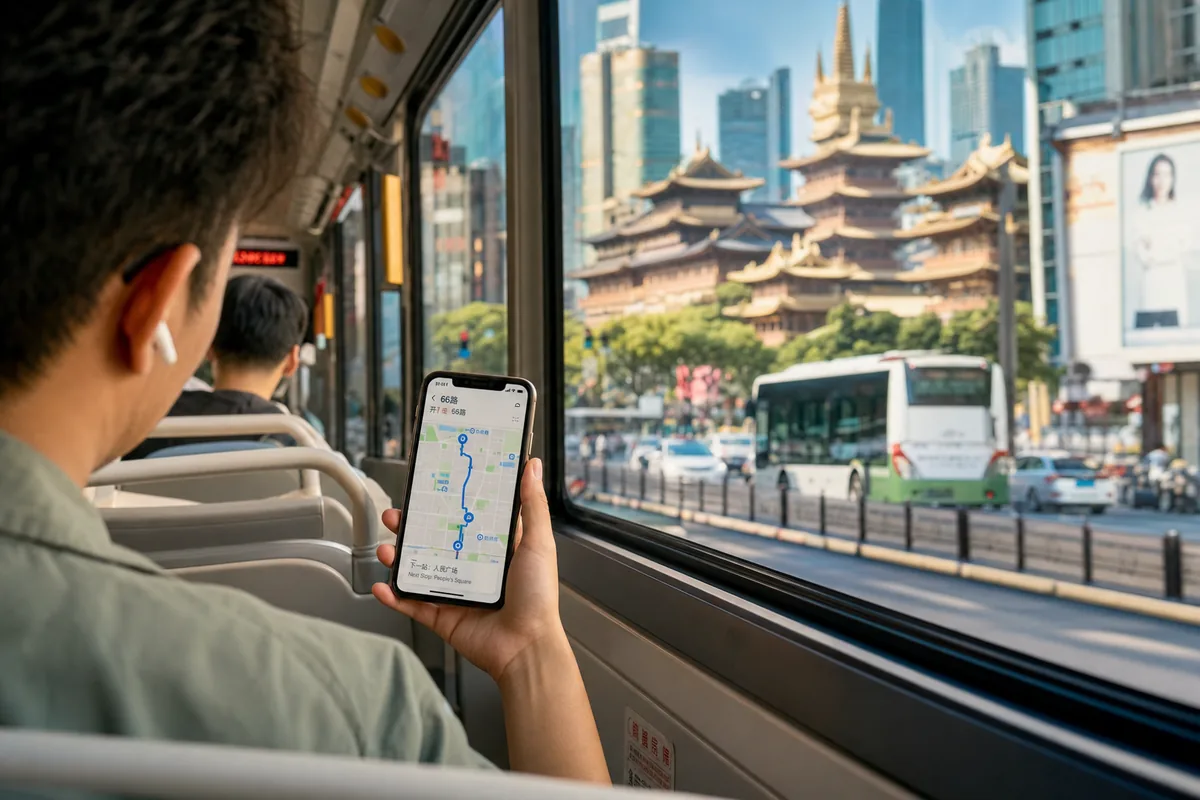
The fix is your phone. A map app that tracks your live position tells you exactly where you are and when your stop is coming, regardless of what language the announcements are in.
- Amap (高德地图, Gāodé Dìtú) is the most foreigner-friendly choice. Its App Store listing officially supports English alongside Simplified and Traditional Chinese, it accepts international phone numbers, and its bus routing is reliable.
- Baidu Maps (百度地图) has the most complete bus data but its interface is mostly Chinese and you'll need to search in Chinese or pinyin.
- Apple Maps has the best English support but only covers basic transit info in major cities.
For a fuller comparison, see our map apps guide. For planning metro routes and day-by-day itineraries across major cities, the WaysChina app offers offline metro maps and a built-in trip planner — useful for sketching out your route before you head out, then switching to a live-navigation map app on the bus itself.
Practical tips for using the bus system
- Have a backup payment method. Set up both an Alipay transit code and either WeChat or a physical card. If a scanner is finicky or your phone dies, you're not stranded.
- Screenshot your route. Save the bus number, your boarding stop, and your exit stop before you lose signal. Underground sections and dead zones happen.
- Board with the crowd, exit early-ish. Buses fill up fast at rush hour. Start moving toward the rear door one stop before yours.
- Keep small cash as an emergency fallback. A 2 RMB ride paid in coins has saved many travelers when an app glitched at the worst moment.
- Watch your belongings on crowded buses. Standard advice for any busy public transport anywhere. See our safety tips for travelers.
Frequently asked questions
Do I need a Chinese SIM card to pay for the bus?
No. You can claim an Alipay transit code with a foreign phone number, and WeChat verification only requires a number that can receive an SMS code. A Chinese SIM is convenient for many things but not required for bus payment.
Can I just tap my foreign contactless credit card on the bus reader?
In a few places, yes — some lines in Beijing and Shanghai accept foreign contactless cards directly (usually a bit pricier than the app fare). But support is patchy and city-specific, so don't rely on it as your only method. The Alipay/WeChat transit code is far more universally accepted.
What if I tap on the wrong door or miss the exit scanner?
On a distance-based-fare bus, missing the exit scan means the system can't calculate your distance and will charge the maximum undiscounted fare on your next ride. If it happens, it's a few extra RMB, not a crisis — just remember to tap on exit next time.
How do I know which buses have English announcements?
There's no reliable nationwide list, and coverage varies even within a single city. Rather than depending on announcements, follow your live location on a map app — it works on every route regardless of language.
Are buses or the metro better for tourists?
The metro is easier for first-timers — clear bilingual signage, no traffic, predictable timing. Buses reach more places and let you see the city, but require a bit more confidence. Many visitors use the metro for longer hops and buses for short final stretches. Compare in our metro systems guide.
The bottom line
Riding city buses in China is cheaper and easier than most visitors expect. Set up an Alipay transit code before you go — it takes a few minutes, works with a foreign phone number and a foreign card, and is accepted in all the major tourist cities. Add a WeChat code or a physical card as backup, keep a few coins for emergencies, and remember the one rule that trips people up: in distance-based-fare cities like Beijing, tap both when you board and when you get off. Use a map app like Amap to follow your live location so the language barrier stops being an issue. Fares run about 1–3 RMB per ride, so the bus is genuinely one of the best deals in Chinese travel. Always check the latest city-specific fare and payment rules before you travel, since they're set locally and can change.
Last updated: June 2026
Read in other languages
Last train times for 10 Chinese metro systems
Every line and station, checked by hand — the same data behind our offline route planner.
Get the WaysChina App
Offline guides, currency converter, essential phrases, and more — all in your pocket.

Related Articles
City Transportation in China: How to Get Around
Metros, taxis, buses, and ride-hailing in Chinese cities — what works for foreign visitors, how to pay, and how to...
China Metro Guide: How to Use the Subway in Any City
A practical guide to using China's metro systems as a foreign traveler — payment with foreign cards, fares, tickets,...

Taxis & Ride-Hailing in China
How to use street taxis and ride-hailing apps like DiDi in China, what fares to expect, and how to avoid the few...