

This article contains affiliate links. If you make a purchase through these links, we may earn a small commission at no extra cost to you. This helps support our work in creating free travel guides.
Run this Jiangnan (江南, Jiāngnán, "south of the river") trip as a line, not a triangle: Shanghai (two nights) → Suzhou (one or two nights) → one water town for a night, Wuzhen or Xitang → Hangzhou (two nights), then a train back to Shanghai or a flight out of Hangzhou. Six days is comfortable, five works if Shanghai and Hangzhou get a day and a half each, and with four you drop Suzhou. The order follows the map: Suzhou is west of Shanghai, the water towns of Jiaxing prefecture sit between Suzhou and Hangzhou, and Hangzhou is the far end. Trains cover both ends, and the one leg without a convenient train, Suzhou to the water town, becomes a coach ride in the middle of the trip. Wuzhen's station is Tongxiang, Xitang's is Jiashan South, and Jiaxing South is neither; the legs are spelled out below.
The route: order, nights and why it runs this way
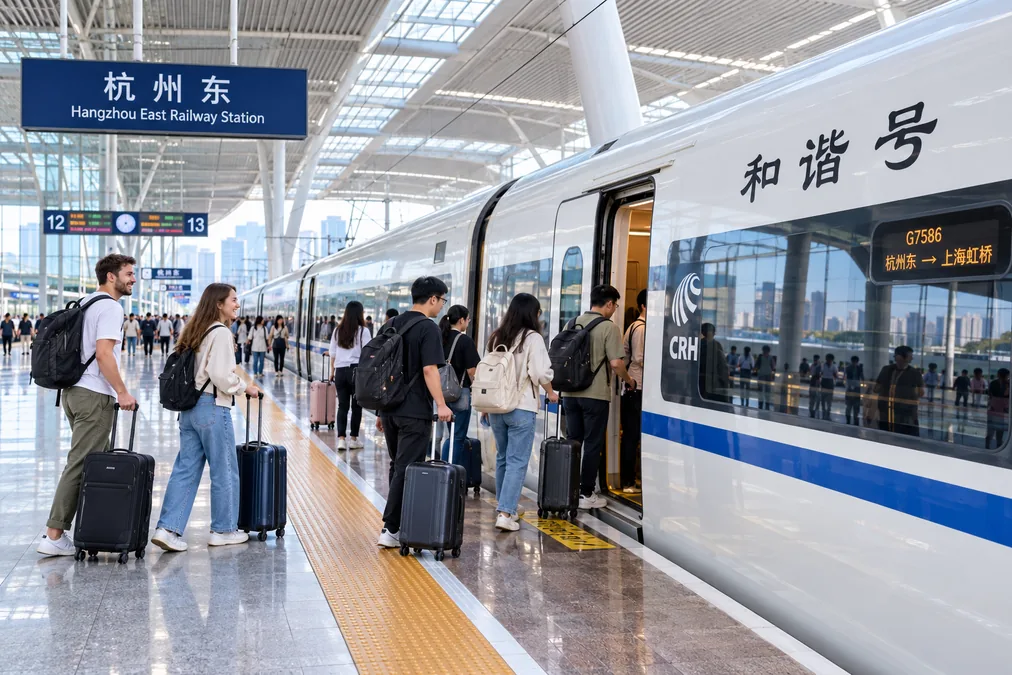
Start in Shanghai, where most flights land: one night to recover, one full day. Then go west to Suzhou, not south to Hangzhou: it is a short hop, about half an hour from Shanghai Hongqiao (虹桥, Hóngqiáo) station, with several trains an hour. From Suzhou the water towns are the next step south, and this is where the train fails you: Suzhou Station has only about three trains a day to Tongxiang (桐乡, Tóngxiāng, Wuzhen's station), all routed the long way round and taking an hour and a half to two hours, while the direct coach takes about an hour and a half. From the water town onwards the train works again: Tongxiang to Hangzhou East is under 40 minutes, and Hangzhou East to Shanghai Hongqiao about an hour with several trains an hour. Schedules change with each seasonal adjustment, so check China Railway's 12306 site for your date.
Loop or open-jaw (flying into Shanghai and out of Hangzhou) both work. Hangzhou has its own airport, and Hongqiao station shares a complex with Hongqiao Airport, so it is the easiest ending if your flight leaves from Hongqiao. Most international flights use Pudong, across the city, so allow extra time for that transfer.
With three or four days, cut a city, not the water town: the water-town night is what you cannot get on a day trip, while Suzhou and Hangzhou can each be done from Shanghai another time (see day trips from Shanghai). Four days: Shanghai (two nights) → Wuzhen (one) → Hangzhou (one) → out; Shanghai Hongqiao to Tongxiang is a direct train of about 35 to 50 minutes. Three days: Shanghai plus either a Suzhou day trip or one Wuzhen night. Nanjing is a separate trip (see our Nanjing guide).
Which water town: Wuzhen, Xitang, Zhouzhuang, Tongli or Zhujiajiao
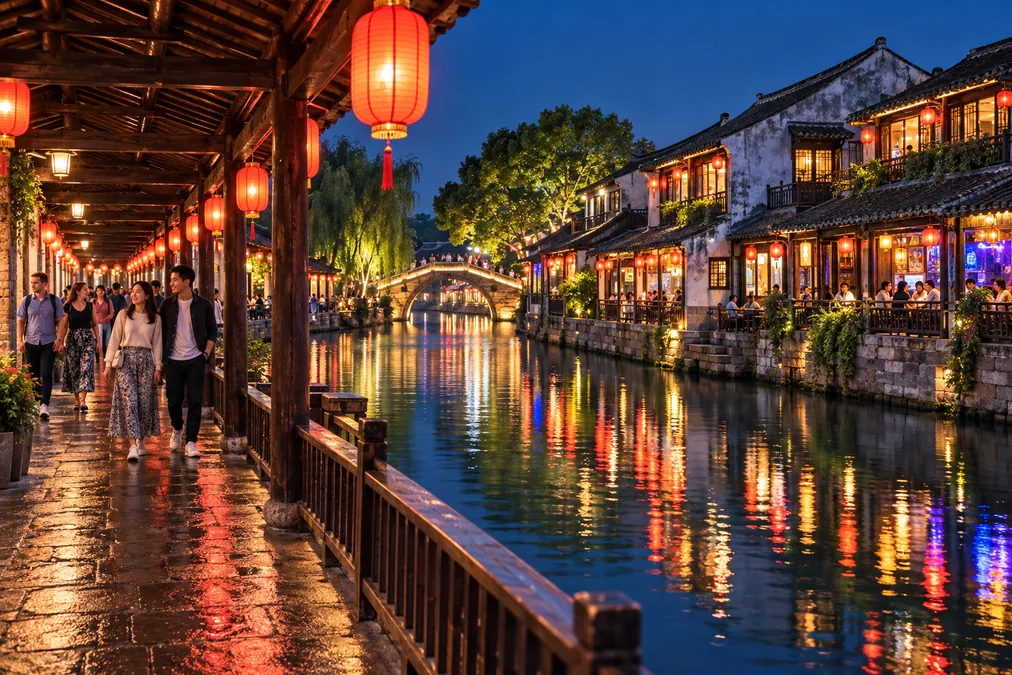
For one night on this route, pick Wuzhen's West Scenic Zone (西栅, Xīzhà, "West Zone") unless you have a reason not to. It is the most managed of the towns: restored canal houses under one operator, lit bridges and waterways after dark, open 9:00 to 22:00, with overnight guests free to come and go outside those hours too. Since 16 March 2025, guests of hotels and guesthouses inside the West Zone (except the Shuixiang Youth Hostel) get the West Zone ticket free for each registered guest, while for everyone else the ticket is single-entry for the day. That rule is the decision: book a bed inside the zone and the ticket question goes away. Book on the official ewuzhen.com, which takes full payment in advance, or on the big hotel sites; either way, check that the booking says the West Zone ticket is included. The East Scenic Zone (东栅, Dōngzhà, "East Zone") is the older-looking daytime half with its own ticket, open 7:00 to 18:00 in summer and 7:00 to 17:30 in winter, linked by a free shuttle about every 20 minutes. Wuzhen suits people who want the evening done well and do not mind that it feels like a resort.
Xitang (西塘, Xītáng) is for people who want a town that is still lived in and open at all hours, with a later, louder night. One ticket covers the whole town and 12 small sights, and once your face is registered at the gate you can leave and come back all day. Unlike Wuzhen, Xitang's ticket is not tied to your room; ask your inn how re-entry works after ticket hours. Near Suzhou: Zhouzhuang (周庄, Zhōuzhuāng) was the first developed for tourism and draws the biggest day-trip crowds, and its operator has announced a ticket valid for three consecutive days; Tongli (同里, Tónglǐ) is the quiet one on the Suzhou metro, so it slots into a Suzhou day rather than replacing the Wuzhen night; Luzhi (甪直, Lùzhí) is smaller still, with free streets and a small combined ticket for its paid halls. Zhujiajiao (朱家角, Zhūjiājiǎo) is the no-ticket option from Shanghai, free to enter with its own stop on Shanghai Metro Line 17.
| Town | Ticket | Hours | Overnight & re-entry |
|---|---|---|---|
| Wuzhen | West Zone ¥150 · East Zone ¥110 · combined ¥190 | West Zone 09:00–22:00 · East Zone 07:00–18:00 summer / 07:00–17:30 winter (boats 08:00–17:00) | A day ticket is one entry that day. Hotel guests get a re-entry pass (room card + ID); since Mar 16, 2025, guests of West Zone hotels and guesthouses (except the Shuixiang Youth Hostel) get West Zone admission free |
| Xitang | ¥95 all-inclusive day ticket (12 sites) · night ticket ¥60 (3 sites) | No fixed closing for the ticketed sites; the night ticket is valid until 24:00 that day (2022 FAQ — confirm on site) | No booking, buy at the gate; your face is registered at entry and you can re-enter all day. Tickets are non-refundable; boats are extra |
| Zhouzhuang | ¥80 (valid 3 consecutive days, since Jul 9, 2026) · full price ¥100 · half price ¥50 | — | The ¥80 ticket covers three consecutive days, so an overnight is included — register in person when buying. The ¥100 lifetime pass needs a Chinese ID card |
| Tongli | ¥100 same day · ¥80 booked at least 1 day ahead · student / senior ¥50 | — | The ticket allows re-entry the same day (official FAQ). Advance tickets are scanned with a Chinese ID card — passport holders buy the same-day ticket at the window |
| Luzhi | Streets free · combined ticket ¥52 for the 6 paid sites · boat ¥150 (up to 6) / ¥240 (up to 8) per boat | 08:30–17:00 for the ticketed sites, ticket sales to 16:30; the streets are open all day | — |
For Wuzhen, buy the West Zone ticket only unless you want a morning in the East: the combined ticket is 190 yuan against 150 for the West alone. A shared boat inside the West Zone is 60 yuan per person one way, so it is a treat, not transport. For Xitang, the ticket office runs 8:00 to 17:00 on normal days and to 22:00 on major public holidays, while the streets never close; the evening ticket is about 60 yuan, so confirm the current price and hours at the gate. Zhouzhuang is open 8:00 to 21:00, main halls included, according to the operator's announcement. Tongli keeps daytime hours and its gardens close in the late afternoon; check on arrival.
Getting between the stops: which legs have a train and which do not
Train at both ends, coach or train-plus-bus in the middle. Times and train counts below change with each seasonal timetable; check 12306 for your date.
Shanghai → Suzhou
Book to Suzhou Station (苏州站, Sūzhōu Zhàn), not Suzhou North: Suzhou Station sits on the northern edge of the old town with Metro Lines 2 and 4 underneath, while Suzhou North is about 10 km out and needs another half hour on Line 2. Trains are frequent enough to buy on the day, holidays excepted.
Suzhou → Wuzhen or Xitang: the leg with no good train
Neither Tongxiang nor Jiashan South has a convenient train from Suzhou, so you have three choices:
- Direct coach, the main route. Coaches run between Wuzhen's West Zone and the Suzhou Tourist Distribution Center (苏州旅游集散中心) about eight times a day taking around 90 minutes, and between Wuzhen bus station (乌镇汽车站) and the coach station on the north square of Suzhou Station (苏州站北广场汽车客运站) about six times a day. Departure times change, so confirm when you buy; fares are a few tens of yuan, so check the price when booking. Wuzhen's official transport page (Chinese) lists current departures. For Xitang, coaches run from the Suzhou Coach Center (苏州客运中心) to Xitang bus station; check times locally.
- Train via Shanghai Hongqiao. Suzhou to Hongqiao, then Hongqiao to Tongxiang, about 35 to 50 minutes and roughly 20 trains a day, or Hongqiao to Jiashan South, about 25 to 35 minutes and about a dozen a day. A backtrack, but all rail and frequent.
- Taxi or DiDi, the ride-hailing app. About 100 km by road. Expect a fare in the low hundreds of yuan and get the app's quote first; it pays off for three or four people with luggage.
Tongxiang station ↔ Wuzhen
Bus K282 runs between Tongxiang station and Wuzhen bus station roughly 6:00 to 17:00, about every 30 minutes; it does not reach the West Zone gate, so at Wuzhen bus station you change to bus K350 by day or night bus 010 after dark, and night buses 009 and 006 make a few evening departures from the West Zone back to the station. It is a city-bus fare; allow up to an hour, or take a taxi from the station if you have luggage, and check the board for current times.
Jiashan South ↔ Xitang
Bus K222 or the tourist direct line goes from Jiashan South to Xitang's car park 1 for about 2 to 5 yuan, but buses are infrequent, so with luggage take a taxi, 20 to 30 minutes for about 40 to 60 yuan; Xitang's official transport guide (Chinese) lists the bus links and coach routes. Do not book to "Jiashan" without the "South": Jiashan Station is the old conventional-rail stop with few or no direct trains from Shanghai. Leaving for Hangzhou, go back to Jiashan South for a train to Hangzhou East: about 30 to 45 minutes, some 20 a day, with the last trains around 21:30 to 22:00, so check.
Wuzhen → Hangzhou
Coach: from the West Zone to central Hangzhou via the coach terminal beside Hangzhou East station, about 13 a day taking around two hours, or from Wuzhen bus station to the Hangzhou Coach Center (杭州客运中心, Jiubao), about 22 a day in about 80 minutes. Train: K282 or a taxi back to Tongxiang, then Tongxiang to Hangzhou East, about 17 to 35 minutes and some 30 trains a day; book to Hangzhou East (杭州东站, Hángzhōu Dōng Zhàn), not Hangzhou Station, which has few or no direct trains to Tongxiang.
Hangzhou → Shanghai
Hangzhou East to Shanghai Hongqiao is 45 to 60 minutes on a direct train, with several trains an hour and second-class fares of roughly 57 to 87 yuan depending on the train. Hangzhou has three stations, so read the name before you pay: Hangzhou East (the main hub, six stops on Metro Line 1 from West Lake) or Hangzhou Station (城站, Chéngzhàn, two stops from the lake), not Hangzhou West, far out in Yuhang. If you arrive late, our Hangzhou metro last-train times show whether Line 1 is still running.
Booking the trains
Every train ticket is real-name, and China Railway's official 12306 website and app accept foreign passports. At the station, passport holders use the staffed channel rather than the automatic gates. Sales open 15 days ahead, counting the travel day. The full walkthrough is in our train booking guide, or book the same trains in English on Trip.com.
The Suzhou stop
One full day covers the core: the Humble Administrator's Garden (拙政园, Zhuōzhèng Yuán) and the Lion Grove Garden (狮子林, Shīzi Lín) in the morning, the Suzhou Museum next door, then Pingjiang Road (平江路, Píngjiāng Lù), a free canal-side street whose north end touches the Humble Administrator's Garden, for the late afternoon. The two gardens and the museum share the Line 6 station (拙政园苏博, Zhuōzhèngyuán Sūbó). Two bookings matter. The Humble Administrator's Garden, Lion Grove and Lingering Garden are Suzhou's three real-name gardens, bookable online with a passport or at the gate, but online slots run out in peak season, so book a few days ahead. The Suzhou Museum's main building is reservation-only, up to seven days ahead, and closed on Mondays; if it is full, the museum's West Hall, across town at Shizishan on Metro Lines 1 and 3, is free and walk-in. Everything else is in our Suzhou guide.
The Hangzhou stop
Two days: one for West Lake (西湖, Xī Hú), one for the hills. West Lake is free and has no gates, so day one is a walk or a boat along whichever shore you choose. Day two is Lingyin Temple (灵隐寺, Língyǐn Sì) and the Longjing (龙井, Lóngjǐng, "Dragon Well") tea village in the same hills. Lingyin has been free since 1 December 2025 but needs a real-name reservation at least one day ahead in the official mini-program, which accepts passports. Make it a weekday: on weekends and public holidays from 8:00 to 17:00 taxis cannot enter the Lingyin area and you are dropped at a transfer point for a shuttle bus. Longjing village is open all day and free. For the Hangzhou and Shanghai legs, the WaysChina app has offline metro maps and a planner that puts your sights in order for the day; it does not cover Suzhou or the water towns. The rest is in our Hangzhou guide.
Luggage, peak season and budget
Luggage
Each adult can bring 20 kg free on the train, and on high-speed services each piece must total no more than 130 cm in length, width and height combined; power banks must be 100 Wh or under. The real problem is the water town: stone lanes, humpback bridges with steps, no cars. In Wuzhen the East Zone visitor centre stores luggage and the West Zone visitor centre forwards it; after checkout your inn can send bags to the West Zone luggage room for you to collect on the way out, and wheeled suitcases are allowed in. Check-in is from 15:00 and checkout by 12:00. Elsewhere, pack a bag you can carry up a flight of stairs. The rail rules in full are in our luggage guide.
Peak season, weekends and Golden Week
The national holidays around Chinese New Year (January or February), 1 May and 1 October, plus the spring and autumn weekends, are when this route strains. Book the Wuzhen West Zone room first, since that room is what makes the ticket free. Xitang extends ticketing to 22:00 on major public holidays and can switch to one-way foot traffic when crowds peak. Suzhou's real-name gardens sell out online in peak season, so book before you arrive. If your dates fall in Golden Week, read our Golden Week guide before you book anything, and put the water-town night on a weekday if you can.
Budget: what the tickets add up to
Wuzhen West alone is 150 yuan, or 190 for both zones; Xitang is 95; Zhouzhuang's three-day ticket is 80. So the water-town ticket runs from 80 to 190 yuan, and nothing at all if you sleep inside Wuzhen West. In Suzhou, the Humble Administrator's Garden is 80 yuan in peak months (April, May and July to October) and 70 otherwise. Hangzhou is nearly free: West Lake and Lingyin cost nothing. Trains: Shanghai to Hangzhou second class is about 57 to 87 yuan; the Wuzhen to Shanghai South (上海南站) coach is about 55 yuan; the other coach and short train legs are a few tens of yuan each, so check the fare when you book. Added up, a five-day loop's tickets and intercity transport come to a few hundred yuan per person before hotels. Hotels are where the budget moves, and the one choice that matters is Wuzhen: inside the West Zone (ticket included, evening access) or outside in the new town (cheaper, but you pay for a single-entry day ticket and lose the late-night and early-morning hours). Compare them on Trip.com. For food and local transport, see our budget guide.
5-day and 7-day itineraries
Both assume you land in Shanghai. To swap Wuzhen for Xitang, replace Tongxiang with Jiashan South and bus K282 with bus K222.
5 days: Shanghai 1.5, Suzhou 1, Wuzhen 1, Hangzhou 1.5
- Day 1, Shanghai. Arrive, drop bags, walk the Bund at dusk. Night: Shanghai.
- Day 2, Shanghai then Suzhou. Morning in Shanghai (one district from our Shanghai guide). Afternoon train Hongqiao → Suzhou Station. Evening on Pingjiang Road. Night: Suzhou.
- Day 3, Suzhou gardens then Wuzhen. Humble Administrator's Garden and Lion Grove at opening, booked ahead, then the Suzhou Museum. Early-afternoon coach from the Suzhou Tourist Distribution Center to Wuzhen West Zone. Check in from 15:00, then the West Zone after dark. Night: Wuzhen West Zone.
- Day 4, Wuzhen morning then Hangzhou. The canals before the day visitors arrive. Bus or taxi to Tongxiang, train to Hangzhou East, Metro Line 1 to the lake. Night: Hangzhou.
- Day 5, Hangzhou then out. Lingyin, reserved the day before, and Longjing in the morning. Afternoon train Hangzhou East → Shanghai Hongqiao, then across the city if your flight is from Pudong, or a flight from Hangzhou.
7 days: Shanghai 2, Suzhou 2 with Tongli, Wuzhen 1, Hangzhou 2
- Day 1, Shanghai. Arrive, the Bund at dusk. Night: Shanghai.
- Day 2, Shanghai. A full day from our Shanghai itinerary. Night: Shanghai.
- Day 3, Suzhou. Morning train Hongqiao → Suzhou Station. Gardens and the museum, Pingjiang Road in the evening. Night: Suzhou.
- Day 4, Tongli from Suzhou. Metro Line 4 to Tongli station, then the T1 tram or bus 725 to the old town, with a tram about every 20 minutes. Tickets are 100 yuan on the day or 80 booked a day ahead, but the advance ticket is scanned with a Chinese ID card, so with a passport plan on the same-day price. Zhouzhuang instead: coach from Suzhou's bus stations or roughly an hour by taxi, confirm locally. Night: Suzhou.
- Day 5, Wuzhen. Morning coach from the Suzhou Tourist Distribution Center to the West Zone. Bags to the visitor centre or your inn, the East Zone by free shuttle in the afternoon, the West Zone at night. Night: Wuzhen West Zone.
- Day 6, Hangzhou. Early canals, then Tongxiang → Hangzhou East. Afternoon and sunset around West Lake. Night: Hangzhou.
- Day 7, Hangzhou then out. Lingyin and Longjing, then an evening train to Shanghai (add the crossing to Pudong if you fly from there) or a flight from Hangzhou.
If this is the last week of a longer trip, arrive into Shanghai from Beijing or Xi'an and run it as above; see our Beijing–Xi'an–Shanghai route and 7-day China itinerary.
Frequently asked questions
Wuzhen or Xitang, if you can only do one?
Wuzhen West for a water-town night done for you: lit until 22:00, and sleeping inside gives each registered guest a free West Zone ticket. Xitang if you want a lived-in town that never closes, one ticket with same-day re-entry by face scan, a later and louder evening, and the shortest rail hop from Shanghai; unlike Wuzhen, its ticket is not tied to your room, so ask your inn how re-entry works after ticket hours. Doing both is possible: a G3 shuttle and a coach link the two towns a few times a day, about an hour's ride.
How do you get from Suzhou to Wuzhen?
Not by a direct train: the few trains from Suzhou to Tongxiang go the long way round and take an hour and a half or more. Take the direct coach from the Suzhou Tourist Distribution Center to the West Zone, or from the north square of Suzhou Station to Wuzhen bus station, several times a day in around 90 minutes. Or ride the train to Shanghai Hongqiao and on to Tongxiang, then bus K282 or a taxi into Wuzhen.
Is four days enough for the Jiangnan loop?
Yes, if you cut one city. The version that loses least is Shanghai (two nights) → Wuzhen (one night) → Hangzhou (one night), because Shanghai to Tongxiang and Tongxiang to Hangzhou East are both direct trains. Cut Hangzhou instead if gardens matter more to you than the lake: Shanghai → Suzhou → Wuzhen → back to Shanghai by coach, about 90 minutes to Shanghai South. All four stops in four days means most of every day on the move.
Is a water town worth an overnight?
Wuzhen West, yes: the day-trip crowds leave around dinner, the zone stays lit until 22:00 and reopens at 9:00, with overnight guests free to walk the canals in between, and the room covers the ticket. Xitang is worth a night for the evening, but its ticket is not tied to your room, so ask your inn how re-entry works after ticket hours. Tongli, Luzhi and Zhujiajiao are half-day trips, back in the city for dinner.
Last updated: September 2026
Read in other languages
Last train times for 10 Chinese metro systems
Every line and station, checked by hand — the same data behind our offline route planner.
Get the WaysChina App
Offline guides, currency converter, essential phrases, and more — all in your pocket.

Related Articles
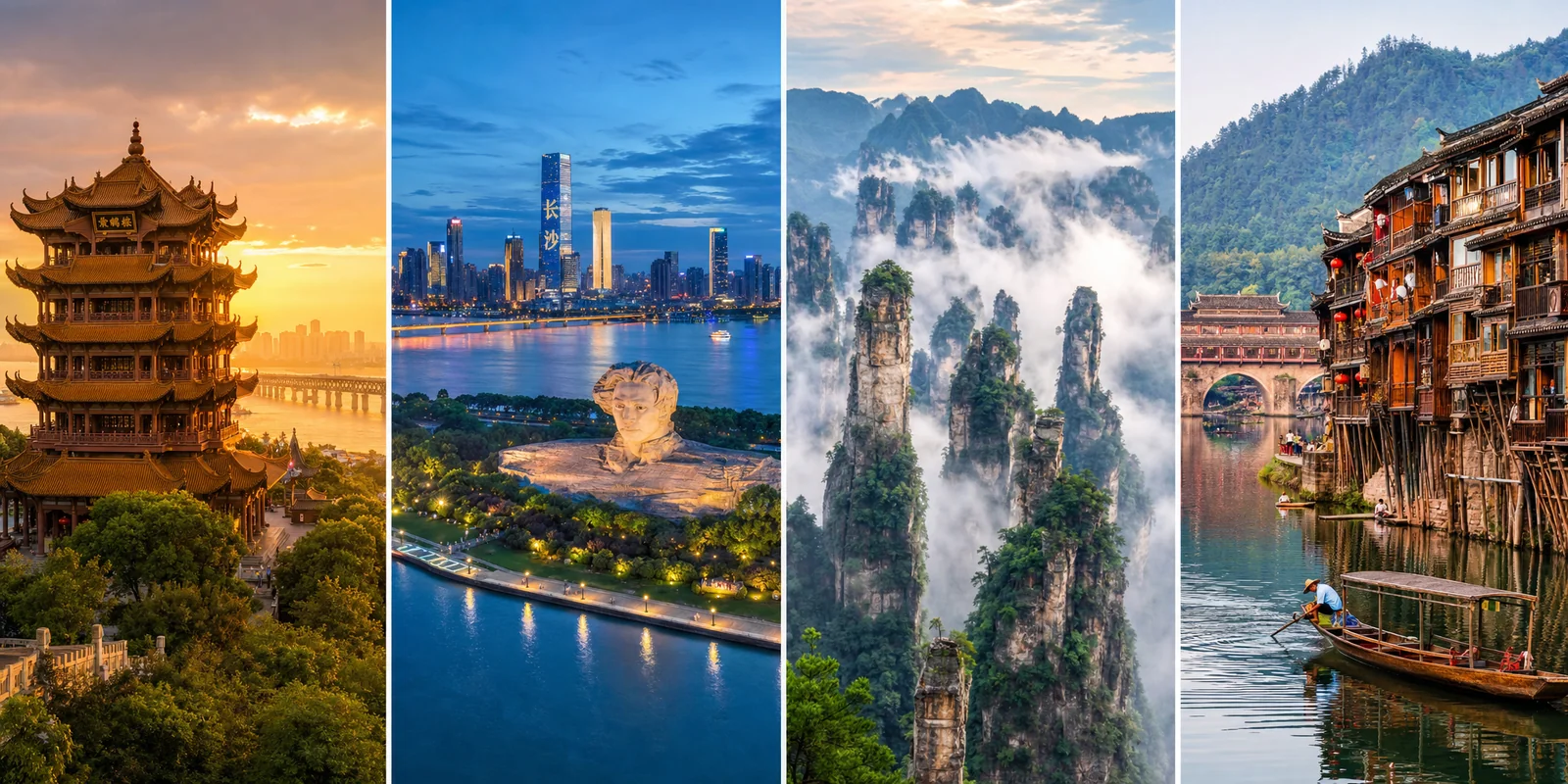
Central China Route: Wuhan-Changsha-Zhangjiajie
A practical 7-8 day Central China itinerary linking Wuhan, Changsha, Zhangjiajie, and Fenghuang by high-speed rail,...

Northeast China Route: Harbin-Changbaishan-Dalian
A 7-8 day route through Northeast China linking Harbin, Changbaishan, and Dalian, with separate winter and summer...
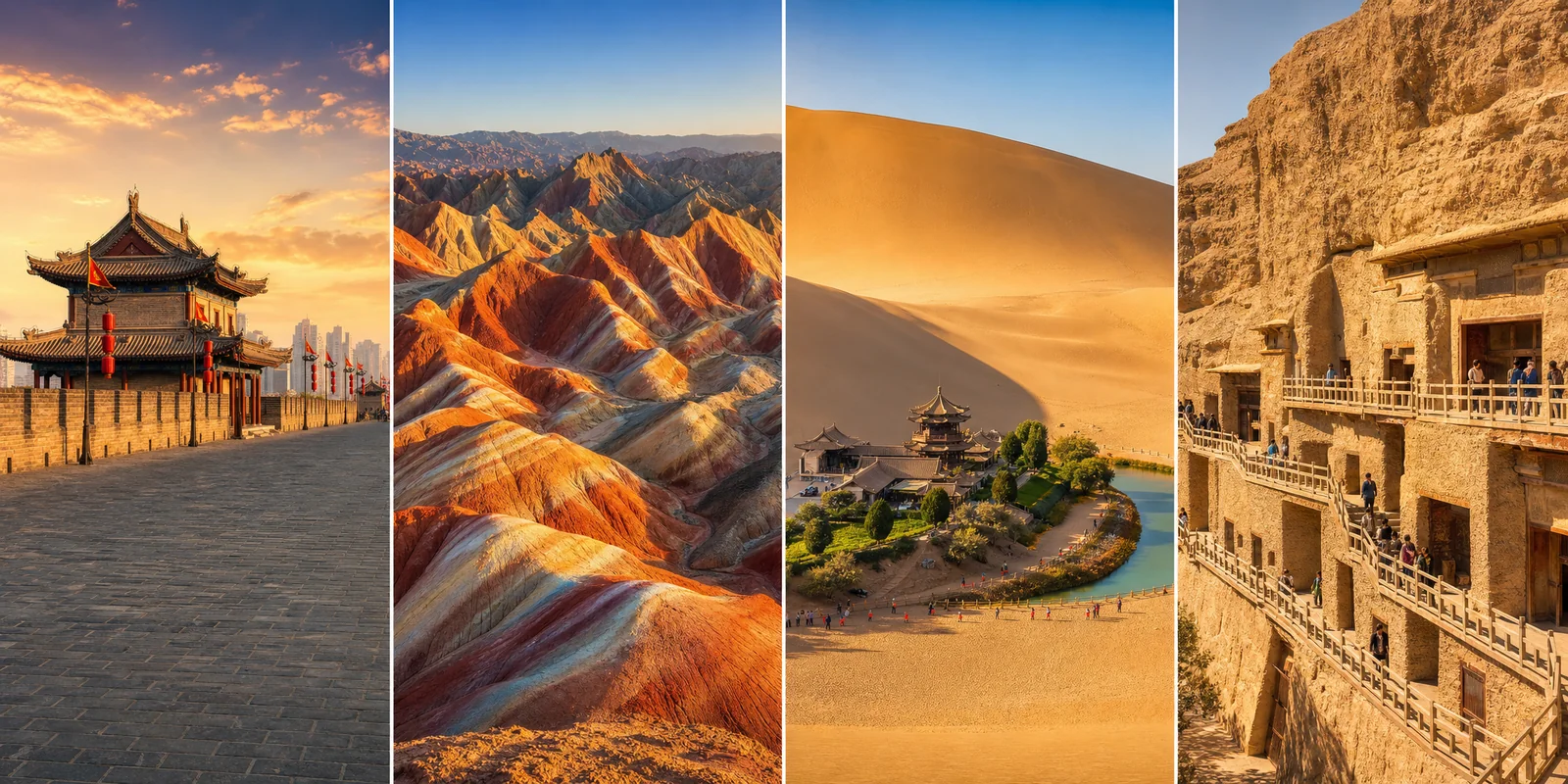
Silk Road Route: Xi'an to Dunhuang
A practical 7-8 day Silk Road itinerary from Xi'an through Lanzhou and Zhangye to Dunhuang, with day-by-day plans,...
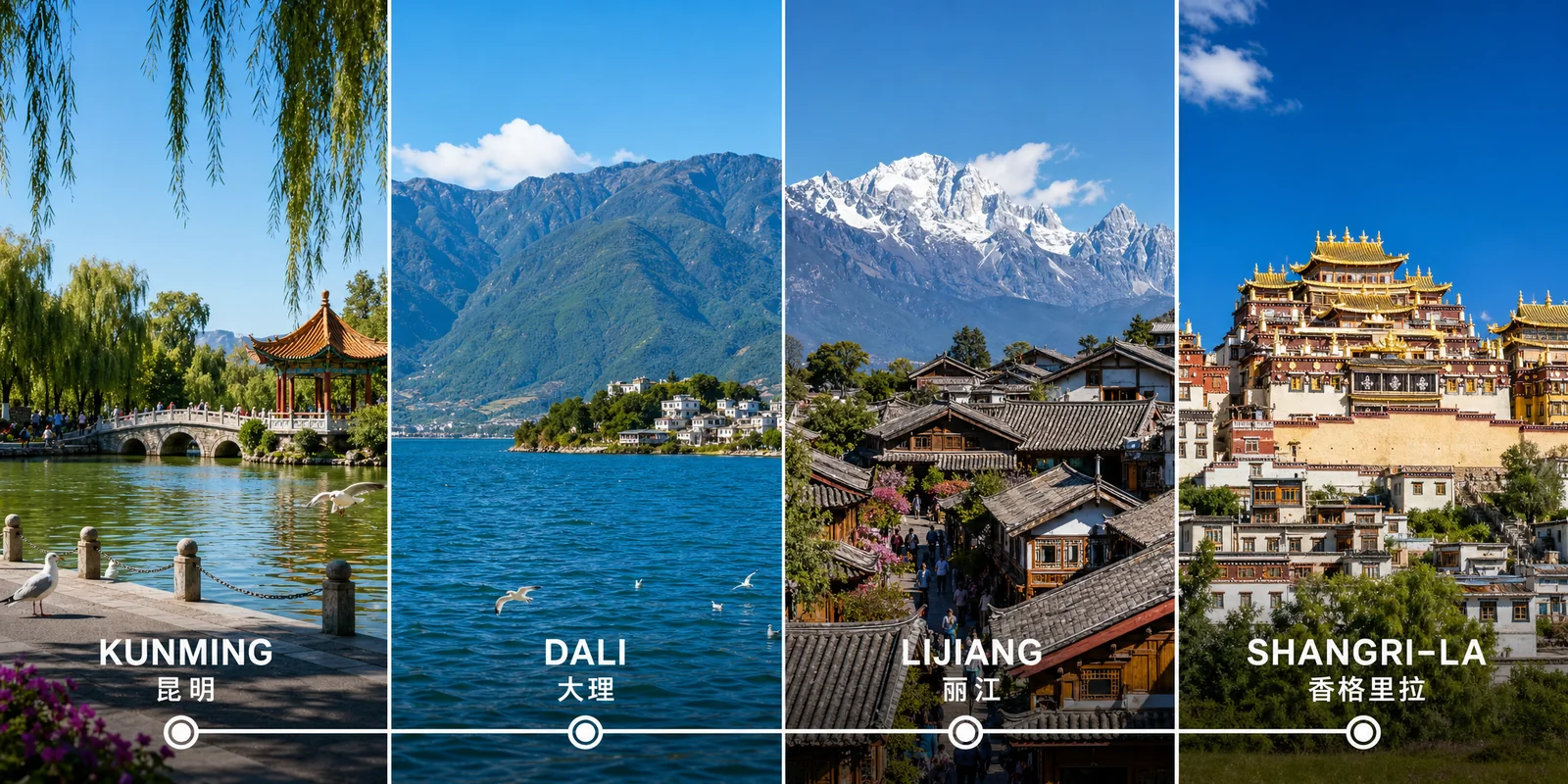
Yunnan Circuit: Kunming-Dali-Lijiang-Shangri-La
A practical 7-10 day Yunnan itinerary covering Kunming, Dali, Lijiang, and Shangri-La — with daily plans, transport...