
Most cultural mistakes travelers make in China are minor, and locals know you're a guest. People won't expect you to get everything right, and small slip-ups get forgiven instantly. But a handful of habits do carry real weight here, and a few gestures or topics can cause genuine discomfort. This guide covers the etiquette that actually matters day to day, from how to hand over a business card to why you shouldn't stick your chopsticks upright in a bowl of rice. The goal isn't to make you anxious. It's to help you read the room and avoid the few mistakes that register.
The Idea Behind Everything: Face and Harmony
Before the specific rules, it helps to understand the two ideas underneath most of them. The first is "face" (面子, miànzi), which roughly means social standing, dignity, and reputation. Causing someone to lose face, such as correcting them publicly, refusing them bluntly, or making them look incompetent in front of others, is the social equivalent of a hard offense. Giving face, by contrast, means showing respect, offering praise, and letting people save dignity even when something goes wrong.
The second idea is a strong preference for keeping things smooth and avoiding open conflict. A direct "no" can feel harsh, so people often soften refusals into "maybe," "it's not very convenient," or "we'll see." If you ask for something and get a vague answer, that's frequently a polite decline. Once these two ideas click, a lot of the specific etiquette stops feeling like arbitrary rules and starts making sense.
Greetings and First Impressions
Greetings in China are generally low-key. A nod, a smile, and a simple "nǐ hǎo" (你好, hello) cover most situations. Handshakes are common in business and formal settings, but they tend to be lighter and briefer than the firm Western grip. Hugs and cheek kisses are not standard between people who've just met, and they can feel intrusive, especially with older people or in professional contexts. When in doubt, follow the other person's lead.
For business or any formal meeting, business cards (名片, míngpiàn) still matter. Present and receive cards with both hands, take a moment to actually look at the card you're given rather than pocketing it immediately, and avoid writing on someone's card in front of them. It's a small ritual, but it signals respect.
Forms of Address
Titles carry weight. Using someone's surname with a title, such as "Manager Wang" or "Teacher Li," is more respectful than jumping straight to a first name. Chinese names put the family name first, so "Wang Wei" has the surname "Wang." With older people, a respectful tone goes a long way, and age is generally treated as something to honor rather than downplay.
Table Manners and Dining
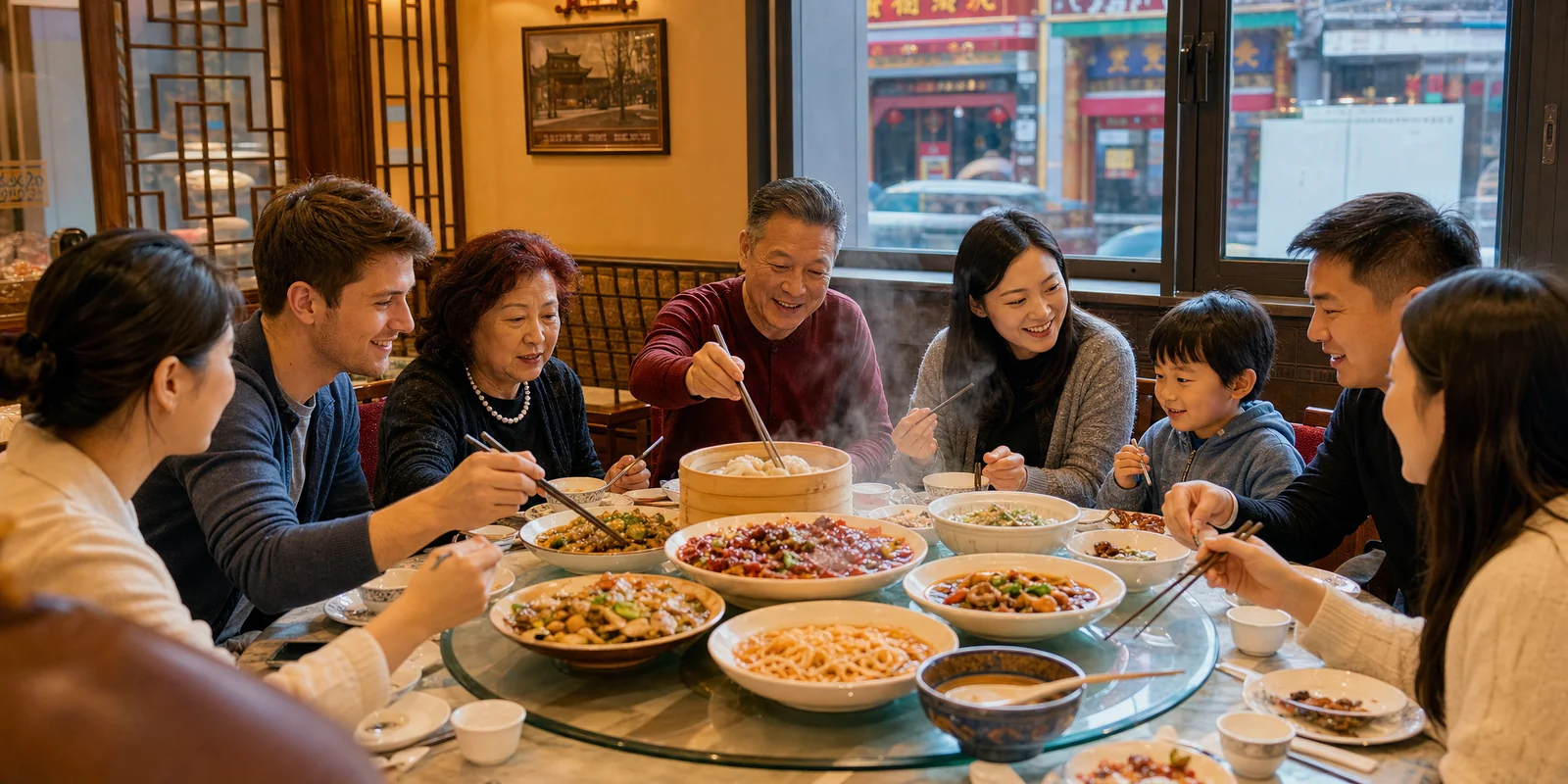
Meals are where most of the visible etiquette lives, and they're also where a relaxed, generous attitude matters more than perfect technique. Chinese dining is communal: dishes are shared in the center of the table, and you take from them with your own chopsticks or with serving utensils when provided.
Chopstick Rules That Actually Matter
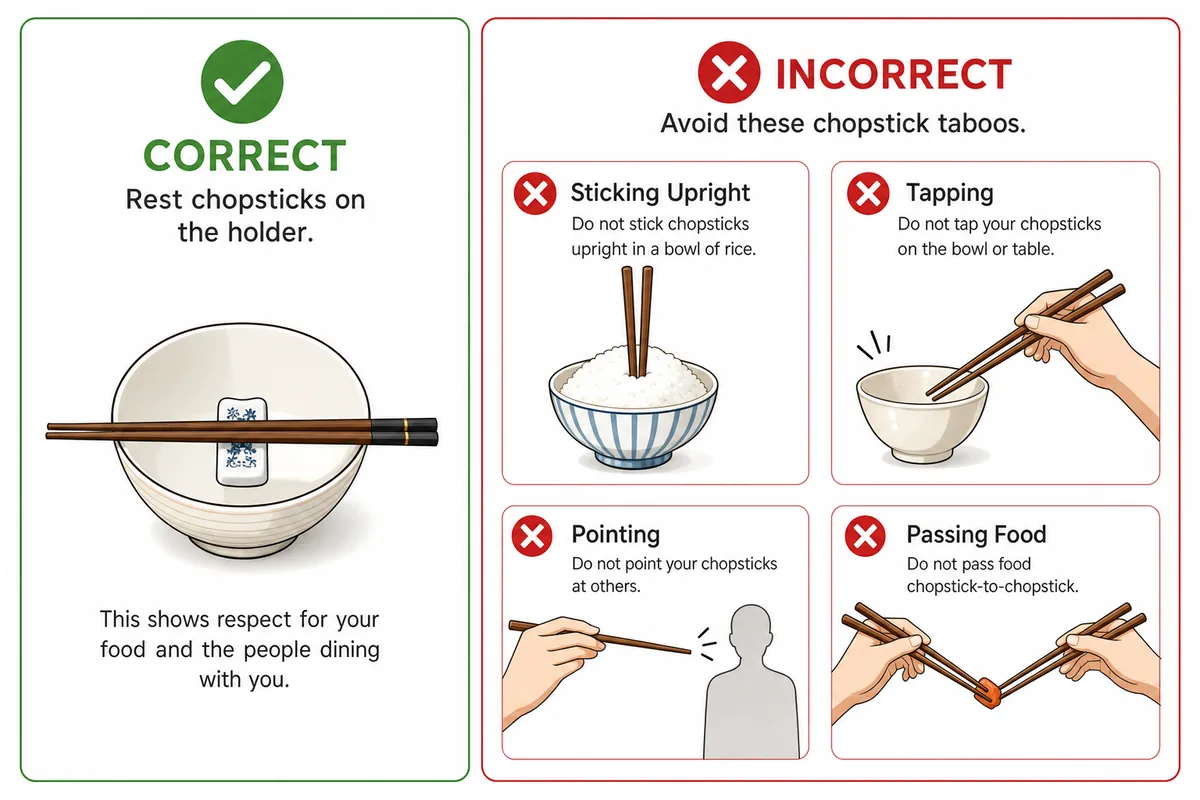
A few chopstick habits are worth avoiding because they carry funeral and death associations:
- Don't stand chopsticks upright in a bowl of rice. This mimics incense sticks burned for the dead and is the single most recognized chopstick taboo. Rest them on a chopstick holder or across the rim of your bowl instead.
- Don't tap your bowl with chopsticks. It's associated with begging.
- Don't use chopsticks to point at people or to spear food.
- Avoid passing food chopstick-to-chopstick with another person. This echoes a funeral ritual involving bones. Use a serving spoon or put food on their plate instead.
Hosting, Toasting, and Paying
If you're invited to a meal, the host usually orders and almost always pays. Offering to split the bill can actually create awkwardness, because hosting is a way of giving face and building the relationship. A polite, light protest is normal theater, but the host will generally insist and win. If you genuinely want to reciprocate, invite them to a meal another time rather than fighting over the check.
Toasting is central to formal and celebratory meals. The word you'll hear is "gānbēi" (干杯), literally "dry the cup," which traditionally means finishing your drink. When toasting someone of higher status or age, lower the rim of your glass below theirs as a sign of respect. If you don't drink alcohol, it's completely acceptable to toast with tea, juice, or water. Just say so up front and no one will push hard.
| At the table | Do | Avoid |
|---|---|---|
| Serving | Take from shared dishes nearest you; offer the best pieces to elders | Reaching across the whole table or digging through dishes |
| Chopsticks | Rest them on a holder or bowl rim | Standing them upright in rice; pointing; tapping bowls |
| Drinking | Toast others, lower your glass for elders | Drinking alone without acknowledging the table |
| Eating pace | Wait for the host or eldest to start | Starting before everyone is seated and signaled |
| Finishing | Leaving a little food can signal you're full and well-fed | In some homes, scraping the plate clean implies you weren't given enough |
Gift Giving
Gifts smooth relationships in China, whether you're visiting someone's home, meeting business contacts, or thanking a host. The thought and the ritual matter more than the price tag. A few conventions are worth knowing.
What to Give
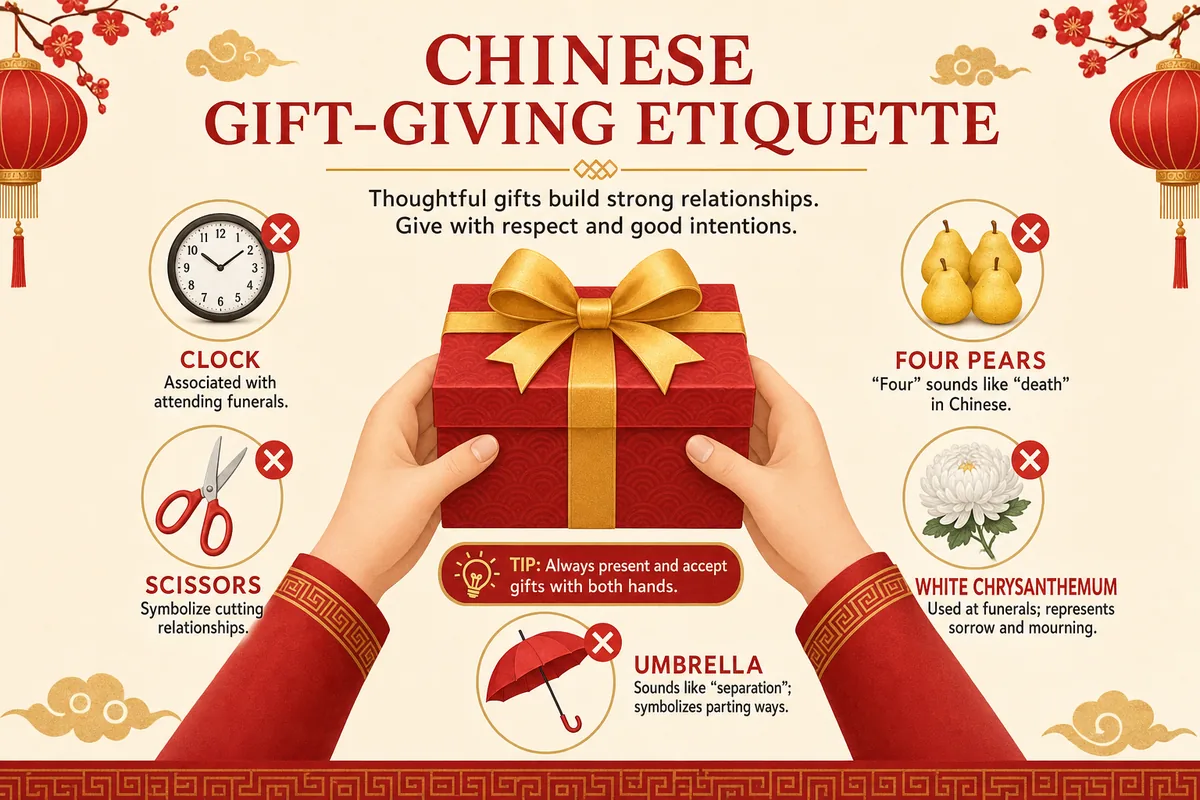
Good general choices include nice tea, quality snacks or fruit, alcohol (if the recipient drinks), or something representative of your home country. If you're visiting a family, a gift for the children or something for the household is well received. Present and receive gifts with both hands.
What to Avoid
Several gifts carry unlucky associations, mostly through wordplay or symbolism:
- Clocks. "To give a clock" (送钟, sòng zhōng) sounds identical to "attending a funeral" (送终). Strongly avoid.
- Sharp objects like knives or scissors, which can symbolize cutting a relationship.
- Pears when given to a couple or partners. "Pear" (梨, lí) sounds like "to separate" (离).
- Umbrellas as gifts, for a similar wordplay reason (伞 sǎn echoes 散, to part).
- White or black wrapping and white flowers (especially chrysanthemums), which are tied to funerals. Red and gold are festive and safe.
- Gifts in sets of four. "Four" (四, sì) sounds like "death" (死, sǐ). Even numbers are generally lucky, with eight (八, bā) being especially auspicious, but four is the exception.
Gestures and Body Language
Most everyday gestures translate fine, but a few are worth knowing.
- Beckoning. To call someone over, face your palm down and wave your fingers toward yourself. The Western palm-up, single-finger "come here" is considered rude and is mainly used for animals.
- Pointing. Pointing at people with a single finger is impolite. Gesture with an open hand instead.
- Feet. Avoid pointing the soles of your feet at people, and don't use your feet to move objects toward someone.
- Public affection. Hand-holding among couples is normal in cities, but heavy public displays of affection are uncommon and draw attention, more so outside big metropolitan areas.
- Personal space and volume. Crowded spaces mean less personal space than many visitors expect, and lively, loud conversation is normal rather than a sign of conflict.
Good news for many travelers: there's no widely offensive equivalent of the middle finger or the "OK" sign that you need to police constantly. The main thing to retrain is the beckoning gesture.
Sensitive Topics and Conversation
Small talk in China can feel surprisingly personal by Western standards. Questions about your age, salary, marital status, and whether you have children are common and usually friendly, not nosy. You don't have to answer precisely; a vague, cheerful response is fine.
On your side, it's wise to steer clear of politically sensitive subjects, especially territorial and sovereignty questions, with people you've just met. These topics can put your conversation partner in an uncomfortable position and rarely lead anywhere good in casual settings. Complaining loudly or being visibly angry in public also lands poorly, since composure is valued and open conflict makes everyone lose face.
Religious and Regional Considerations
China is large and varied, and etiquette shifts with region and setting. A few situations call for extra awareness.
Temples and Religious Sites
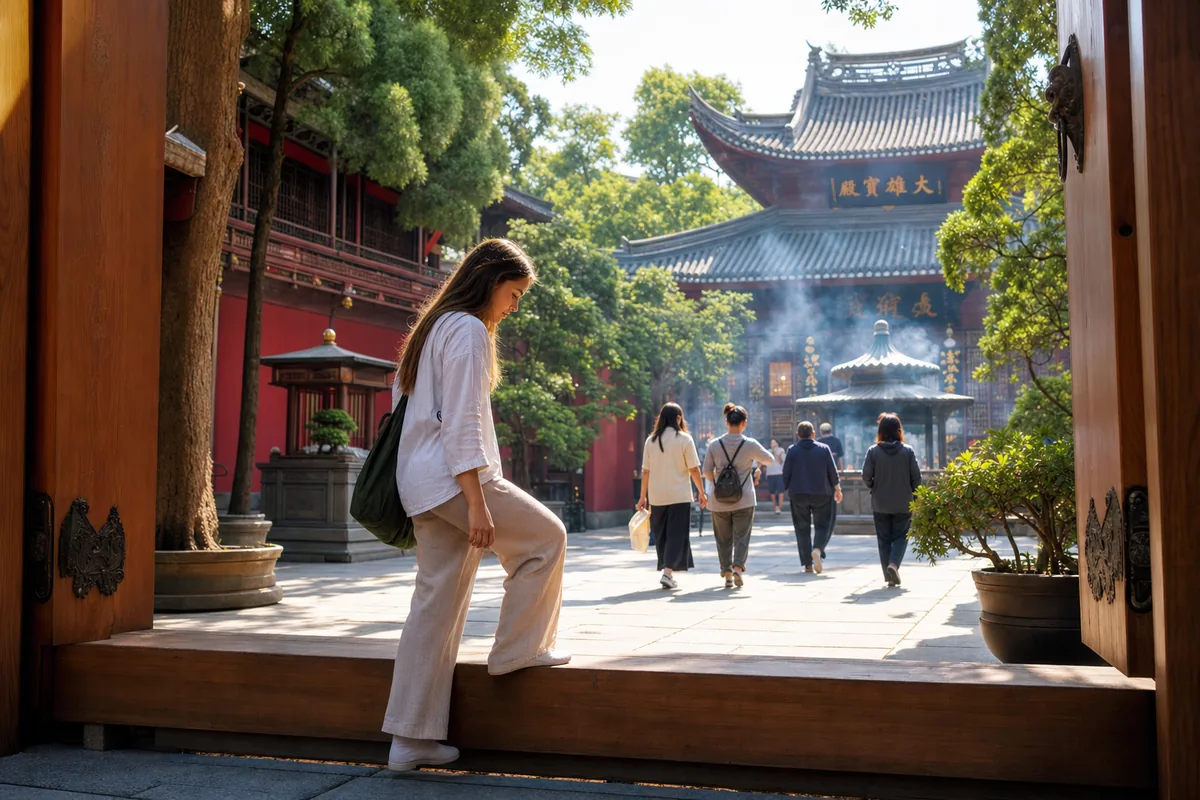
At Buddhist and Taoist temples, dress modestly with shoulders and knees covered. Step over the raised wooden thresholds rather than on them. Ask before photographing monks or worshippers, and look for signs prohibiting photography inside halls, especially of statues. Keep your voice low. When walking around a stupa or sacred object in Tibetan Buddhist areas, the customary direction is clockwise.
Ethnic and Religious Minority Areas
In regions with large Hui or Uyghur Muslim populations, respect halal customs and dress more conservatively. In Tibetan areas, treat prayer flags, mani stones, and religious objects with care, and again ask before photographing people. UNESCO documents many of these cultural and religious sites and their significance; their World Heritage listings for China are a useful starting point for understanding what you're visiting.
City vs. Countryside
Big cities like Shanghai and Beijing are cosmopolitan, and locals are used to foreign visitors and varied behavior. Smaller towns and rural areas are more traditional, so the etiquette here matters a bit more, and modest dress and reserved behavior are appreciated. For broader context on staying respectful and safe as you travel, see our safety tips for travelers.
Tipping and Service
Tipping is not part of mainstream Chinese culture and can even cause confusion in many everyday settings like restaurants, taxis, and local shops. Trying to tip a taxi driver or a noodle shop owner may get politely refused. There are exceptions in tourism, such as private tour guides and drivers, and some upscale international hotels. We cover the full picture, including where tipping is now expected, in our dedicated guide to tipping culture in China.
Practical Etiquette Cheat Sheet
If you only remember a handful of things, make it these:
| Situation | The move |
|---|---|
| Eating rice | Never stand chopsticks upright in the bowl |
| Receiving a card, gift, or tea | Use both hands; look at what you're given |
| Someone refuses your gift | Offer again warmly; first refusal is modesty |
| Calling someone over | Palm down, wave fingers toward you |
| Disagreement in public | Stay calm; avoid making anyone lose face |
| Gift to avoid | Clocks, sharp objects, sets of four, white flowers |
| Toasting an elder | Lower your glass below theirs |
| At a temple | Cover shoulders and knees; ask before photos |
A Few Words on Communication
Even basic Mandarin earns enormous goodwill, and people are quick to forgive accent and grammar. A sincere "xièxie" (谢谢, thank you) and "nǐ hǎo" go a long way. If you want a small kit of phrases that smooth daily interactions, our survival phrases guide covers the essentials. Mandarin etiquette also leans on politeness markers and softeners, so a warm tone often matters more than precise words.
Final Thoughts
Chinese etiquette can look like a long list of rules, but it comes down to two instincts: protect people's dignity, and keep interactions smooth. Get those right and the specifics mostly take care of themselves. The few things genuinely worth memorizing are the upright chopsticks taboo, using both hands for cards and gifts, avoiding clocks and sets of four as gifts, and staying calm rather than confrontational in public. Beyond that, a smile, a bit of effort with the language, and a willingness to follow your host's lead will carry you through almost any situation. Locals notice the effort far more than the occasional mistake. Before you go, it's also worth glancing at a few related basics so the cultural side and the practical side line up.
Last updated: June 2026
Read in other languages
Last train times for 10 Chinese metro systems
Every line and station, checked by hand — the same data behind our offline route planner.
Get the WaysChina App
Offline guides, currency converter, essential phrases, and more — all in your pocket.

Related Articles
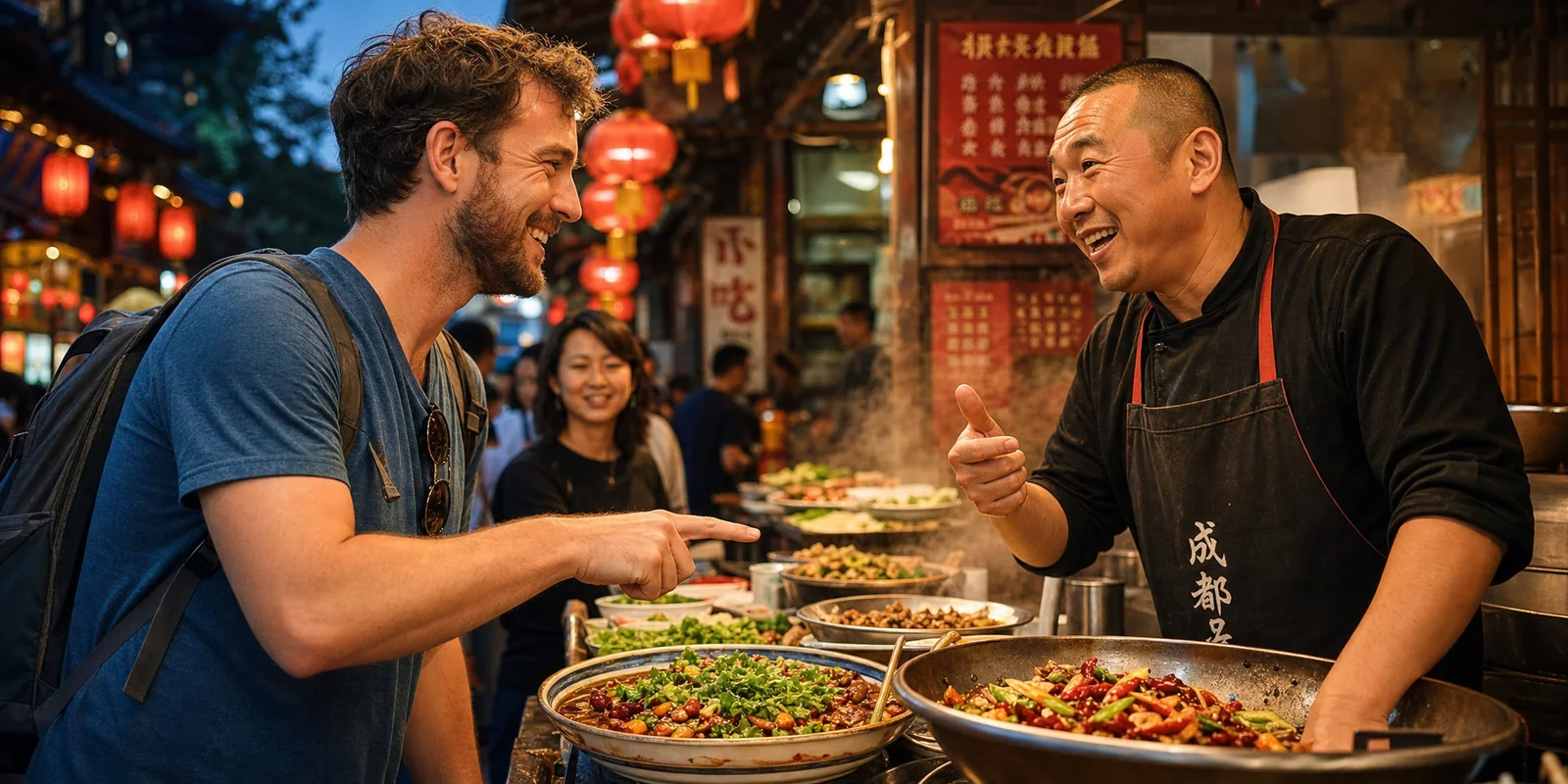
Language Basics: Survival Chinese Phrases for Travelers
You don't need to speak Mandarin to travel China, but a few survival phrases make everything smoother. Here are the...
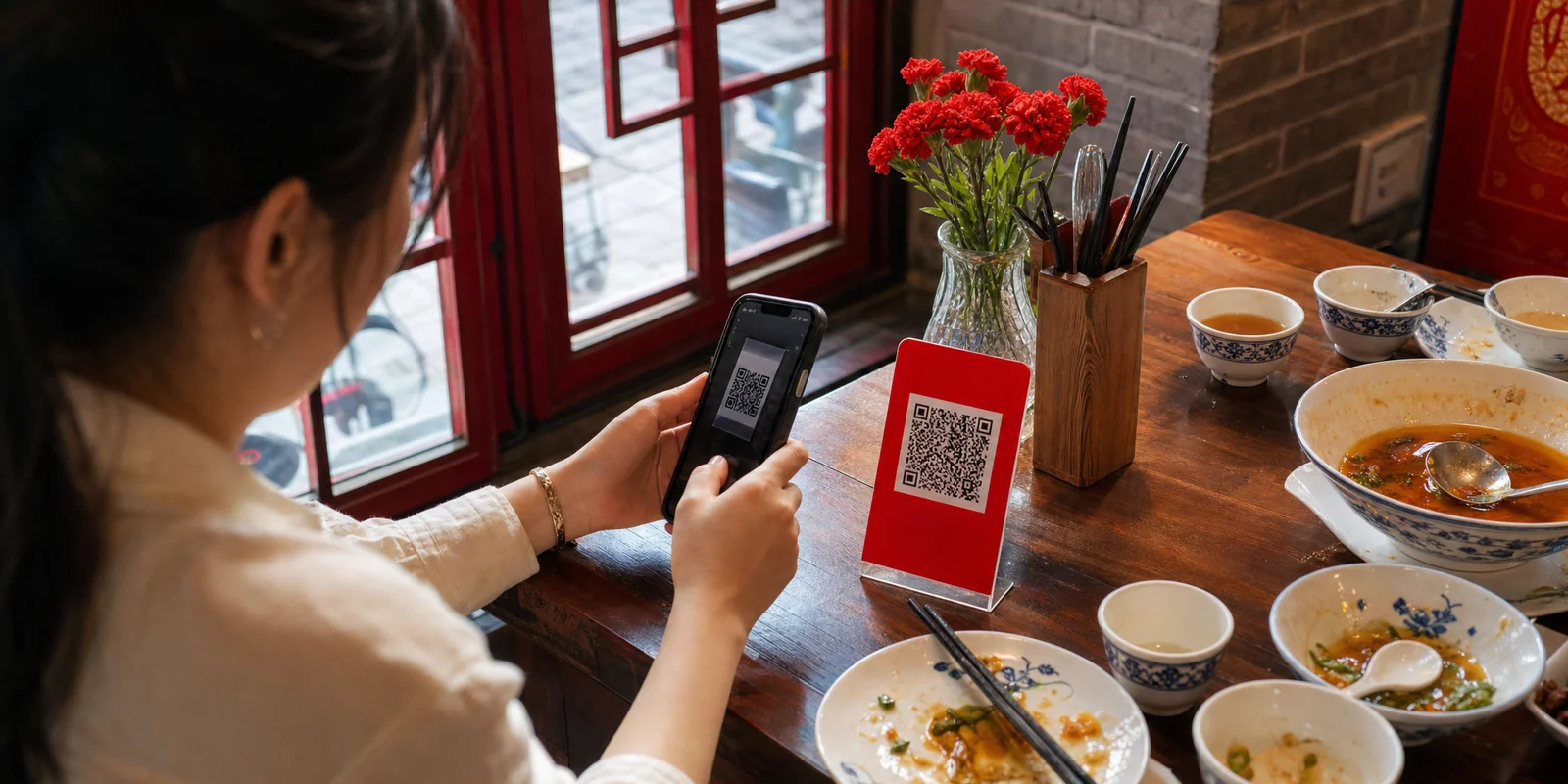
Tipping Culture in China
Tipping is not part of everyday life in China — no one expects it at restaurants, taxis, or hotels. Here's where the...