
This article contains affiliate links. If you make a purchase through these links, we may earn a small commission at no extra cost to you. This helps support our work in creating free travel guides.
Tianjin is the easiest big city to reach from Beijing — the high-speed train takes about 30 minutes, which is shorter than crossing Beijing on the subway. Most travelers come here as a day trip, but the city rewards an overnight stay: a riverfront Ferris wheel, several blocks of preserved European architecture, traditional old streets, and a street-food scene that locals take seriously. This guide covers how to get here, what's actually worth your time, where to eat, and how to fit Tianjin into a Beijing-based trip.
Why Visit Tianjin
Tianjin spent the late 19th and early 20th centuries as a treaty port, which means foreign powers carved out their own districts here. The result is unusual for China: within a short walk you can pass Italian villas, British-style mansions, French cathedrals, and German-era warehouses. Locals call it the "museum of world architecture" (万国建筑博览会, wànguó jiànzhù bólǎnhuì), and it's the main reason the city looks unlike anywhere else in North China.
Beyond the buildings, Tianjin has a relaxed, slightly old-fashioned feel. It's known across China for two things: comedy (the city is the home of xiangsheng, traditional crosstalk comedy) and food. You don't need to understand the comedy to enjoy the food, and the food alone justifies the trip.
How Long to Stay
One full day covers the highlights if you move efficiently. Two days lets you slow down, eat properly, and see the riverfront both in daylight and lit up at night. We'd lean toward an overnight stay if your schedule allows — the European concession areas look much better in the evening, and a same-day return to Beijing means rushing the best part.
Getting to Tianjin
From Beijing by High-Speed Rail
This is how almost everyone arrives. High-speed trains (高铁, gāotiě) run frequently between Beijing South Station (北京南站) and Tianjin Station, with the fastest taking around 30 minutes. Trains depart every few minutes during the day, so you don't need to plan far ahead — though booking the morning before guarantees a seat on the time you want.
Second-class fares run roughly 55–70 RMB each way. You can book through the official 12306 platform or use an English-language booking site if you'd rather avoid the Chinese-only interface. For a quick look at schedules and to lock in tickets in English, Trip Com Train is straightforward.
Three stations matter in Tianjin: Tianjin Station (central, closest to the European concessions and the Tianjin Eye), Tianjin West Station (handles many Beijing trains), and Tianjin South Station (further out). Check which station your train uses before booking, because they're not interchangeable on arrival.
From the Airport
Tianjin has its own airport (Tianjin Binhai International, TSN), but most international visitors fly into Beijing and take the train. If you land at Beijing Daxing (PKX), there's even a direct high-speed connection toward Tianjin. For most itineraries, the Beijing–Tianjin train is the simplest plan.
Getting Around the City
Tianjin has a clean, expanding metro system that reaches most attractions, and fares are cheap. Taxis and ride-hailing (via Didi) are affordable and widely available. The core sightseeing area — the concessions and the riverfront — is walkable once you're there, so you'll mostly use the metro or a taxi to reach the starting point.
Top Things to Do in Tianjin
Italian Concession (Italian Style Town)
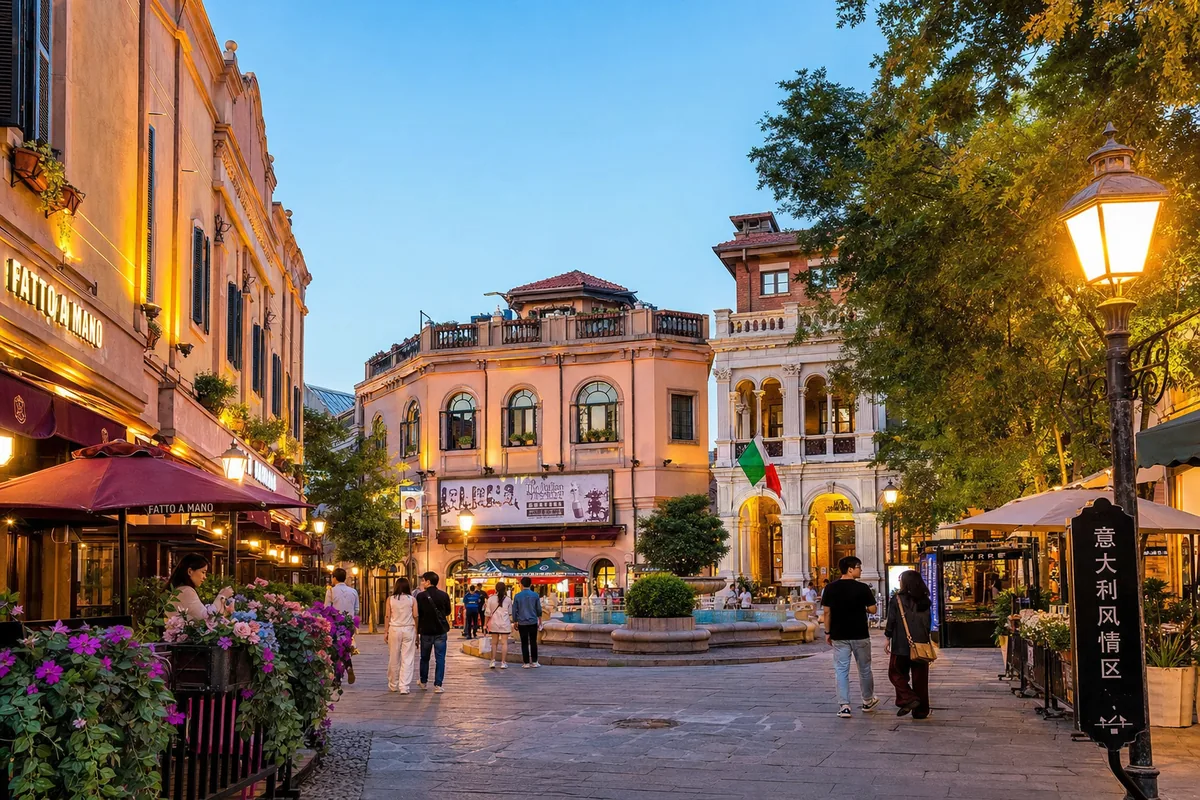
This is the largest preserved Italian-style district outside Italy itself, and it's the most photogenic corner of Tianjin. The streets are lined with restored villas, arched windows, and a central piazza, and the whole area is now full of restaurants, cafés, and bars. It's compact and entirely walkable. Come in the late afternoon, wander the side streets, and stay for dinner as the lights come on. Several Italian and Western restaurants operate here, though prices run higher than elsewhere in the city.
The district sits within easy reach of Tianjin Station — about a 10-minute walk across the river, which makes it a natural first stop if you arrive by train.
Five Great Avenues (Wudadao)
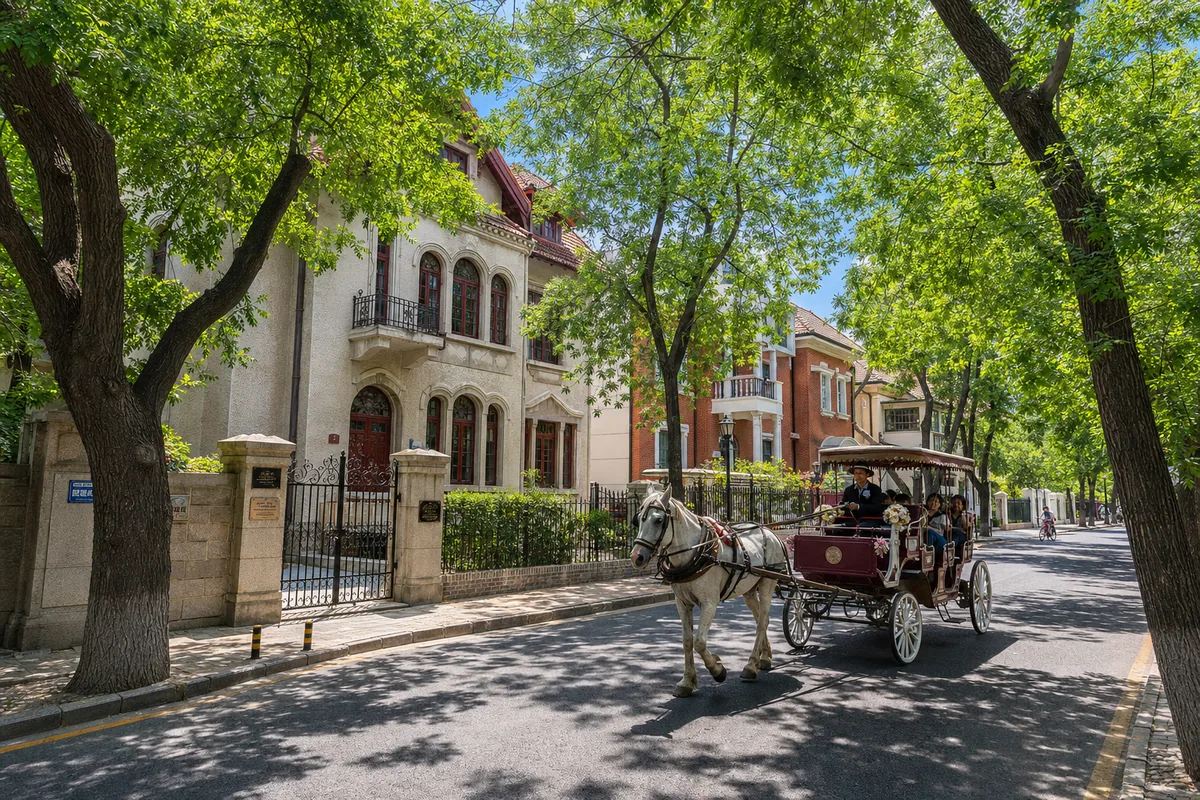
Five Great Avenues (五大道, Wǔdàdào) is a quieter, leafier counterpart to the Italian quarter — five parallel streets lined with more than 2,000 garden villas in British, French, Spanish, and other styles, built when this was the British concession. Many were once homes of warlords, businessmen, and former officials, and a number now carry small plaques telling their stories.
The best way to see it is on foot or by one of the horse-drawn carriages and pedicabs that circle the area. It's a residential neighborhood as much as an attraction, so the pace is slow and pleasant. Budget an hour or two if you enjoy architecture and people-watching.
Tianjin Eye
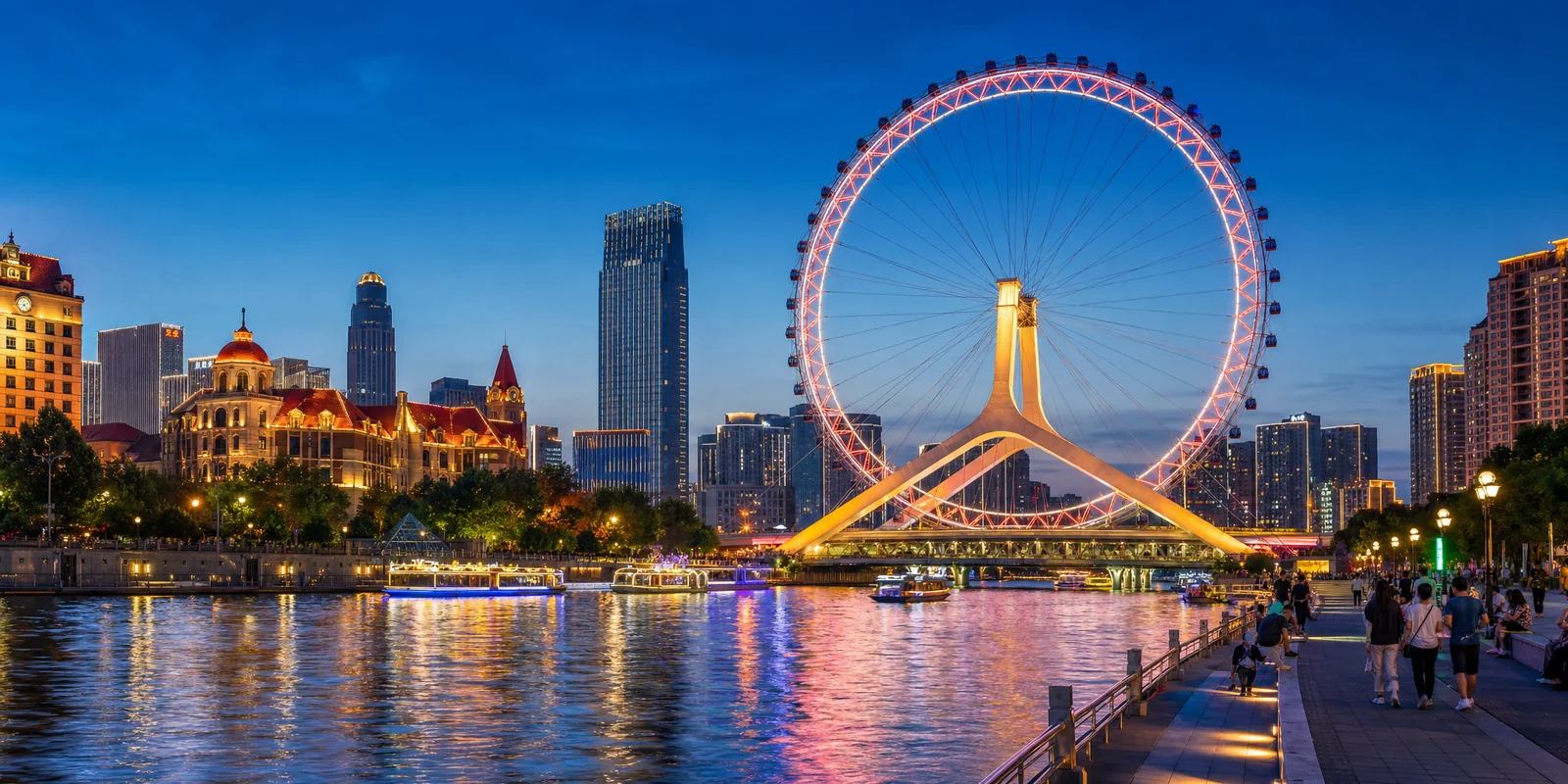
The Tianjin Eye (天津之眼) is a Ferris wheel built directly onto a bridge over the Hai River — one of the few in the world positioned this way. A full rotation takes about 30 minutes, and from the top you can see the river curving through the city and the bridges along it. It's best at dusk or after dark, when the city lights reflect off the water. Tickets cost around 70 RMB. Lines can build up on weekends and holidays, so go on a weekday evening if you can.
Ancient Culture Street (Guwenhua Jie)
For a complete change of mood, Ancient Culture Street (古文化街, Gǔwénhuà Jiē) recreates a traditional Qing-dynasty commercial street, with carved wooden shopfronts selling folk crafts, paper kites, clay figurines, calligraphy supplies, and snacks. It's touristy and can get crowded, but it's a good place to pick up souvenirs and try local sweets. The Tianhou Temple, dedicated to the sea goddess Mazu, sits within the street and reflects the city's history as a port and shipping hub.
Porcelain House
The Porcelain House (瓷房子, Cí Fángzi) is genuinely strange in the best way — a French-style mansion covered, inside and out, in millions of pieces of broken porcelain, ancient ceramic shards, crystals, and antique vases. A private collector spent years encrusting the building with fragments of Chinese ceramics spanning centuries. It's gaudy, dense, and unlike anything else you'll see. There's an entry fee of around 50 RMB. Whether it's "art" is up for debate, but it's worth a look for the sheer scale of obsession on display.
If you'd rather not piece together the logistics yourself, half-day guided walking tours of the concession districts are available and can be booked through platforms like Klook.
Tianjin Food Guide
Tianjin takes its food seriously, and three local specialties show up on nearly every visitor's list. None of them require a fancy restaurant — the best versions are often from small shops and street stalls.
Jianbing Guozi (Savory Crepe)
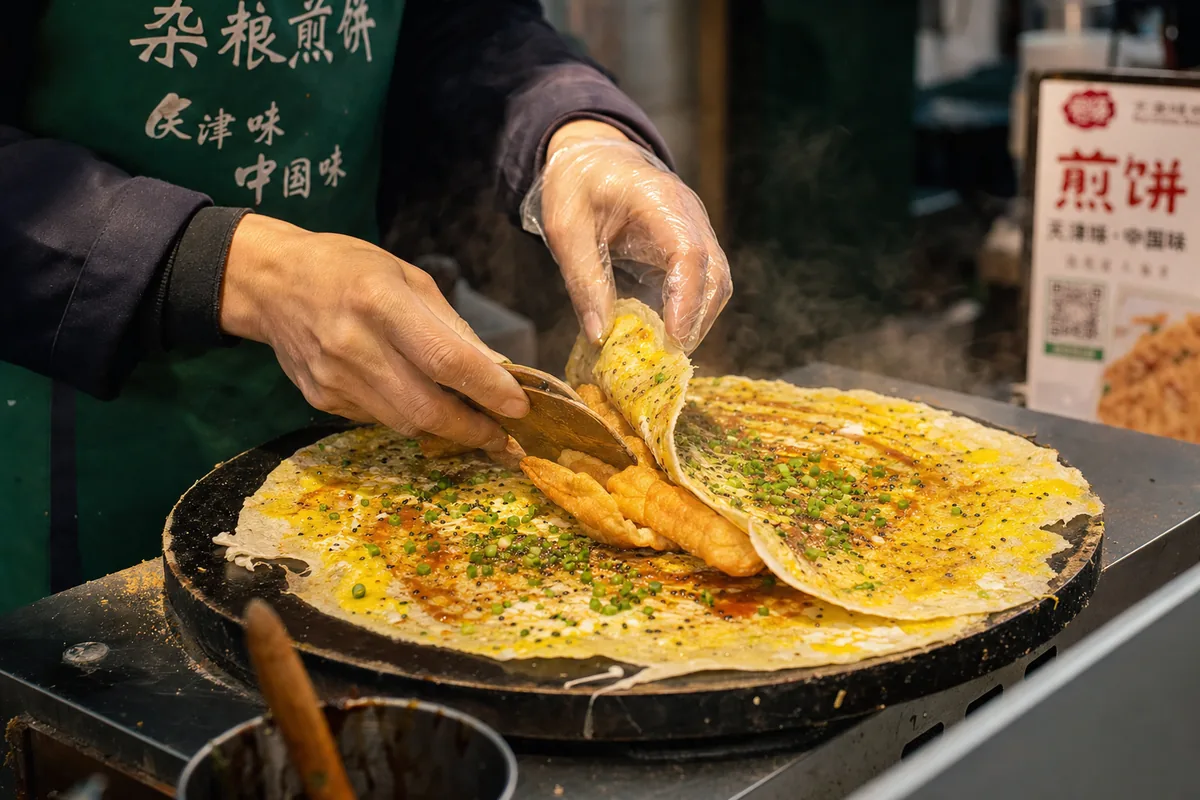
Tianjin claims to be the birthplace of jianbing (煎饼果子, jiānbing guǒzi), the savory breakfast crepe now sold across China. The Tianjin version is strict about tradition: a thin pancake made from mung bean flour, an egg cracked on top, brushed with sauce and chili, sprinkled with scallions, and wrapped around a crispy fried cracker (the guozi). Locals will tell you it shouldn't contain lettuce, ham, or anything else — purists are firm about this. Find it at a busy morning stall and eat it on the spot.
Goubuli Baozi (Steamed Buns)
Goubuli (狗不理, Gǒubùlǐ) is Tianjin's most famous steamed bun brand, with a history going back more than 150 years. The buns are filled with seasoned pork and pleated with a precise number of folds. Honest note: the flagship restaurants are pricey and lean heavily on the brand name, and many locals find smaller bun shops just as good for a fraction of the cost. Try it if you want the famous name; don't feel obligated to.
Mahua (Fried Dough Twist)
Tianjin's mahua (麻花, máhuā) are crunchy, deep-fried dough twists, often sweet and studded with sesame, nuts, or candied fruit. The most famous brand is Shibajie Mahua ("18th Street Mahua"), and oversized versions are sold as gifts. They keep well, so they make a practical souvenir to bring back to Beijing or home.
If you have specific dietary needs, it's worth reading our guide to ordering food with zero Chinese before you go, since many of the best stalls have no English menu.
Where to Stay in Tianjin
If you're staying overnight, base yourself near the Hai River and the concession districts. This puts you within walking distance of the Italian quarter, the Tianjin Eye, and Ancient Culture Street, and close to Tianjin Station for an easy return to Beijing.
- Heping District (和平区): The central, walkable heart of old Tianjin. Best for first-time visitors who want everything close by.
- Near Tianjin Station: Convenient for short stays and early train departures, with a range of mid-range hotels.
- Five Great Avenues area: Quieter, with a few boutique hotels set in restored villas if you want atmosphere.
Tianjin has the full range, from international chains to budget guesthouses, and rates are generally lower than Beijing for comparable quality. You can compare options and prices on Booking.com.
For more on the registration rules, see our guide to booking hotels and registration in China.
Suggested Itineraries
Tianjin Day Trip from Beijing
A day trip is very doable. Take an early train from Beijing South, and you'll be in Tianjin by mid-morning.
- Morning: Arrive at Tianjin Station, walk to the Italian Concession, grab a jianbing on the way.
- Midday: Cross toward Ancient Culture Street; browse the crafts and have lunch.
- Afternoon: See the Porcelain House, then taxi to the Five Great Avenues for a relaxed walk.
- Evening: Ride the Tianjin Eye at dusk, then catch a train back to Beijing.
Two-Day Trip
With two days, spread the same sights out and add an unhurried evening in the Italian quarter. Spend day one on the riverfront and concessions, stay overnight near Heping District, and use day two for the Five Great Avenues, a museum or two, and a long lunch before heading back.
Tianjin also slots neatly into a larger North China trip. If you're combining it with other major cities, our Beijing–Xi'an–Shanghai classic route shows how the rail network connects them, and Tianjin makes an easy add-on at the Beijing end.
Best Time to Visit
Spring (March–May) and autumn (September–November) are the most comfortable, with mild temperatures and clearer skies. Summer can be hot and humid, and winter is cold and gray — though the riverfront lights still look good when it's bracingly cold. Avoid the first week of October (the National Day holiday), when domestic crowds peak everywhere.
Final Tips
Tianjin works best when you treat it as a change of pace rather than a checklist. The European architecture, the riverfront, and the food are the core; everything else is a bonus. Set up mobile payments before you arrive, bring your passport for trains and hotels, and don't over-schedule — half the pleasure here is wandering the concession streets without a fixed plan.
If you have only one day, make it the riverfront, the Italian quarter, and a proper jianbing. If you have two, slow down and let the city's old-fashioned rhythm set the pace.
Related Reading
- Beijing Complete Guide — your likely base for visiting Tianjin.
- Beijing Day Trips — other easy escapes from the capital.
- High-Speed Train Complete Guide — everything on booking and riding China's rail network.
- Best Street Food Cities — where else to eat well across China.
Last updated: June 2026
Read in other languages
Last train times for 10 Chinese metro systems
Every line and station, checked by hand — the same data behind our offline route planner.
Get the WaysChina App
Offline guides, currency converter, essential phrases, and more — all in your pocket.

Related Articles
3 Days in Beijing: A Day-by-Day Itinerary Built Around the Bookings
A three-day Beijing route in metro order — imperial axis, Great Wall, Temple of Heaven and hutongs — with the...

Day Trips from Beijing: Which Great Wall Section, Plus the Ming Tombs, Tianjin and Chengde
Which Great Wall section fits you — Mutianyu, Badaling, Jinshanling or Simatai with Gubei — plus the Ming Tombs,...
Beijing Food Guide: What to Eat, Where to Eat It, and What to Skip
Peking duck the right way, zhajiangmian, copper-pot lamb hotpot and which old-Beijing snacks are worth it, plus...

Datong Complete Guide
Datong was the first capital of the Northern Wei dynasty and home to the UNESCO-listed Yungang Grottoes. Here's how...