
This article contains affiliate links. If you make a purchase through these links, we may earn a small commission at no extra cost to you. This helps support our work in creating free travel guides.
Ten days is enough to see four of China's most important cities without rushing through any of them. The classic route — Beijing, Xi'an, Chengdu, and Shanghai — gives you imperial history, the Terracotta Army, pandas and laid-back teahouse culture, and a modern megacity, all connected by high-speed rail and short flights. This plan assumes you land in Beijing and fly out of Shanghai (an open-jaw ticket), which saves backtracking. Below you'll find a day-by-day breakdown, exactly how to get between cities, a budget you can plan around, and notes on how to adjust if you'd rather swap a city or slow down.
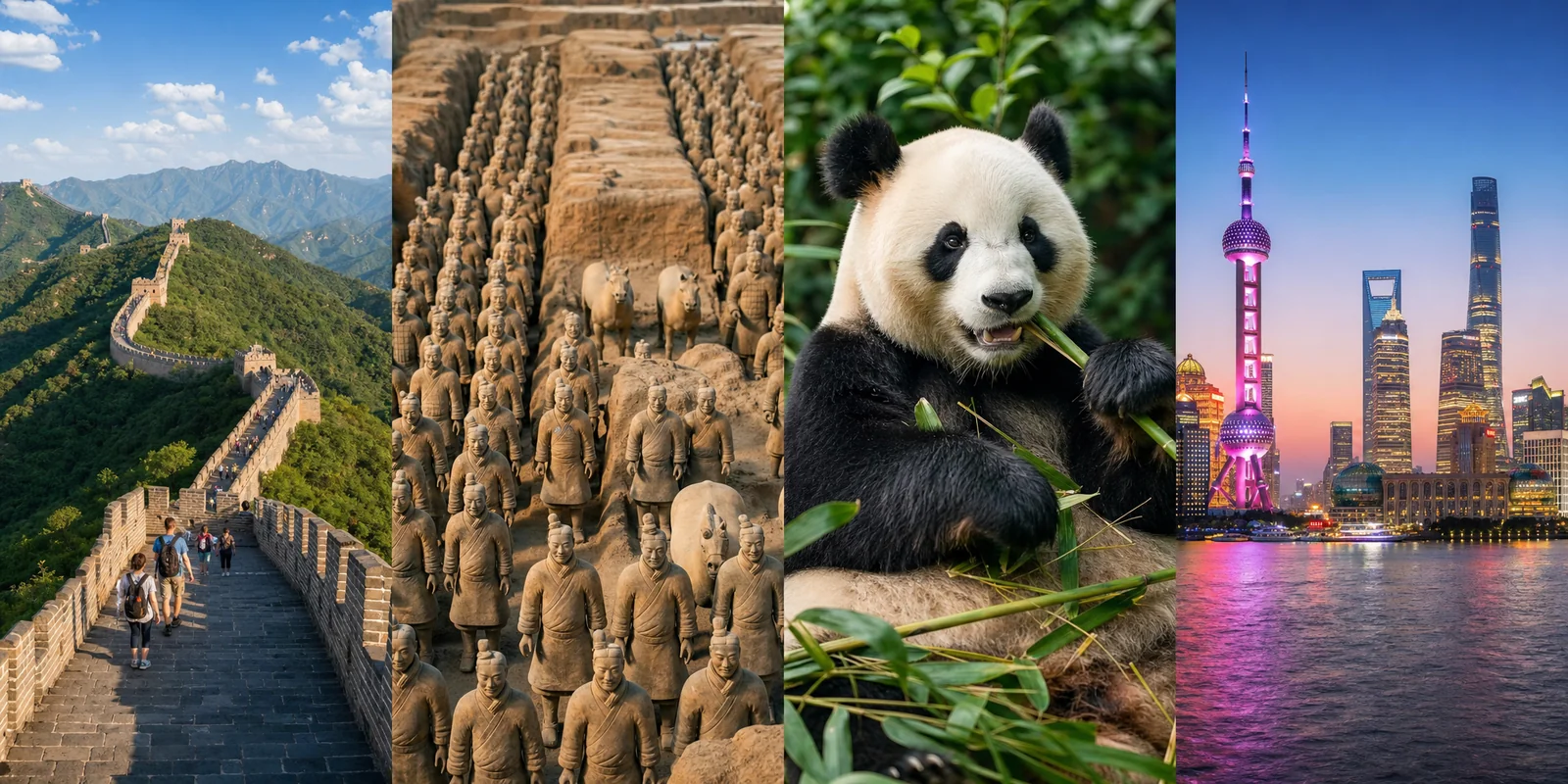
Route Overview
The order matters. Going Beijing → Xi'an → Chengdu → Shanghai keeps your travel legs efficient and ends in the city with the most flight connections home. Here's the shape of the trip:
- Days 1–3: Beijing — Forbidden City, Great Wall, Temple of Heaven, hutongs
- Days 4–5: Xi'an — Terracotta Army, city wall, Muslim Quarter
- Days 6–7: Chengdu — Giant pandas, teahouses, Sichuan food
- Days 8–10: Shanghai — the Bund, Yuyuan Garden, French Concession, day trip option
Two cities get three days (Beijing and Shanghai, because they have the most to see), and two get two days (Xi'an and Chengdu, which are very doable in that time). The best seasons for this trip are spring (March–May) and autumn (September–November) — comfortable temperatures and clear-ish skies. Summer is hot and humid in all four cities, and Chengdu in particular stays grey. If you're traveling in late spring or early autumn, check the Golden Week travel dates first, because the early-October national holiday makes trains and sights extremely crowded.
Days 1–3: Beijing
Beijing is big, and the major sights are spread out, so don't try to cram. Three days lets you cover the essentials without burning out.
Day 1: Arrival and the city center
Most international flights land at Beijing Capital (PEK) or Daxing (PKX). From PEK, the Airport Express metro to the city takes about 25 minutes; from PKX it's the Daxing Airport Express line. After checking in and resting, ease into the trip with Tiananmen Square and a walk through the surrounding area. If you arrive early enough and aren't wrecked by jet lag, visit the Temple of Heaven (天坛, Tiāntán) in the late afternoon — the park is calmer then, and locals practice tai chi and play cards in the surrounding grounds.
Day 2: Forbidden City and hutongs
Start early at the Forbidden City (故宫, Gùgōng). Book tickets online in advance — they sell out, especially in peak season, and same-day tickets are not guaranteed. Entry is timed, and you'll need your passport to collect the ticket. Budget two to three hours to walk through from south to north, exiting at the back near Jingshan Park, where you can climb the hill for a view down over the entire palace complex and its golden roofs.
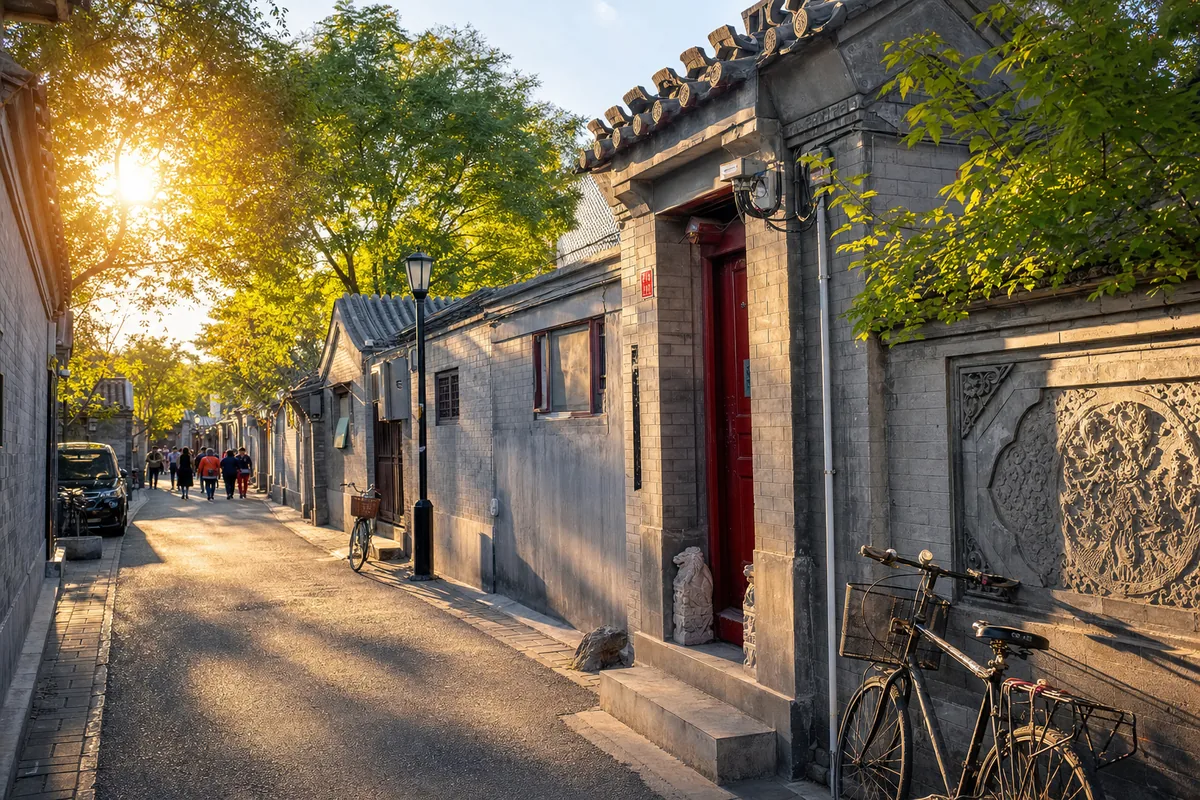
In the afternoon, wander the hutongs (胡同, hútòng) — the old alleyway neighborhoods. The areas around Nanluoguxiang and the Drum and Bell Towers are touristy but walkable; the smaller lanes off the main strip are quieter and more authentic. This is a good spot for an early dinner of Peking duck.
Day 3: Great Wall
Give the Great Wall a full day. The two most accessible sections from Beijing are Mutianyu (restored, with a cable car and toboggan, less crowded, family-friendly) and Badaling (closer, more famous, much more crowded). For most travelers, Mutianyu is the better experience. It's about 1.5–2 hours each way by car. You can take a public bus plus shuttle, but the logistics eat into your day — many visitors book a half- or full-day tour or a private driver instead. A guided Great Wall trip with hotel pickup is easy to arrange through Klook, and it removes the transport headache.
Days 4–5: Xi'an
Xi'an was the capital of China for over a thousand years and the eastern end of the Silk Road. It's compact, the old city is still ringed by an intact Ming-dynasty wall, and the Terracotta Army is just outside town.
Getting from Beijing to Xi'an
Take the high-speed train (高铁, gāotiě). The Beijing West to Xi'an North route takes about 4.5 to 6 hours depending on the service. Trains run frequently through the day. Book a morning departure so you arrive with time to settle in. Second class is comfortable and cheap; first class gives you a bit more legroom for a modest premium. You can book through the official 12306 site/app, or through Trip.com if you'd rather have an English interface and pay with a foreign card.
Day 4: Terracotta Army
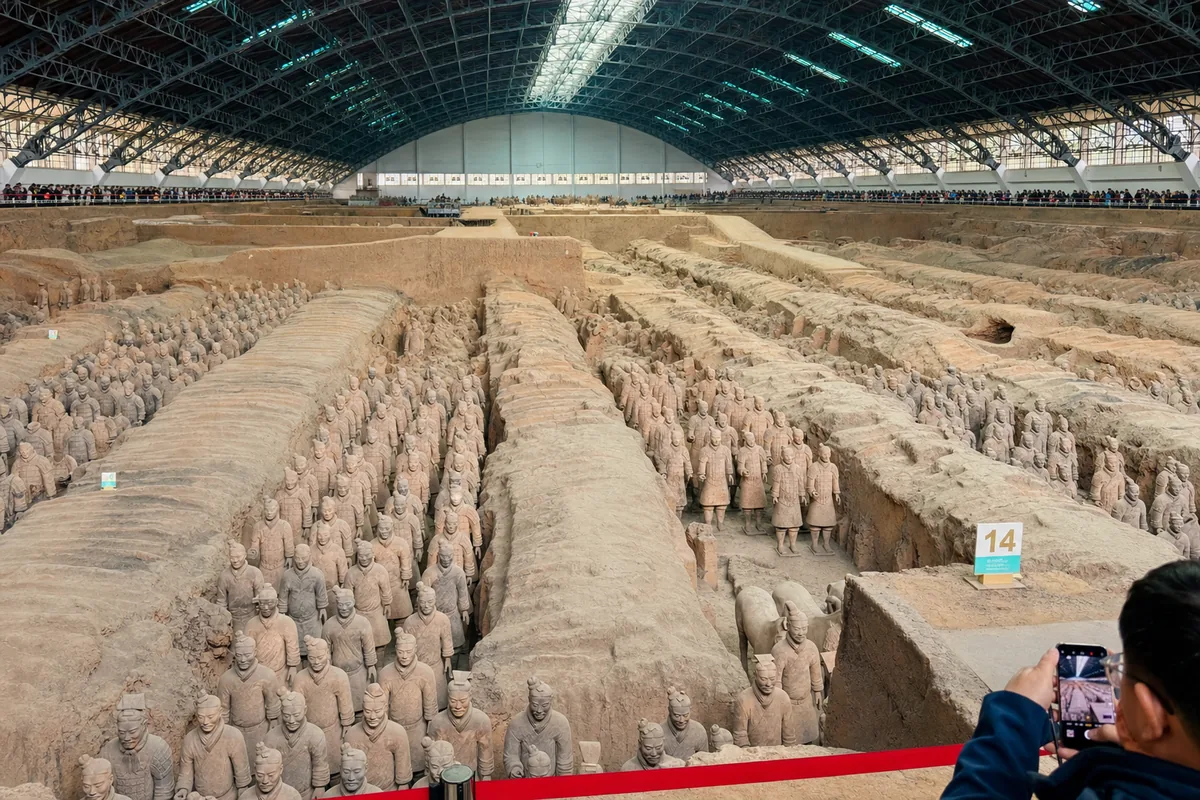
The Terracotta Warriors (兵马俑, Bīngmǎyǒng) are about an hour east of central Xi'an. Go in the morning before the tour buses fully arrive. There are three excavation pits; Pit 1 is the largest and most impressive, with rows of life-size soldiers, each with a different face. A guide (or a good audio guide) genuinely helps here — without context, it's rows of statues; with context, it's one of the most remarkable archaeological finds anywhere. Back in the city in the afternoon, walk or cycle the top of the city wall — you can rent bikes and ride the full 14 km loop in about 1.5 hours.
Day 5: Old city and Muslim Quarter
Spend the morning at the Big Wild Goose Pagoda (大雁塔, Dàyàntǎ) and the Shaanxi History Museum, which is excellent and free (reserve in advance, it's popular). In the late afternoon and evening, head to the Muslim Quarter (回民街, Huímínjiē) — narrow lanes packed with food stalls run by Xi'an's Hui Muslim community. Try the roujiamo (a stuffed flatbread often called a Chinese hamburger), hand-pulled biangbiang noodles, and persimmon cakes. For more on what to eat here, see the Xi'an food guide.
Days 6–7: Chengdu
Chengdu is the change of pace on this trip. After the intensity of Beijing and Xi'an, it's slower, greener, and built around teahouses, food, and pandas. People come for the giant pandas and stay for the Sichuan cooking.
Getting from Xi'an to Chengdu
The high-speed train from Xi'an to Chengdu takes about 3 to 4 hours and runs through the Qinling mountains and a long series of tunnels. It's the easy choice. There are also short flights (about 1.5 hours), but with airport transfers and security, the train is comparable in total time and drops you in the city center.
Day 6: Pandas and the old town
Go to the Chengdu Research Base of Giant Panda Breeding (大熊猫繁育研究基地) as early as you can — the pandas are most active in the cool morning, roughly 8:30–10:00, after which they nap. By mid-morning you may be looking at sleeping balls of fur. Book entry tickets in advance. In the afternoon, slow down: visit a traditional teahouse (the one in People's Park is the classic spot), get your ears cleaned if you're feeling adventurous, and wander the restored lanes of Jinli or Kuanzhai Alley.

Day 7: Sichuan food and culture
This is the day to eat well. Sichuan food is about more than spice — it's the numbing tingle of Sichuan peppercorn (麻, má) combined with chili heat (辣, là). Have hotpot for dinner if you can handle it (you can order a split pot with a mild broth on one side). During the day, consider a cooking class or a visit to the Wenshu Monastery and its vegetarian restaurant. In the evening, a Sichuan opera show with its famous face-changing (变脸, biànliǎn) act is a genuinely fun hour — you can book one through Klook. For a deeper take on the city, see the full Chengdu guide.
Days 8–10: Shanghai
Shanghai is the modern bookend to the trip — skyscrapers, colonial-era architecture along the river, world-class food, and the easiest international airport to fly home from.
Getting from Chengdu to Shanghai
This is the one leg where you should fly. Chengdu to Shanghai is about 1,650 km — the high-speed train takes 11+ hours, while the flight is around 3 hours. Book a domestic flight from Chengdu (CTU or TFU) to Shanghai (PVG or SHA). Morning flights give you most of the day on arrival. See our domestic flights guide for booking and airport tips.
Day 8: The Bund and Pudong
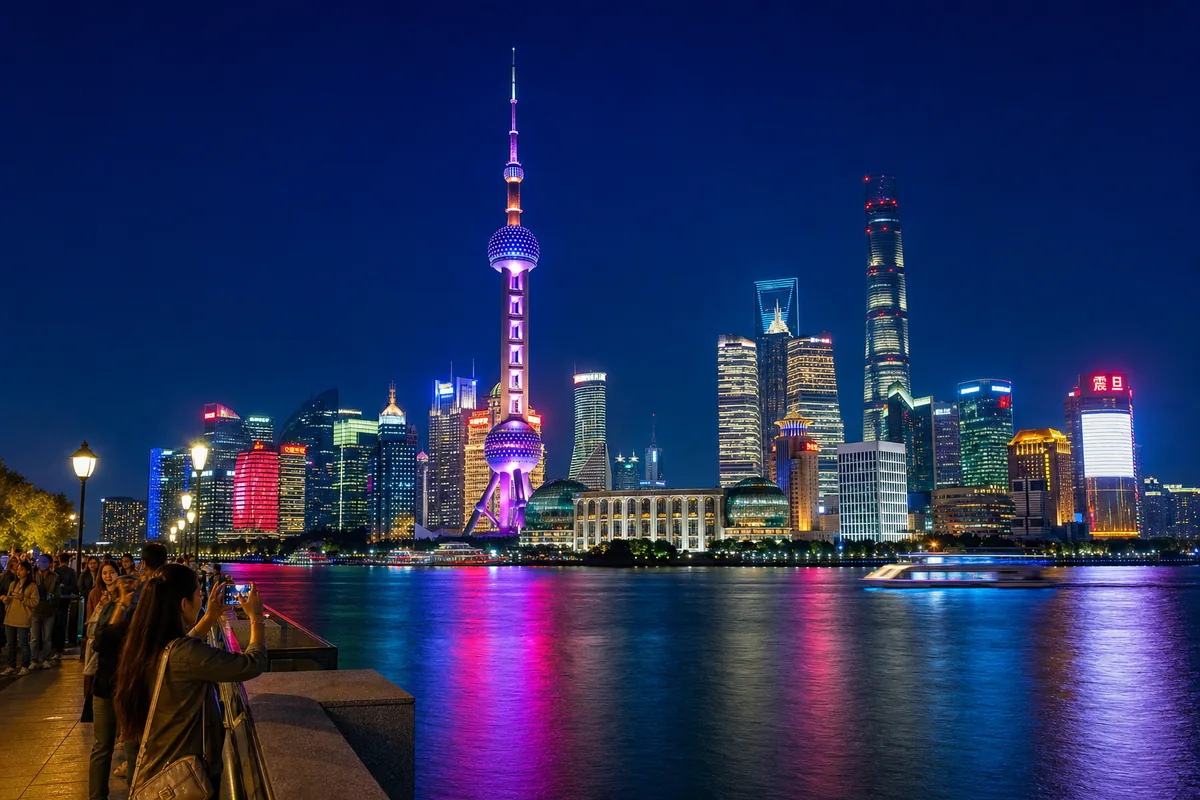
Start at the Bund (外滩, Wàitān), the riverfront promenade lined with 1920s European-style buildings. Across the Huangpu River, the Pudong skyline rises — the Oriental Pearl Tower, the Shanghai Tower (China's tallest building, with an observation deck on the 118th floor), and the bottle-opener-shaped World Financial Center. Walk the Bund in the morning, cross to Pudong in the afternoon, and come back to the Bund after dark when the whole skyline lights up. The view of the bend in the river with the towers behind it is the postcard shot of modern China.
Day 9: Old town and the French Concession
In the morning, visit Yuyuan Garden (豫园, Yùyuán), a classical Ming-dynasty garden, and the surrounding old-town bazaar (touristy but worth a walk). In the afternoon, shift gears to the French Concession — tree-lined streets, cafés, boutiques, and converted lane houses around Tianzifang and Wukang Road. This is the most pleasant part of Shanghai to just walk. For more food ideas, the Shanghai food guide covers everything from soup dumplings to fine dining.
Day 10: Day trip or slow morning, then fly home
Your last day depends on your flight time. If you fly out in the evening, you have time for a half-day. Options: a quick trip to the water town of Zhujiajiao (about an hour from the city), the Shanghai Museum, or simply a relaxed final morning of shopping and coffee. If you have a full extra day to spare, Suzhou and Hangzhou are both under an hour by high-speed train and make excellent day trips — see Shanghai day trips for details. Then head to the airport (Pudong PVG for most international flights) with plenty of buffer — allow at least 3 hours before an international departure.
Transport: How the Whole Trip Connects
Three of the four legs are high-speed rail, and one is a flight. Here's the summary:
| Leg | Mode | Duration | Notes |
|---|---|---|---|
| Beijing → Xi'an | High-speed train | 4.5–6 hrs | Book a morning departure |
| Xi'an → Chengdu | High-speed train | 3–4 hrs | Scenic mountain route |
| Chengdu → Shanghai | Flight | ~3 hrs | Train too long; fly instead |
For the trains, you'll need your passport to book and to board — it's your ticket. Arrive at stations 45–60 minutes early; they're large and security takes time. If booking the official system feels fiddly, our guide to booking train tickets walks through both the official app and third-party options. Within each city, the metro is cheap, fast, and signed in English, and ride-hailing via Didi (the local equivalent of Uber) is easy once you've linked a payment method. For planning metro routes and saving your day-by-day stops across all four cities, the WaysChina app has offline metro maps and a built-in trip planner.
Budget: What to Expect
Costs vary a lot by travel style. Below is a rough per-person estimate for the 10 days, excluding your international flights in and out of China. Prices are approximate and shift with season — treat them as planning figures, not quotes.
| Category | Budget | Mid-range | Comfortable |
|---|---|---|---|
| Accommodation (9 nights) | $180–360 | $450–800 | $1,000+ |
| Intercity transport (3 legs) | $150–220 | $200–300 | $300–450 |
| Local transport | $40–60 | $60–90 | $120+ |
| Food | $100–150 | $200–350 | $500+ |
| Attractions & tours | $80–120 | $150–250 | $350+ |
| Total (per person) | ~$550–900 | ~$1,050–1,800 | ~$2,300+ |
China is generally affordable once you're on the ground — street food and metro rides cost very little, and even mid-range hotels are good value. The biggest swings come from accommodation and how many guided tours you book. For a full breakdown, see the China travel budget guide.
Where to stay
In each city, base yourself centrally to save transit time: near the Forbidden City or Wangfujing in Beijing, inside the city wall in Xi'an, around Chunxi Road or the Tianfu Square area in Chengdu, and near the Bund, People's Square, or the French Concession in Shanghai. Booking ahead is wise in peak season. You can compare options and prices across all four cities on Trip Com Hotel, which tends to have the widest inventory for mainland China and works smoothly with foreign cards.
How to Adjust This Itinerary
This plan is flexible. A few common variations:
- Swap Chengdu for Guilin/Yangshuo. If dramatic karst scenery and the Li River appeal more than pandas, replace Chengdu with Guilin. The route becomes Beijing–Xi'an–Guilin–Shanghai. See the Guilin and Yangshuo guide.
- Have only a week? Drop one city — the classic short version is Beijing–Xi'an–Shanghai. Our 7-day China itinerary lays it out.
- Have two weeks? Add days in each city, slot in Suzhou or Hangzhou near Shanghai, or extend into a longer loop. See the 2-week China adventure.
- Prefer everything arranged for you? A fully organized version of this exact four-city route, with guides, drivers, and tickets handled, can be booked through operators like China Highlights.
Final Tips Before You Go
This four-city route is the most efficient way to see imperial, ancient, laid-back, and modern China in ten days. To recap the essentials: travel Beijing → Xi'an → Chengdu → Shanghai to minimize backtracking; book the Forbidden City, Terracotta Army, panda base, and Shanghai Tower tickets in advance; take the high-speed train for the first two legs and fly the last; and set up mobile payments before you arrive. Bring your passport everywhere, allow buffer time at stations and airports, and don't over-schedule — leave room to sit in a Chengdu teahouse or walk a Beijing hutong with no agenda. Check current ticket policies and visa or visa-free entry rules close to your departure, since these change.
Next steps: confirm your open-jaw flights (into Beijing, out of Shanghai), book your three intercity tickets, and reserve hotels in central locations for each city.
Last updated: June 2026
Read in other languages
Last train times for 10 Chinese metro systems
Every line and station, checked by hand — the same data behind our offline route planner.
Get the WaysChina App
Offline guides, currency converter, essential phrases, and more — all in your pocket.

Related Articles
Central China Route: Wuhan-Changsha-Zhangjiajie
A practical 7-8 day Central China itinerary linking Wuhan, Changsha, Zhangjiajie, and Fenghuang by high-speed rail,...

Northeast China Route: Harbin-Changbaishan-Dalian
A 7-8 day route through Northeast China linking Harbin, Changbaishan, and Dalian, with separate winter and summer...

Jiangnan Water Towns Route: Shanghai, Suzhou, Wuzhen and Hangzhou in 5 to 7 Days
Shanghai → Suzhou → a night in Wuzhen or Xitang → Hangzhou: the order, nights per stop, which water town to pick,...
Silk Road Route: Xi'an to Dunhuang
A practical 7-8 day Silk Road itinerary from Xi'an through Lanzhou and Zhangye to Dunhuang, with day-by-day plans,...