
This article contains affiliate links. If you make a purchase through these links, we may earn a small commission at no extra cost to you. This helps support our work in creating free travel guides.
The classic Yunnan circuit runs north from Kunming through Dali and Lijiang up to Shangri-La, climbing from about 1,900m to over 3,200m along the way. It's the most popular route in southwest China for good reason: one efficient high-speed rail line links the first three cities, the scenery shifts from lakes to old towns to Tibetan plateau, and you can do the core in seven days or stretch it to ten without backtracking. This guide gives you a day-by-day plan, the transport options between each stop, altitude and season warnings, and a budget comparison so you know what you're actually spending.
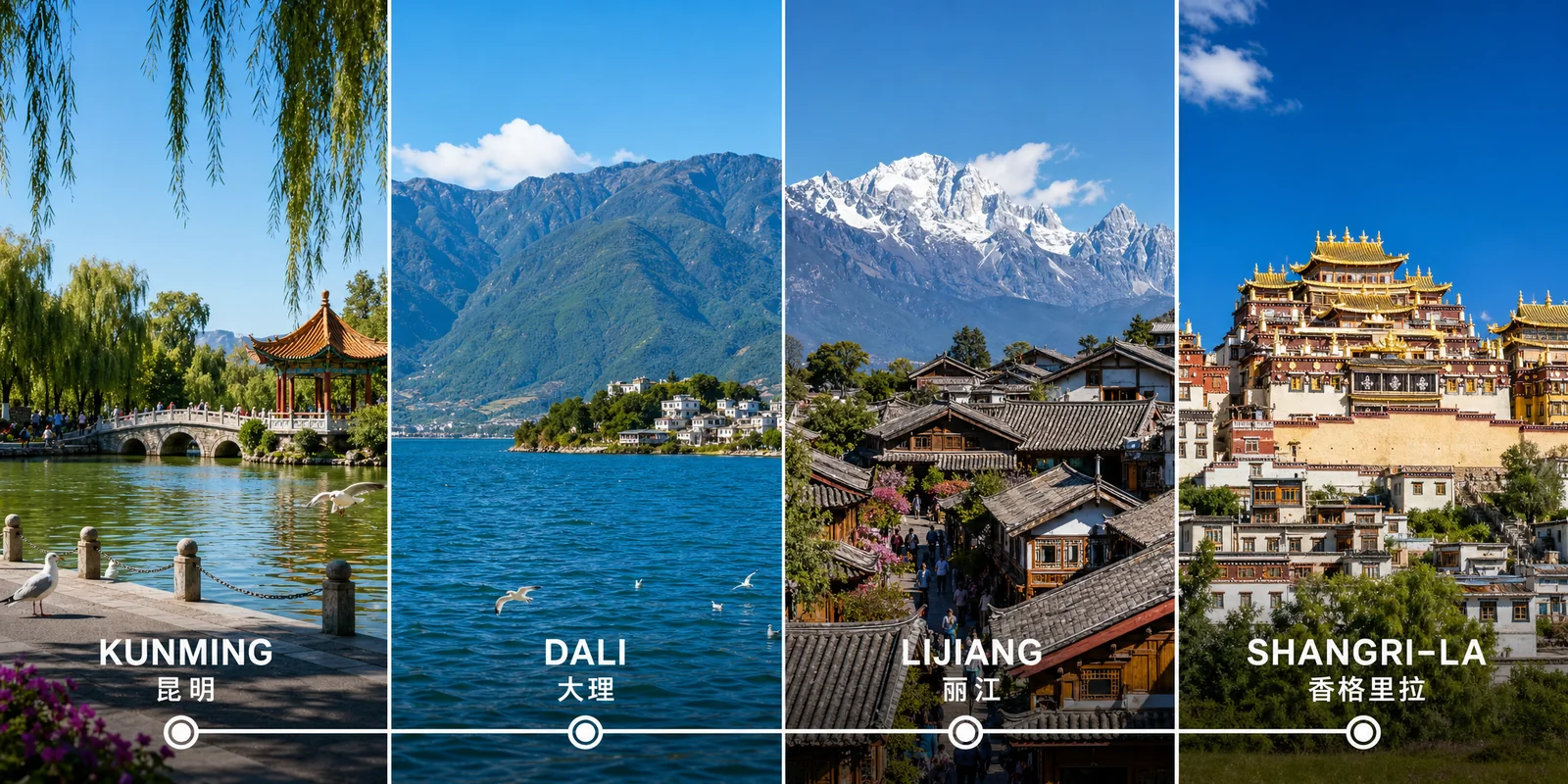
Route Overview
Here's the shape of the trip. You fly into Kunming (昆明, Kūnmíng), then move north — Dali, Lijiang, Shangri-La — each leg a step higher in elevation. Most travelers fly out of Lijiang or Shangri-La at the end rather than doubling back to Kunming, which saves a full day.
| Stop | Elevation | Suggested nights | Why you stop here |
|---|---|---|---|
| Kunming | ~1,900m | 1–2 | Arrival hub, Stone Forest, mild weather |
| Dali | ~1,970m | 2 | Erhai Lake, old town, Bai culture |
| Lijiang | ~2,400m | 2–3 | Old town, Jade Dragon Snow Mountain, Tiger Leaping Gorge |
| Shangri-La | ~3,200m | 2 | Tibetan monasteries, grasslands, Pudacuo park |
The 7-Day Core Itinerary
Day 1 — Arrive in Kunming
Fly into Kunming Changshui International Airport (KMG). It's well connected to most major Chinese cities and has direct international routes from places like Bangkok, Singapore, and Seoul. The airport metro and shuttle buses reach the city center in about 50 minutes.
Kunming is called the "Spring City" (春城, Chūnchéng) because of its mild year-round climate, sitting at around 1,900m. Use the first afternoon to settle in and adjust — wander Green Lake Park (翠湖公园, Cuìhú Gōngyuán), which has free entry, and eat your first bowl of crossing-the-bridge noodles (过桥米线, guòqiáo mǐxiàn), the regional specialty where you add raw ingredients to a bowl of scalding broth at the table.
Day 2 — Stone Forest, then north to Dali
The Stone Forest (石林, Shílín) is a UNESCO-listed karst landscape about 90 minutes east of Kunming — towering limestone pillars you can walk between on paved paths. It's a half-day trip. You can take a tour bus or the high-speed train to Shilin South Station, then a local shuttle. Entry is around ¥130.
If you want a faster pace, skip the Stone Forest and head straight to Dali in the morning. The high-speed train from Kunming to Dali takes about 2 hours.

Day 3 — Dali: Erhai Lake and the old town
Dali sits on the western shore of Erhai Lake (洱海, Ěrhǎi), backed by the Cangshan mountains. The classic way to see the lake is to rent an electric scooter or e-bike and ride the eastern shore road, stopping at villages and viewpoints. A full loop is about 120km, so most people ride a section rather than the whole thing.
Dali Old Town (大理古城, Dàlǐ Gǔchéng) is the base for most visitors — stone streets, Bai minority architecture, cafes, and bars. It's touristy, but the surrounding villages like Xizhou (喜洲) are quieter and worth a half day for the traditional Bai courtyard houses and the morning market.
Day 4 — Dali to Lijiang
The high-speed train from Dali to Lijiang takes about 2 hours. Spend the afternoon in Lijiang Old Town (丽江古城, Lìjiāng Gǔchéng), another UNESCO World Heritage site — a maze of canals, wooden buildings, and cobbled lanes built by the Naxi people. It gets crowded and commercial in the central areas, so head to the quieter northern and eastern edges or up to Lion Hill for the rooftop views over the tiled roofs.
Lijiang sits at 2,400m. You probably won't feel it much, but it's a good checkpoint to notice how you're handling altitude before going higher.

Day 5 — Jade Dragon Snow Mountain
Jade Dragon Snow Mountain (玉龙雪山, Yùlóng Xuěshān) rises to 5,596m about an hour north of Lijiang. A cable car takes you to around 4,500m, where a boardwalk lets you walk up toward the glacier. This is the highest point most people reach on the trip, and the thin air is noticeable — walk slowly and don't be surprised if you're short of breath.
The mountain area also includes Blue Moon Valley and the open-air "Impression Lijiang" show directed by Zhang Yimou. Tickets are tiered and can sell out in peak season, so book ahead. You can arrange the cable car, park entry, and transport as a package — comparing options on a platform like Klook saves time over piecing it together at the gate.
Day 6 — Tiger Leaping Gorge, then Shangri-La
On the way from Lijiang to Shangri-La, Tiger Leaping Gorge (虎跳峡, Hǔtiào Xiá) is one of the deepest river canyons in the world, where the Jinsha River squeezes between two 5,000m+ massifs. There are two ways to experience it: the lower road with platforms near the river (a couple of hours, easy), or the famous High Trail, a two-day hike along the upper canyon. If you're on the 7-day plan, do the lower gorge as a stop; if you have extra days, the High Trail is the highlight of the whole circuit for many hikers.
Continue to Shangri-La (香格里拉, Xiānggélǐlā), formerly called Zhongdian, at 3,200m. The drive from Lijiang is about 3.5–4 hours total including the gorge stop. Take it easy on arrival — this is where altitude hits hardest.

Day 7 — Shangri-La and departure
Shangri-La is culturally Tibetan. Songzanlin Monastery (松赞林寺, Sōngzànlín Sì), the largest Tibetan Buddhist monastery in Yunnan, sits just outside town and is sometimes called the "Little Potala Palace." The old town (Dukezong) has a giant prayer wheel you can help turn. If you have the morning, Pudacuo National Park (普达措国家公园) has alpine lakes and meadows on a boardwalk loop.
Shangri-La's Diqing Airport (DIG) has flights to Kunming, Chengdu, Lhasa, and a few other cities, so you can fly out from here rather than backtracking. If you'd rather end in Lijiang, return there by bus (about 4 hours) and fly from Lijiang Sanyi Airport (LJG).
Stretching to 9–10 Days
If you have more time, here's where the extra days pay off:
- Tiger Leaping Gorge High Trail (2 days): The full two-day trek with an overnight at a guesthouse like Tea Horse or Halfway. This is the single best addition for active travelers.
- Shaxi Old Town (1 day): A quiet ancient town on the old Tea Horse Road between Dali and Lijiang — much less commercial than the big old towns.
- Extra day in Dali (1 day): More of Erhai Lake, a chairlift up Cangshan, or a cooking class.
- Lugu Lake (2 days): A high alpine lake on the Yunnan-Sichuan border, home to the matrilineal Mosuo people. It's a long drive from Lijiang but very different from everywhere else.
For a sense of how Yunnan fits into a broader trip, our 10-Day China Trip Plan shows how to combine a regional circuit like this with one or two other parts of the country.
Transport Between Stops
The good news: Kunming, Dali, and Lijiang are now linked by high-speed rail, which transformed this route. The slower last leg to Shangri-La is by road or air.
| Leg | Best option | Time | Approx. cost |
|---|---|---|---|
| Kunming → Dali | High-speed train | ~2 hrs | ¥145–185 |
| Dali → Lijiang | High-speed train | ~2 hrs | ¥75–110 |
| Lijiang → Shangri-La | Bus / private car | ~3.5–4 hrs | ¥65 (bus) / more for car |
| Shangri-La → Kunming | Flight | ~1 hr | ¥400–900+ |
Train tickets go on sale up to about 15 days in advance and the popular Dali and Lijiang trains do sell out in peak season. You can book through the official 12306 system or an English-language platform like Trip.com, which handles passport-holder bookings without the language barrier. For more on the booking process, see our guide to booking train tickets.
For the Lijiang–Shangri-La leg there's no train. Buses leave from Lijiang's bus stations regularly; a shared or private car costs more but lets you stop at Tiger Leaping Gorge along the way, which is why many travelers choose it. Inbound flights to Kunming can be compared on Trip.com alongside the Shangri-La return leg.
When to Go: Season by Season
Yunnan is a year-round destination, but each season changes the experience and the price.
| Season | Conditions | Crowds & prices |
|---|---|---|
| Spring (Mar–May) | Mild, flowers blooming, clear days. Best overall. | Busy, high prices — peak season |
| Summer (Jun–Aug) | Rainy season; green and lush but afternoon downpours | Moderate; domestic school-holiday spikes in Jul–Aug |
| Autumn (Sep–Nov) | Clear skies, comfortable temps. Excellent. | Busy; very crowded during Golden Week (early Oct) |
| Winter (Dec–Feb) | Cold and dry, sunny days, snow on the peaks. Shangri-La gets genuinely cold. | Quietest; cheapest hotels and flights |
Winter is underrated here. Kunming, Dali, and Lijiang are sunny and dry — cold at night but pleasant by day — and the snow-capped mountains look their best against blue skies. Just pack properly for Shangri-La, where winter temperatures drop well below freezing. For the broader picture, our guide to the best time to visit China puts Yunnan's seasons in national context.
Budget Comparison
These are realistic per-person daily estimates excluding the long-haul flight to China. Yunnan is one of the better-value regions in China, especially outside peak season.
| Style | Accommodation | Daily total (per person) |
|---|---|---|
| Backpacker | Hostel dorm / guesthouse, ¥40–120 | ¥200–350 |
| Mid-range | Boutique hotel / nice guesthouse, ¥250–500 | ¥500–800 |
| Comfort | 4–5 star / design hotel, ¥600–1,500+ | ¥1,000–2,000+ |
The biggest swing is season. The same guesthouse room in Lijiang can cost ¥150 in winter and ¥450 during Golden Week. Booking ahead in peak season locks in both price and availability — platforms like Booking Com Hotel list a wide range of the old-town guesthouses that make staying in Dali and Lijiang memorable. For a full 7-day trip, a mid-range traveler typically spends ¥4,000–6,000 plus internal transport (¥600–1,500 depending on whether you fly out of Shangri-La).
A few fixed costs to budget for: Jade Dragon Snow Mountain (cable car + park + transport) runs ¥400–600 all-in; Pudacuo National Park is around ¥260; Stone Forest is ¥130. These add up, so factor in roughly ¥1,000–1,500 in attraction tickets for the full circuit.
Practical Notes
- Altitude: Drink water, go slow your first day in Shangri-La, and avoid heavy drinking on arrival. If you have a heart or lung condition, talk to a doctor before the trip.
- Payments: Mobile payments (Alipay and WeChat Pay) work everywhere, even at village stalls. Set them up before you arrive — see our guide to using Alipay with foreign cards.
- Packing layers: You'll go from warm Dali afternoons to near-freezing mountain tops in the same day. Bring layers and a warm jacket regardless of season.
- Hotel registration: Hotels and licensed guesthouses register your stay with police automatically (住宿登记, zhùsù dēngjì). Stick to licensed accommodation and you don't need to worry about it.
Yunnan's tourism authorities maintain official information on the province's parks and heritage sites; UNESCO lists both the Old Town of Lijiang and the South China Karst (which includes the Stone Forest) on its World Heritage register, with background worth a read before you go.
Summary
The Kunming–Dali–Lijiang–Shangri-La circuit is the most rewarding introduction to southwest China, and seven days covers the core comfortably. Move north so you gain altitude gradually, use the high-speed train for the first three legs, and budget road time and acclimatization for the final stretch to Shangri-La. Travel in spring or autumn for the clearest weather, or winter if you want lower prices and sunny mountain views — just skip Golden Week. Book Jade Dragon Snow Mountain tickets and peak-season trains and hotels ahead, set up mobile payments before you land, and pack layers for the daily temperature swings. From here, your next step is locking in your arrival date and your first two train tickets.
Last updated: June 2026
Read in other languages
Last train times for 10 Chinese metro systems
Every line and station, checked by hand — the same data behind our offline route planner.
Get the WaysChina App
Offline guides, currency converter, essential phrases, and more — all in your pocket.

Related Articles

Central China Route: Wuhan-Changsha-Zhangjiajie
A practical 7-8 day Central China itinerary linking Wuhan, Changsha, Zhangjiajie, and Fenghuang by high-speed rail,...

Northeast China Route: Harbin-Changbaishan-Dalian
A 7-8 day route through Northeast China linking Harbin, Changbaishan, and Dalian, with separate winter and summer...

Jiangnan Water Towns Route: Shanghai, Suzhou, Wuzhen and Hangzhou in 5 to 7 Days
Shanghai → Suzhou → a night in Wuzhen or Xitang → Hangzhou: the order, nights per stop, which water town to pick,...
Silk Road Route: Xi'an to Dunhuang
A practical 7-8 day Silk Road itinerary from Xi'an through Lanzhou and Zhangye to Dunhuang, with day-by-day plans,...