
This article contains affiliate links. If you make a purchase through these links, we may earn a small commission at no extra cost to you. This helps support our work in creating free travel guides.
Doing business in China is easier than it used to be, but it still rewards preparation. The visa process has its own track for commercial travelers, payments and connectivity work differently than at home, and a few etiquette habits around meetings and dinners can make or break a first impression. This guide covers what you actually need to get sorted before and during a business trip: the right visa, meeting and dining etiquette, the main business districts in each major city, and how to handle translation when negotiations get technical.

Getting the Right Visa
For commercial travel, the category you want is the M visa (商务签证, shāngwù qiānzhèng) — China's business and trade visa. It covers attending meetings, trade fairs, negotiations, signing contracts, and short-term commercial activities. If you're going to work or be employed in China, that's a different category (the Z visa), and the M visa won't cover it.
To apply, you'll generally need an invitation letter from a Chinese company or a trade fair organizer, alongside the standard application form, a passport valid for at least six months, and a passport photo. The invitation should state the purpose of the visit, your itinerary, and who covers your expenses. Processing typically takes about four working days at most consulates, with express options available for a higher fee.
Validity varies a lot by nationality. US passport holders, for example, can often get multi-entry M visas valid for several years, while other nationalities may receive single- or double-entry visas. Always confirm the latest requirements for your passport before you book anything — rules change and consulate-specific quirks are common. The National Immigration Administration is the authoritative source for current entry policy.
If the paperwork feels overwhelming or your timeline is tight, visa agencies handle the submission and document checks for you. Services like visa agencies like iVisa can manage the process end to end, which is worth considering when you're juggling an invitation letter, supporting documents, and a consulate appointment under deadline.
Before You Land: The Practical Setup
Two things will shape your whole trip, so handle them before departure.
Payments. China runs almost entirely on mobile payments via QR code. Set up Alipay (支付宝, Zhīfùbǎo) or WeChat Pay (微信支付, Wēixìn zhīfù) and link a foreign card before you arrive — both now support international Visa and Mastercard. You'll use it for taxis, coffee, lunch, and most everything else. Carry some cash as backup, but you'll rarely need it.
Connectivity. Many services you rely on for work — Google, Gmail, WhatsApp, most Western apps — are blocked on the mainland Chinese internet. If your company runs on Google Workspace or you need WhatsApp to reach colleagues, sort out a VPN before you arrive (you can't easily download one once you're there). An international roaming plan or a travel eSIM that routes through an overseas network is the simplest workaround for many business travelers.

Business Etiquette: Meetings
Chinese business culture is more formal and hierarchy-aware than what many Western visitors are used to, but it's not a minefield. A handful of habits cover most situations.
Punctuality and Greetings
Arrive on time or a few minutes early — lateness reads as disrespect. Greetings are usually a light handshake, often with a slight nod. Let the most senior person on the Chinese side set the pace. Address people by title and surname (in Chinese, the surname comes first), and wait to be invited to use first names rather than jumping straight to them.
Business Card Etiquette
The exchange of business cards (名片, míngpiàn) is a small ritual that carries real weight. Offer and receive cards with both hands, with the text facing the recipient so they can read it. When you receive a card, take a moment to actually look at it — read the name and title — before setting it down. Don't shove it in your back pocket or scribble on it in front of the giver; both come across as dismissive.
Seating and Hierarchy
Seating at a meeting is rarely random. The most senior guest is typically seated facing the door, and the host sits opposite or nearby. In meetings, expect to be guided to your seat — don't grab a chair at random. The same logic applies in cars: the seat behind the front passenger is often considered the place of honor. When in doubt, hang back a beat and let your host direct you.
Decisions in Chinese organizations often run up the hierarchy, so the person across the table may not be the final decision-maker. Patience matters. A first meeting is frequently about building trust rather than closing a deal, and pushing too hard for an immediate yes can backfire.
Business Etiquette: The Dinner
The business dinner (商务宴请, shāngwù yànqǐng) is where a lot of relationship-building actually happens, and it follows its own customs. If you're invited to one, treat it as part of the negotiation, not an afterthought.
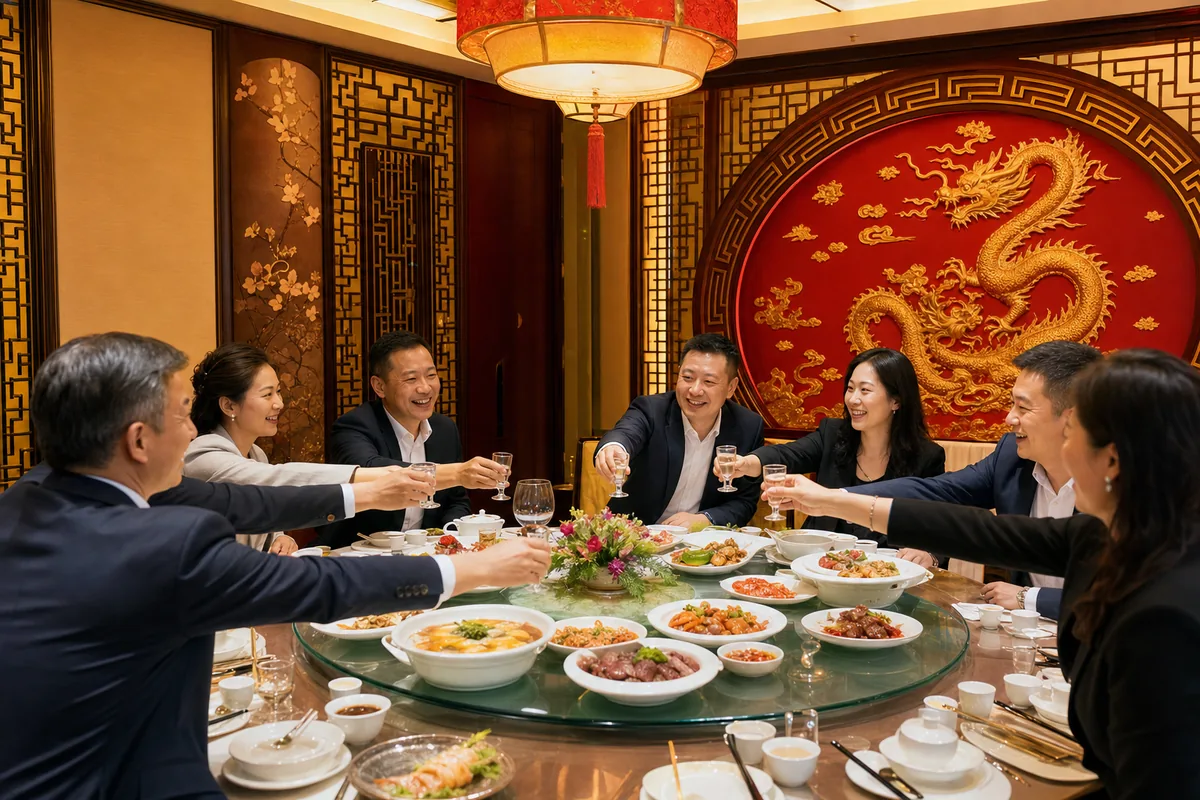
Seating and Ordering
The host orders, and there's usually far more food than the table can finish — that abundance is intentional and a sign of generosity. You're not expected to clear your plate. Dishes are shared from the center, often on a rotating turntable. Wait for the host to invite everyone to start before you dig in.
Toasting Culture
Toasting (敬酒, jìngjiǔ) is central to a Chinese business dinner. The host usually offers the first toast to the whole table. After that, individual toasts circulate, often one-on-one. A few pointers:
- Ganbei (干杯) literally means "dry the cup" — finishing the drink. If you can't or don't want to drink that much, it's fine to take a sip instead; just don't claim "ganbei" and then only sip.
- When clinking glasses with someone more senior, hold your glass slightly lower than theirs as a sign of respect.
- It's perfectly acceptable to decline alcohol for health, religious, or personal reasons. Toast with tea or a soft drink instead — the gesture matters more than the contents. Say so politely up front and it's rarely an issue.
Chopstick and Table Manners
A couple of things to avoid: don't stick your chopsticks upright in a bowl of rice (it resembles incense at a funeral), and don't use them to point at people. Let your host or the most senior person take the first bite of a new dish. If someone serves you food or pours your tea, a small nod or a light tap of two fingers on the table is the customary thank-you.
Where to Base Yourself: Business Districts
Choosing the right area saves you commuting time and puts you near the right offices, restaurants, and transport.

Beijing
The CBD (Central Business District) around Guomao and Jianguomen is the financial and corporate core, home to many multinationals and embassies. Zhongguancun in the northwest is the tech hub, often called China's Silicon Valley. Both are well served by the subway, which is the fastest way to move around the city during rush hour.
Shanghai
Lujiazui in Pudong is the skyline you've seen in photos — banks, financial firms, and the major towers. Across the river, the areas around Nanjing West Road and Jing'an host many corporate offices, agencies, and consulates, with excellent hotels and dining nearby. Pudong Airport (PVG) handles most long-haul international flights; Hongqiao (SHA) is closer to the city center and the high-speed rail hub.
Shenzhen and Guangzhou
In Shenzhen, Futian is the CBD and Nanshan is the tech district (home to many hardware and electronics companies). Guangzhou's Zhujiang New Town (Tianhe) is the modern business core, and the city's twice-yearly Canton Fair draws trade visitors from around the world.
Hotels for Business Travelers
International chains cluster in these districts and reliably offer fast in-room internet, business centers, English-speaking front desks, and proximity to offices. When you're billing time to a client or employer, that consistency is worth paying for. Booking platforms like Book through Trip.com list most major-chain and local business hotels in the CBDs above, and let you filter by district so you stay within a short ride of your meetings.
Handling the Language Gap
English is more common in big-city business circles than it used to be, but you can't count on it — especially in factories, government offices, or smaller suppliers outside the major hubs. Plan for the gap.
- For casual situations — taxis, restaurants, signage — a translation app does the job. Camera translation for menus and documents is genuinely useful, and voice translation handles simple back-and-forth.
- For meetings and negotiations, hire a professional interpreter. Don't rely on an app when contract terms, specifications, or pricing are on the line — nuance and tone matter, and a small mistranslation can be expensive. Your hotel, local partner, or a translation agency can arrange one; for important negotiations, brief them on the technical vocabulary in advance.
- For documents, get contracts and technical specs professionally translated, not machine-translated. If a contract exists in both Chinese and English, clarify which version governs in case of dispute.
Frequently Asked Questions
Can I do business activities on a tourist (L) visa?
Officially, no. The L visa is for tourism. Attending formal meetings, signing contracts, or conducting commercial activity should be done on an M visa. For a low-key trip you might get away with informal meetings on a tourist visa or visa-free entry, but for anything official, use the right category.
How much should I budget for a business trip?
Costs in the major business cities are comparable to other large Asian metros. A four- or five-star business hotel in a CBD typically runs higher than equivalent properties in smaller cities, while transport (subway and ride-hailing) and meals stay affordable. Build in extra for interpreter fees and any business entertaining you host.
Is tipping expected in a business context?
Tipping isn't part of the culture in China and isn't expected at restaurants, taxis, or hotels. Don't tip your business hosts or counterparts — it would be awkward. The reciprocal gesture in business relationships is hosting and gift-giving, not cash.
Should I bring gifts?
A modest gift from your home country or company — something representative, not extravagant — is well received at a first meeting. Present and receive gifts with both hands. Avoid clocks (the phrase "giving a clock" sounds like attending a funeral), and avoid anything in sets of four (the number sounds like "death").
Quick Reference
| Situation | What to do |
|---|---|
| Commercial visit | Apply for an M visa with an invitation letter |
| Before departure | Set up Alipay/WeChat Pay; install and test a VPN |
| Exchanging cards | Both hands; read the card before putting it away |
| Seating | Wait to be directed; senior guest faces the door |
| Toasting | Lower your glass to seniors; sip is fine if you say so |
| Negotiations | Hire a professional interpreter, not an app |
| Tipping | Not expected — don't |
Summary
A successful business trip to China comes down to preparation more than memorizing rules. Get the M visa sorted early with a proper invitation letter, and set up mobile payments and a VPN before you fly. Once you're there, the etiquette is mostly common courtesy with a few specifics: exchange cards with both hands, follow your host's lead on seating, pace yourself at the dinner, and treat the first meeting as relationship-building rather than deal-closing. For anything where money or contract terms are at stake, hire a professional interpreter. Do those things and you'll come across as a serious, respectful counterpart — which is exactly what opens doors here.
Next step: confirm your visa requirements with the Chinese consulate that covers your region, then book a hotel in the right business district for your meetings.
Related Reading
- How to Apply for China Visa — full walkthrough of the application process and documents.
- Cultural Etiquette & Taboos — broader context on customs beyond the boardroom.
- Internet & VPN Guide — how to keep your work tools running on the mainland.
- Luxury Hotels — premium options in the major business districts.
- Translation Apps Comparison — which app works best for menus, signs, and conversation.
Last updated: June 2026
Read in other languages
Last train times for 10 Chinese metro systems
Every line and station, checked by hand — the same data behind our offline route planner.
Get the WaysChina App
Offline guides, currency converter, essential phrases, and more — all in your pocket.

Related Articles
Accessible Travel in China
An honest look at wheelchair travel in China: what works, what doesn't, and how to plan around the gaps. Covers...

Couples & Honeymoon Travel in China
A practical guide to romantic travel in China — where to go for couples and honeymoons, how to plan the route, and...

Digital Nomad Guide to China
Working remotely from China is very doable once you sort out three things: your visa, your internet setup, and your...

Female Solo Travel in China
China is one of the safer destinations for women traveling alone. Here's an honest, practical guide to safety,...