
This article contains affiliate links. If you make a purchase through these links, we may earn a small commission at no extra cost to you. This helps support our work in creating free travel guides.
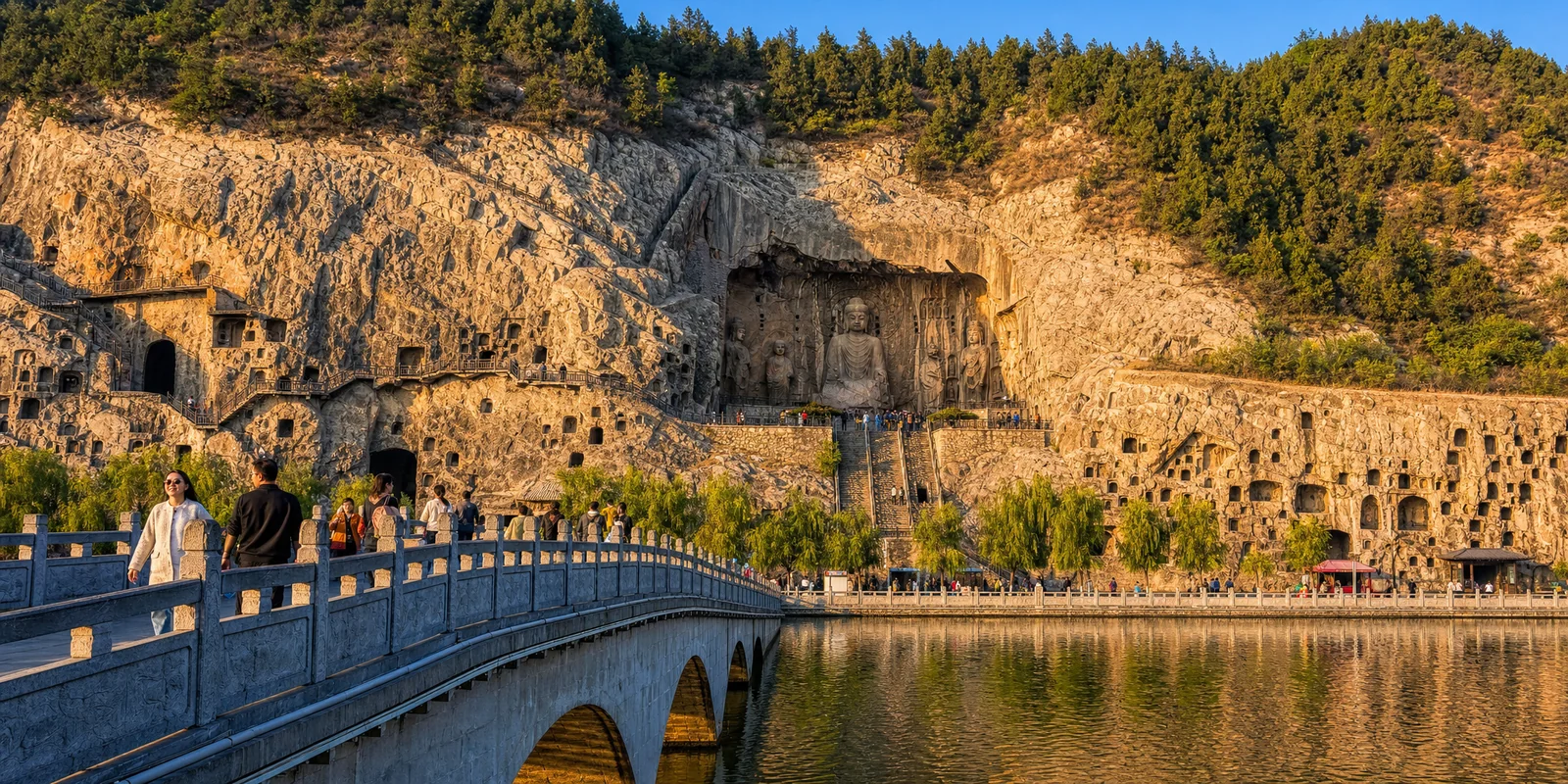
Luoyang sits in western Henan along the Yellow River, and for over a thousand years it was one of the most important cities in China. Thirteen dynasties made it their capital, which is why locals call it the "thirteen-dynasty ancient capital" (十三朝古都, shísān cháo gǔdū). Today it's a mid-sized industrial city that most foreign travelers visit for one reason above all: the Longmen Grottoes (龙门石窟, Lóngmén Shíkū), a UNESCO World Heritage site with tens of thousands of Buddhist carvings cut into limestone cliffs. Add the original Shaolin Temple a short drive away, China's first Buddhist temple, and a spring peony festival that draws millions, and two to three days here are easy to fill. This guide covers what to see, how to get around, where to eat, and how to slot Luoyang into a wider trip.
Why visit Luoyang
Luoyang's appeal is historical and concentrated. You don't come here for nightlife or modern skylines. You come for Buddhist art that spans the Northern Wei through Tang dynasties, for the place where Chan (Zen) Buddhism and Chinese kung fu trace their roots, and for a few days of walking through sites that show up in Chinese history textbooks. The city is compact enough to handle in a couple of days, and it pairs naturally with Xi'an to the west, since both were imperial capitals along the same historical corridor.
Most travelers spend two days if they focus on the grottoes and old town, or three if they add the Shaolin Temple day trip. The pace is relaxed compared to Beijing or Shanghai, and English signage exists at major sites but thins out quickly elsewhere, so a translation app helps.
When to go
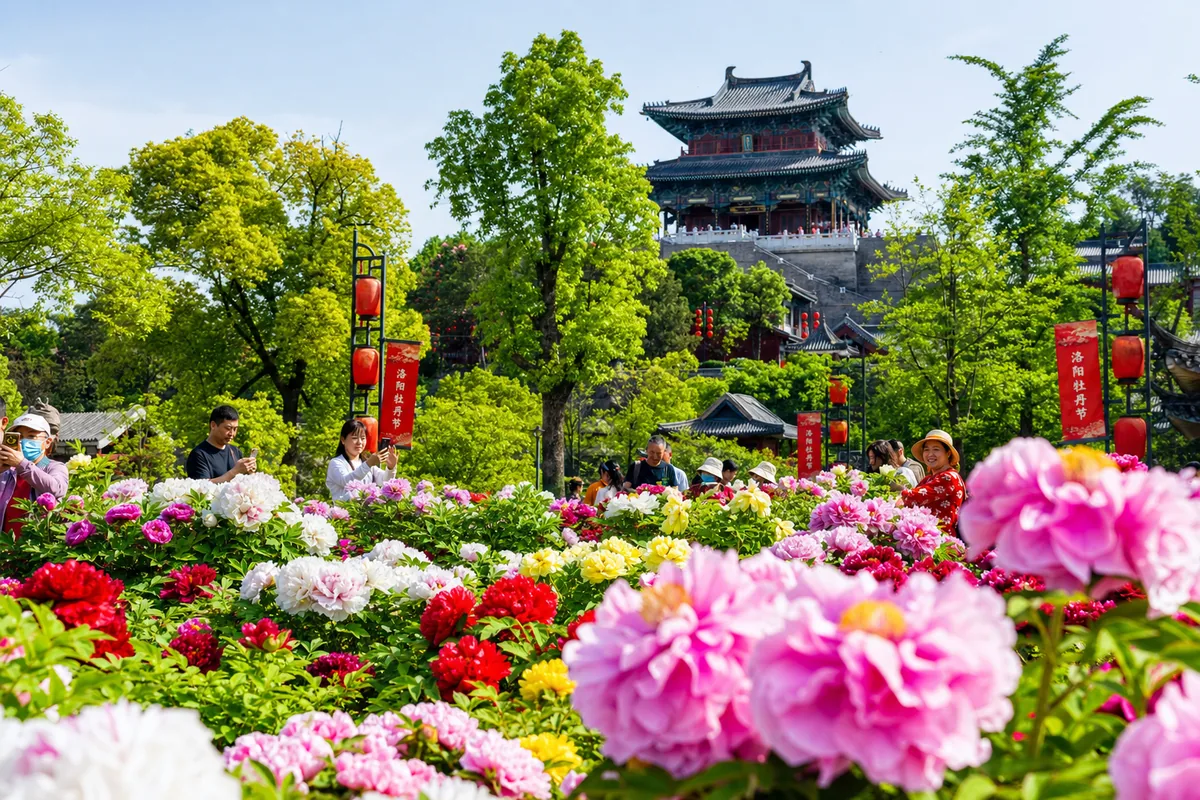
Spring (March to May) and autumn (September to November) are the comfortable seasons. Spring is the headline draw because of the Luoyang Peony Festival (洛阳牡丹文化节, Luòyáng Mǔdān Wénhuà Jié), which runs roughly through April into early May. Luoyang has cultivated peonies since the Tang dynasty and treats the flower as a civic symbol; during the festival, parks across the city fill with hundreds of varieties in bloom. The flip side is crowds and higher hotel prices, so book accommodation well ahead if you're traveling then.
Summers are hot and humid, and winters are cold and gray with occasional smog. If you visit outside spring, autumn gives you mild weather and thinner crowds, which makes the grottoes far more pleasant to walk.
Longmen Grottoes
This is the reason Luoyang is on the map for most international visitors. The Longmen Grottoes (sometimes called the Longmen caves) stretch along both banks of the Yi River, where carvers spent more than 400 years cutting Buddhist figures into the cliffs, beginning around the late 5th century. There are over 2,300 caves and niches and roughly 100,000 statues, ranging from tiny figures a few centimeters tall to the enormous seated Vairocana Buddha.
That Vairocana Buddha is the image you'll have seen in photos: about 17 meters tall, with a calm, slightly smiling face said to be modeled on Empress Wu Zetian, who helped fund its carving in the Tang dynasty. It anchors the Fengxian Temple grotto and is the highlight of any visit.
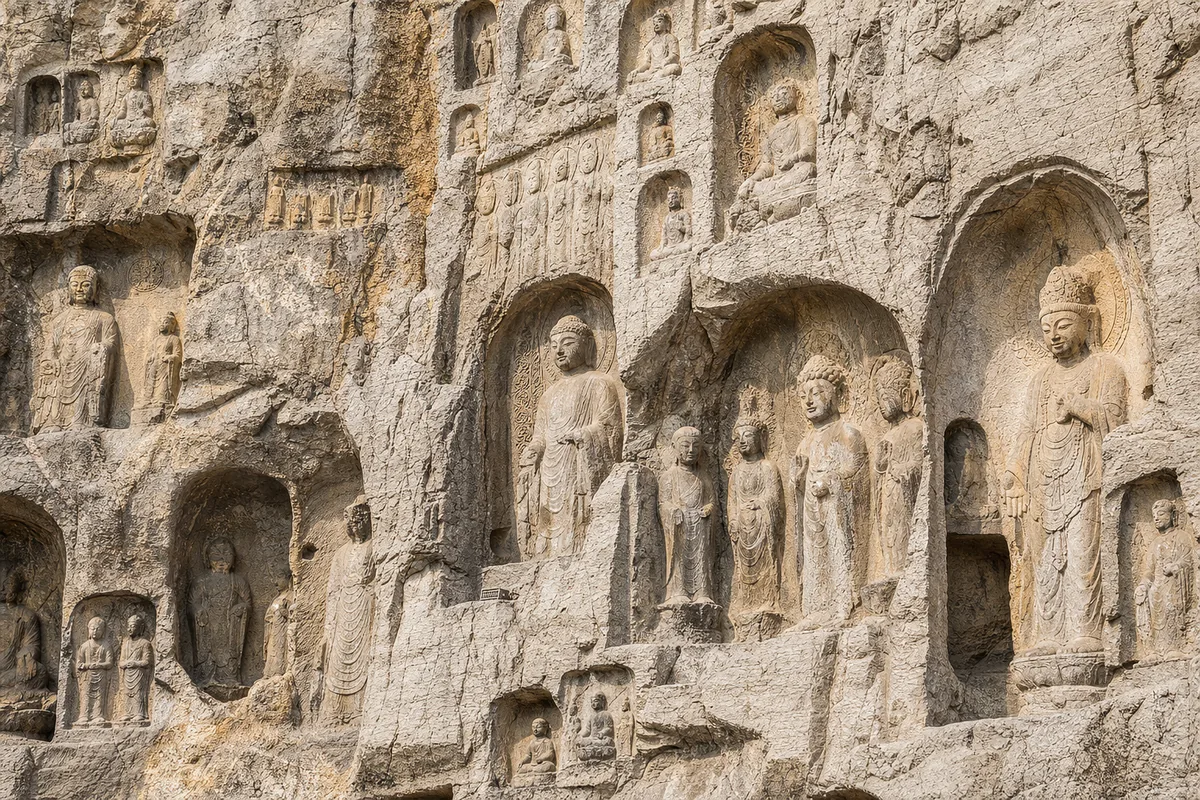
The site is large. A typical visit follows the West Hill caves (where most of the major grottoes are), crosses a bridge to the East Hill for a view back across the river, and ends at Xiangshan Temple and the Bai Garden, the tomb of Tang poet Bai Juyi. Plan for three to four hours of walking. There's a lot of climbing on stone steps, so wear proper shoes.
- Getting there: Bus 81 or 71 from the city center, or a Didi ride (about 20–30 minutes from downtown). A taxi or ride-hail is the simplest option.
- Hours: Generally open daily, with longer hours in peak season; gates close in the late afternoon, so arrive by early afternoon at the latest.
- Tickets: Buy at the gate or online. Bring your passport, since the same ID is often needed for entry.
You can find the official site listing through the UNESCO World Heritage Centre, which has background on the carvings and their dating. For a guided walk that explains the iconography (which is easy to miss on your own), a booked tour is worth it. You can arrange a Longmen Grottoes guide through Klook if you'd rather not navigate ticketing and transport yourself.
Shaolin Temple
Here's the thing travelers often get wrong: the Shaolin Temple (少林寺, Shàolín Sì) is not in Luoyang. It sits at the foot of Mount Song in Dengfeng (登封), about 75–90 minutes by road east of Luoyang, technically closer to Zhengzhou. You can absolutely visit it as a day trip from Luoyang, but plan the transport.
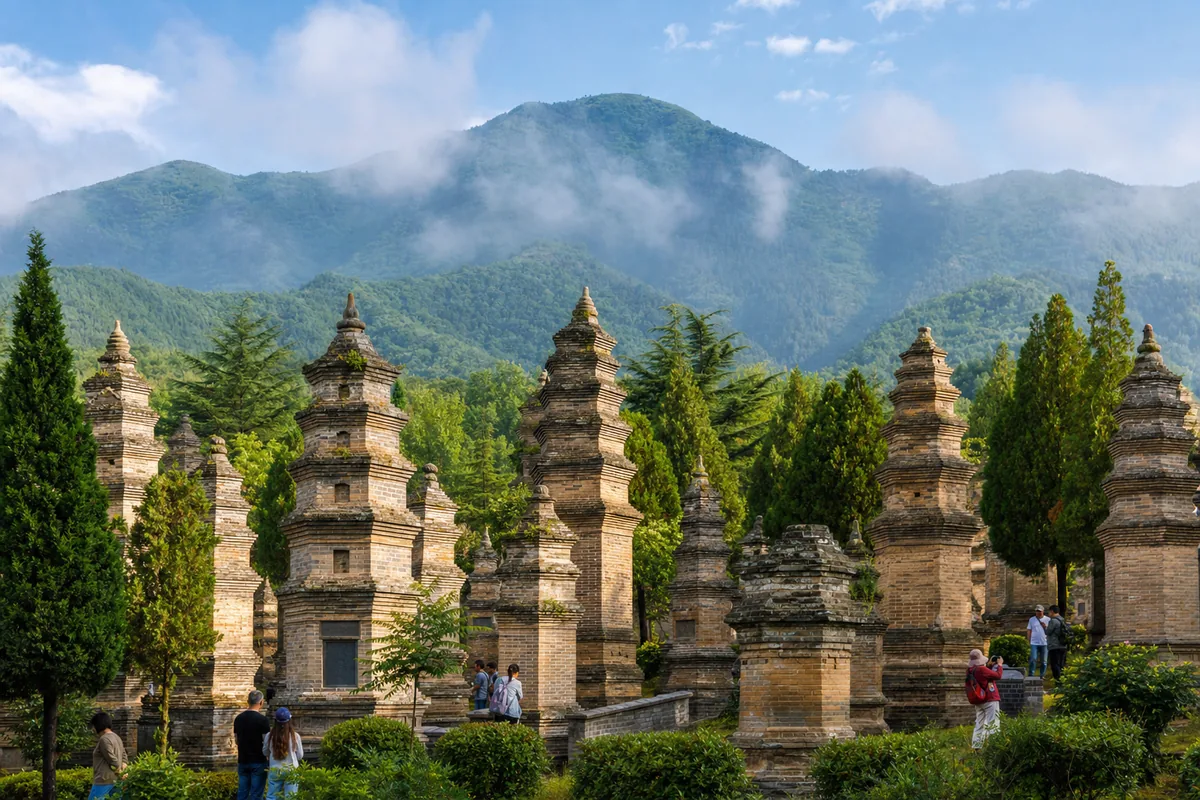
Shaolin is the birthplace of Chan Buddhism in China and the temple most associated with Chinese martial arts. Founded in the 5th century, it's where the legend of Bodhidharma and centuries of kung fu tradition took shape. The complex includes the main temple halls, the Pagoda Forest (塔林, Tǎlín)—a field of over 200 brick stupas marking the graves of eminent monks—and martial arts schools where thousands of students train. Daily kung fu performances by the monks are part of the visit, theatrical but genuinely skilled.
- From Luoyang: The easiest options are a chartered car/driver for the day or a Didi for the round trip (negotiate waiting time). There are also tourist buses and coach tours that bundle transport and tickets.
- Time needed: A full day. The site is spread out, and a shuttle or walk connects the temple, Pagoda Forest, and the cable car up Mount Song.
- What to expect: Crowds, especially at performance times, and a fair amount of walking.
Because the logistics involve crossing between prefectures, many visitors book a day tour that handles the driving and entrance tickets. A Shaolin Temple visit can be arranged through Getyourguide, which is worth considering if you want a guide who can explain the kung fu and Chan history rather than just dropping you at the gate.
White Horse Temple
The White Horse Temple (白马寺, Báimǎ Sì) is, by tradition, the first Buddhist temple founded in China, dating to around 68 CE in the Eastern Han dynasty. The name comes from the white horses said to have carried Buddhist scriptures from India. For anyone interested in how Buddhism entered China, this is the origin point.
It's a working temple with monks, incense, and quiet courtyards rather than a flashy attraction. A distinctive feature is the cluster of international halls built in Indian, Thai, and Burmese architectural styles, gifted by those countries, which sit just outside the main grounds. It's about 13 km east of central Luoyang, around 25–30 minutes by Didi or bus.
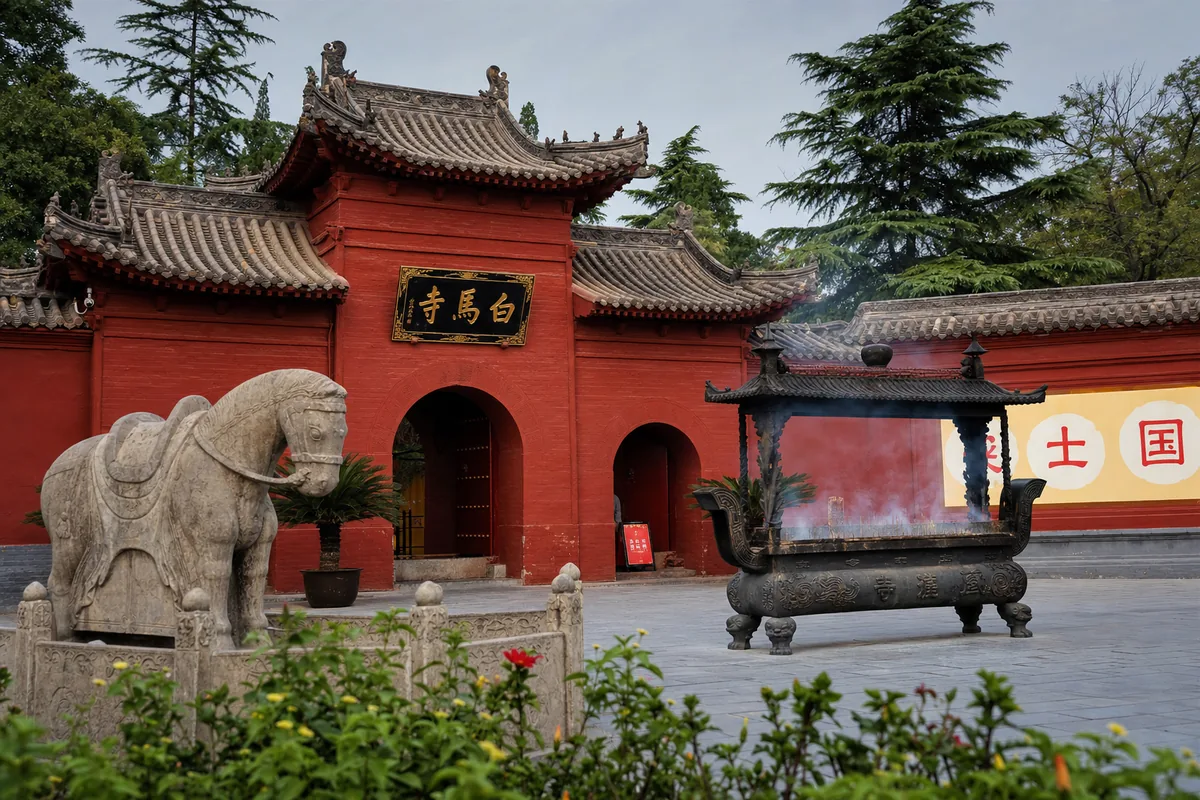
Compared to Longmen, it's a calmer, shorter stop—budget one to two hours. It pairs well with a morning at Longmen if you're tight on time, or as a gentler afternoon after a big day of walking.
Luoyang Old Town
Luoyang Old Town (洛邑古城 / 老城, Lǎochéng) is the city's restored historic quarter, centered on Lijing Gate (丽景门, Lìjǐng Mén). During the day it's a place to wander narrow lanes, browse shops, and see traditional architecture; after dark it lights up and the food stalls and tea houses come alive. This is where to spend an evening, sample street snacks, and get a feel for the city beyond its monuments.
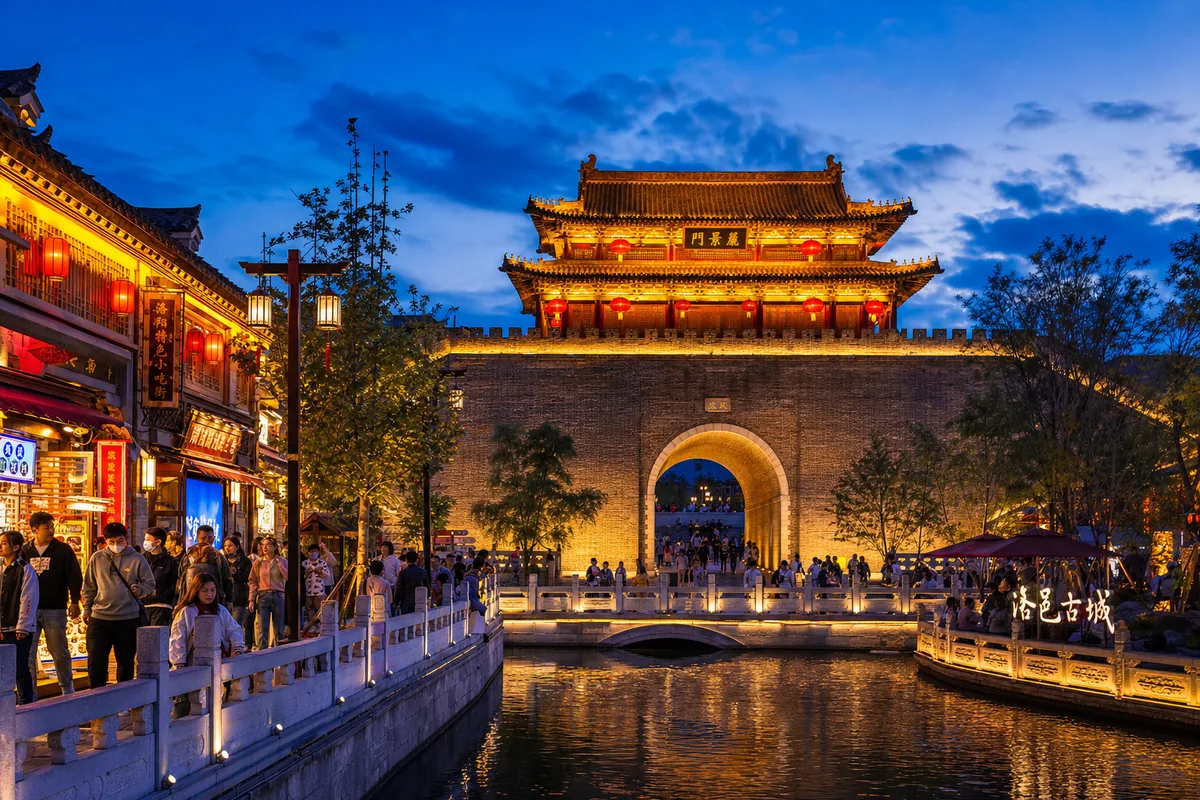
The area is touristy and partly reconstructed, so set expectations accordingly—it's not an untouched ancient village. But it's pleasant, walkable, and the best place in the city for an evening meal and a sense of local life. The Luoyang Museum and the Tianzi Jia Liu (Heavenly Son's Carriage of Six Horses) chariot pits are also nearby if you want to add a half-day of history.
Luoyang food
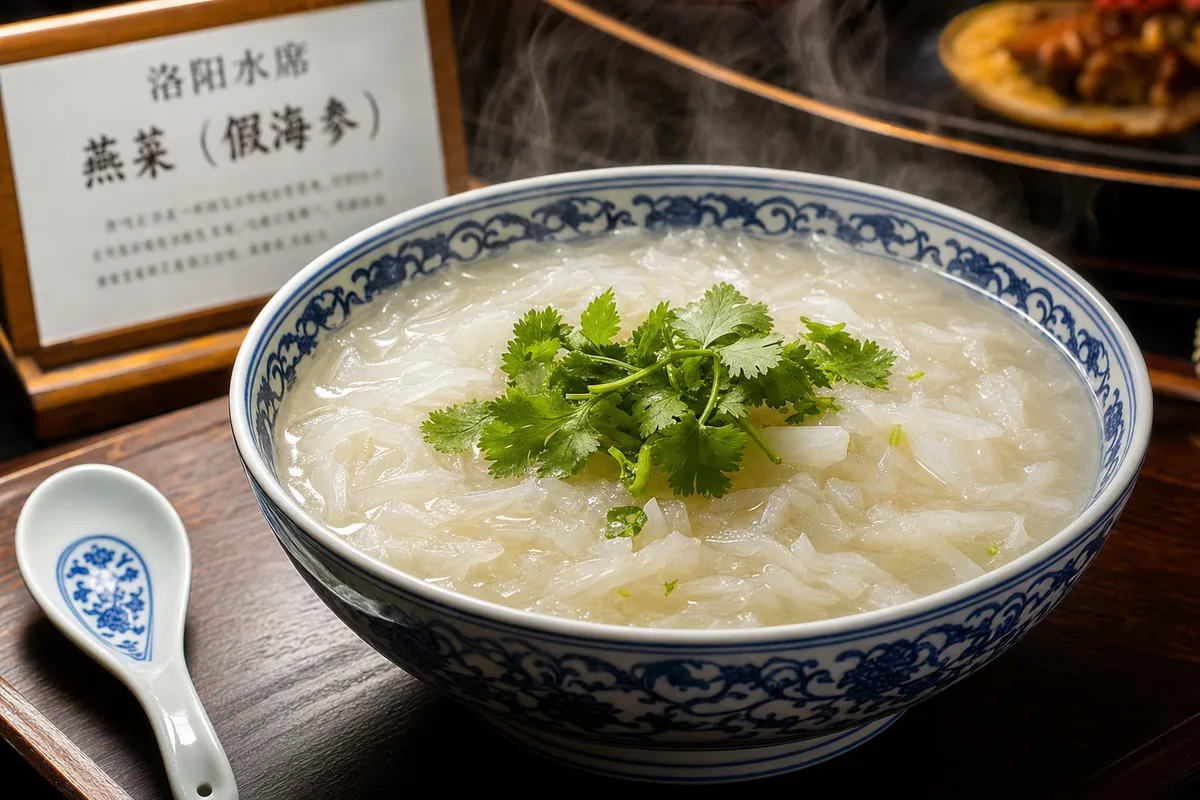
Luoyang's signature is the Water Banquet (水席, Shuǐxí), a Tang-dynasty banquet tradition of around 24 courses, most of them soupy or broth-based—hence "water." Dishes are served one after another in sequence, and the style runs from sour-and-spicy soups to braised and steamed dishes. You don't need to order the full banquet; many restaurants serve individual Water Banquet dishes. The most famous single dish is the "false sea cucumber" or Luoyang yan cai (洛阳燕菜), a radish-based soup originally created to resemble luxury ingredients.
Beyond the banquet, look for:
- Hu spicy soup (胡辣汤, húlàtāng) — a peppery, thick breakfast soup common across Henan.
- Niu rou tang (牛肉汤) — beef soup eaten for breakfast with flatbread, a local morning staple.
- Buckwheat and noodle dishes typical of Henan's wheat-belt cooking.
For variety and atmosphere, eat in or around the old town in the evening. For an authentic Water Banquet, the long-running restaurants near Lijing Gate are a safe bet. If you don't read Chinese, point at photo menus or use a translation app—English menus are rare outside hotels.
Getting to Luoyang
Luoyang is well connected by high-speed rail. The main station for fast trains is Luoyang Longmen Station (洛阳龙门站), not the older central Luoyang Station, so check which one your ticket uses.
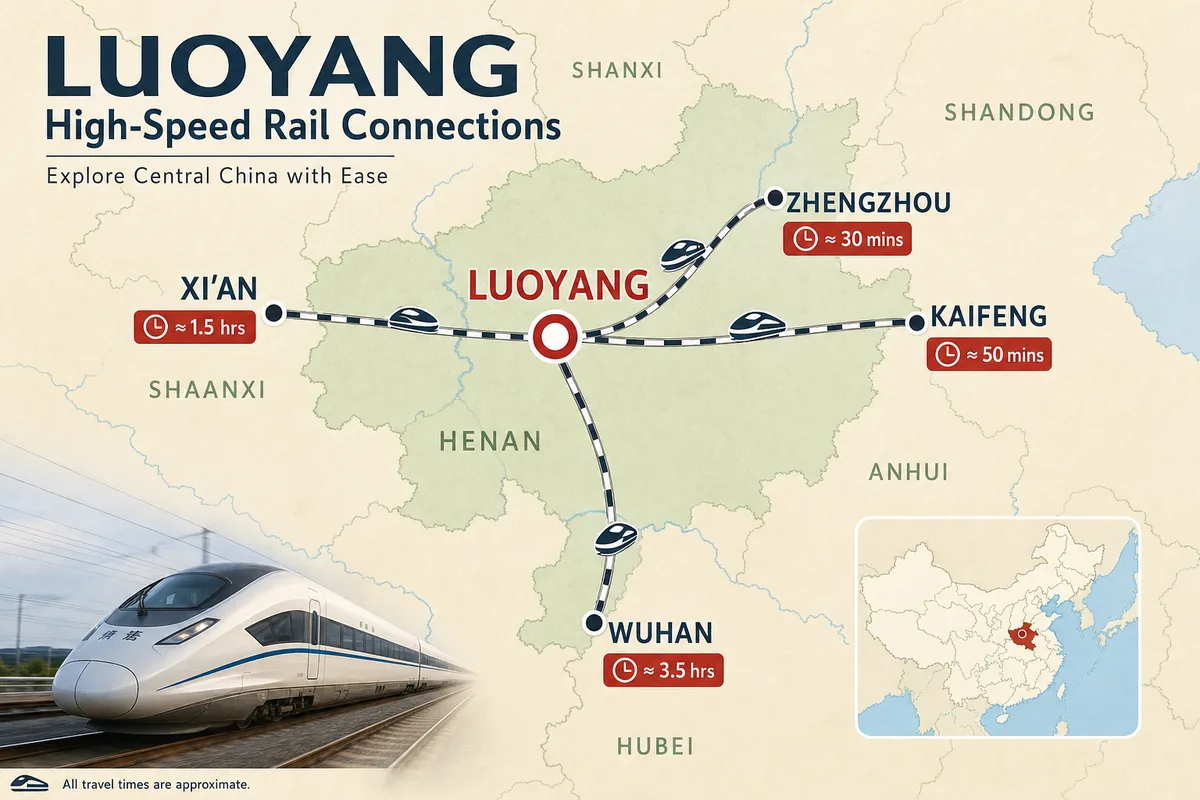
| From | Mode | Approx. time |
|---|---|---|
| Xi'an | High-speed rail | 1.5–2 hours |
| Zhengzhou | High-speed rail | 35–45 minutes |
| Kaifeng | High-speed rail (via Zhengzhou) | 1–1.5 hours |
| Wuhan | High-speed rail | 2.5–3 hours |
| Beijing | High-speed rail | 3.5–4.5 hours |
The Xi'an to Luoyang route is the most popular pairing—both cities were imperial capitals, and the train makes a same-day connection effortless. You can compare schedules and book seats in English through Trip.com, or use the official China Railway 12306 platform if you're comfortable with it. Either way, book a few days ahead during spring festival season, when peony crowds fill trains.
Luoyang also has a small airport with domestic flights, but for most travelers the train is faster and more convenient than flying.
Getting around the city
Luoyang has a growing metro system and an extensive bus network, but for sightseeing most visitors rely on Didi (China's main ride-hailing app) because the major sites are spread out and not all on metro lines. Fares are cheap by Western standards. Taxis are available too, but ride-hailing avoids language barriers since the destination is set in the app.
Set up your payment apps before arriving—almost everything runs on mobile QR payments, and having Alipay or WeChat Pay linked to a foreign card will save you constant friction. For planning metro routes and day-by-day itineraries across Chinese cities, the WaysChina app offers offline metro maps and a built-in trip planner, which helps when you're piecing together a multi-city route.
Where to stay
For a short visit, base yourself near Luoyang Old Town for atmosphere and evening dining, or near Wangcheng Square / Zhongzhou Road for a central, well-connected location. Staying near Longmen Station works if you have an early onward train but puts you farther from the old town's evening scene.
- Budget: Hostels and guesthouses around the old town, often under ¥150 a night.
- Mid-range: Business hotels along Zhongzhou Road, comfortable and central.
- Higher-end: A handful of international-standard hotels near the city center.
Luoyang's room rates are reasonable outside the peony festival, when prices climb and availability tightens. You can compare hotels across districts on Booking.com to match your base to your itinerary. Remember that all hotels in China must register foreign guests with the police at check-in (住宿登记, zhùsù dēngjì), so smaller places that aren't set up for foreigners may turn you away—booking a hotel used to international guests avoids that headache.
Suggested itineraries
Two days
- Day 1: Morning at the Longmen Grottoes (three to four hours), afternoon at the White Horse Temple, evening in Luoyang Old Town for dinner and a Water Banquet.
- Day 2: Luoyang Museum or the chariot pits in the morning, peony parks in spring, then onward train in the afternoon.
Three days
- Day 1: Longmen Grottoes and White Horse Temple.
- Day 2: Full-day Shaolin Temple trip to Dengfeng (kung fu show, Pagoda Forest, Mount Song).
- Day 3: Old town, museum, peonies (in season), and departure.
Combining Luoyang with nearby cities
Luoyang sits on the high-speed corridor between Xi'an and central China, which makes it easy to chain with other destinations:
- Xi'an (1.5–2 hrs): The classic pairing of two ancient capitals. Many travelers do Xi'an's Terracotta Army first, then a short hop east to Luoyang.
- Zhengzhou (35–45 min): Henan's provincial capital and a major rail hub; useful as a connection point, and home to the Henan Museum.
- Kaifeng (about 1–1.5 hrs via Zhengzhou): Another former capital with a well-preserved old-China atmosphere and famous night markets.
- Wuhan (2.5–3 hrs): A larger city to the south, a gateway to central China and the Yangtze.
A common route runs Xi'an → Luoyang → Zhengzhou/Kaifeng, threading together some of China's deepest historical sites in under a week.
Practical notes
- Carry your passport—it's needed for site entry and hotel check-in.
- Major sites have English signage; restaurants and buses generally don't, so keep a translation app handy.
- Wear sturdy shoes for Longmen and Shaolin—both involve a lot of stone steps and walking.
- Ticket prices and opening hours change seasonally; check the latest before you go, especially around the peony festival.
Final thoughts
Luoyang rewards travelers who care about history and Buddhist art more than modern attractions. The Longmen Grottoes alone justify the trip, and the original Shaolin Temple, the White Horse Temple, and a spring peony bloom round out a focused two- to three-day stop. The smart move is to pair it with Xi'an by high-speed rail, time it for spring or autumn if you can, and book ahead during the festival. Sort out your payment apps and a translation app before arriving, carry your passport, and you'll move through the city with little friction. From here, Zhengzhou, Kaifeng, and Wuhan are all an easy train ride away.
Last updated: June 2026
Read in other languages
Last train times for 10 Chinese metro systems
Every line and station, checked by hand — the same data behind our offline route planner.
Get the WaysChina App
Offline guides, currency converter, essential phrases, and more — all in your pocket.

Related Articles
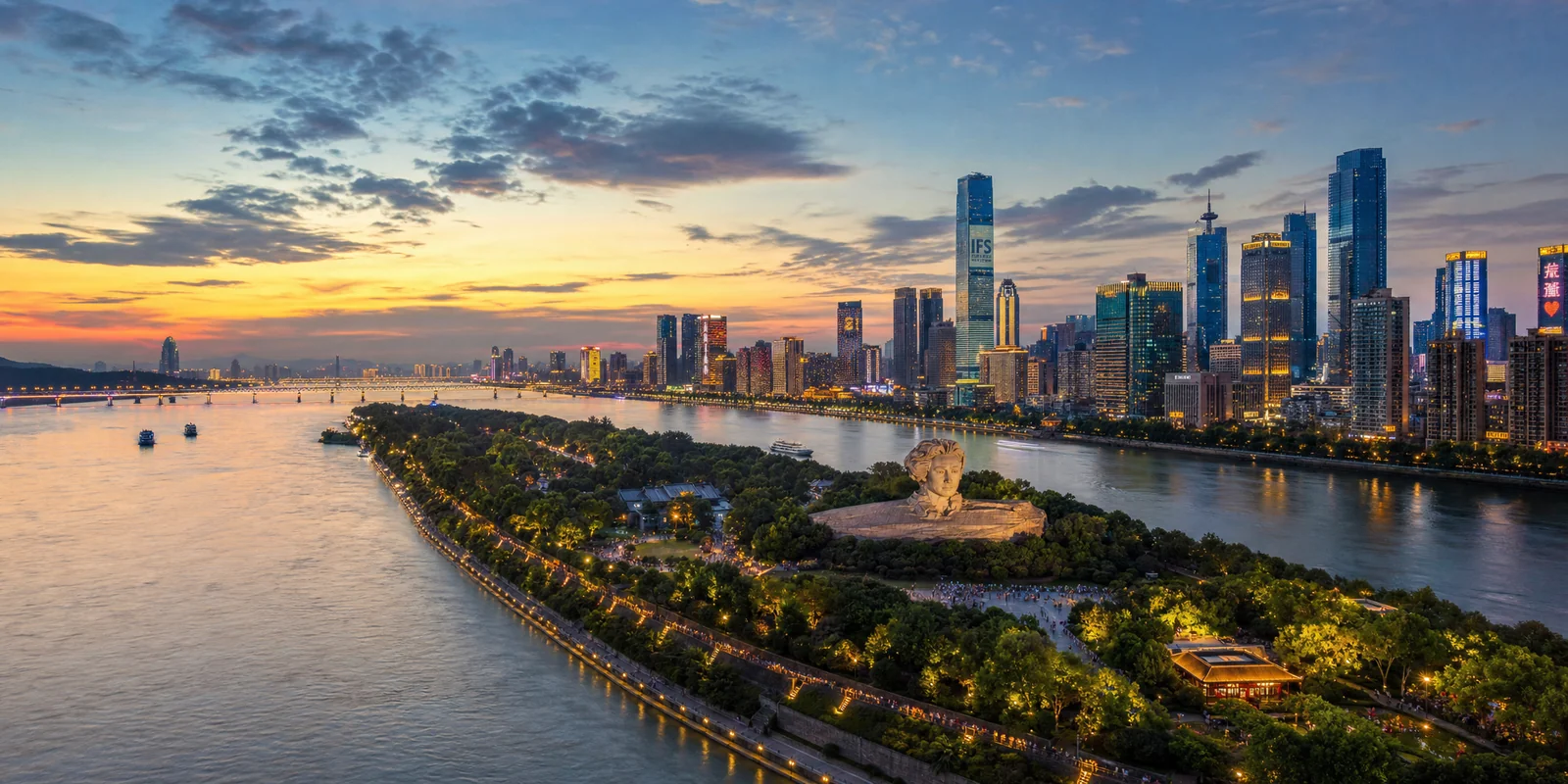
Changsha Complete Guide
Changsha is China's capital of spicy food and late-night street life. Here's how to eat, explore Orange Island and...
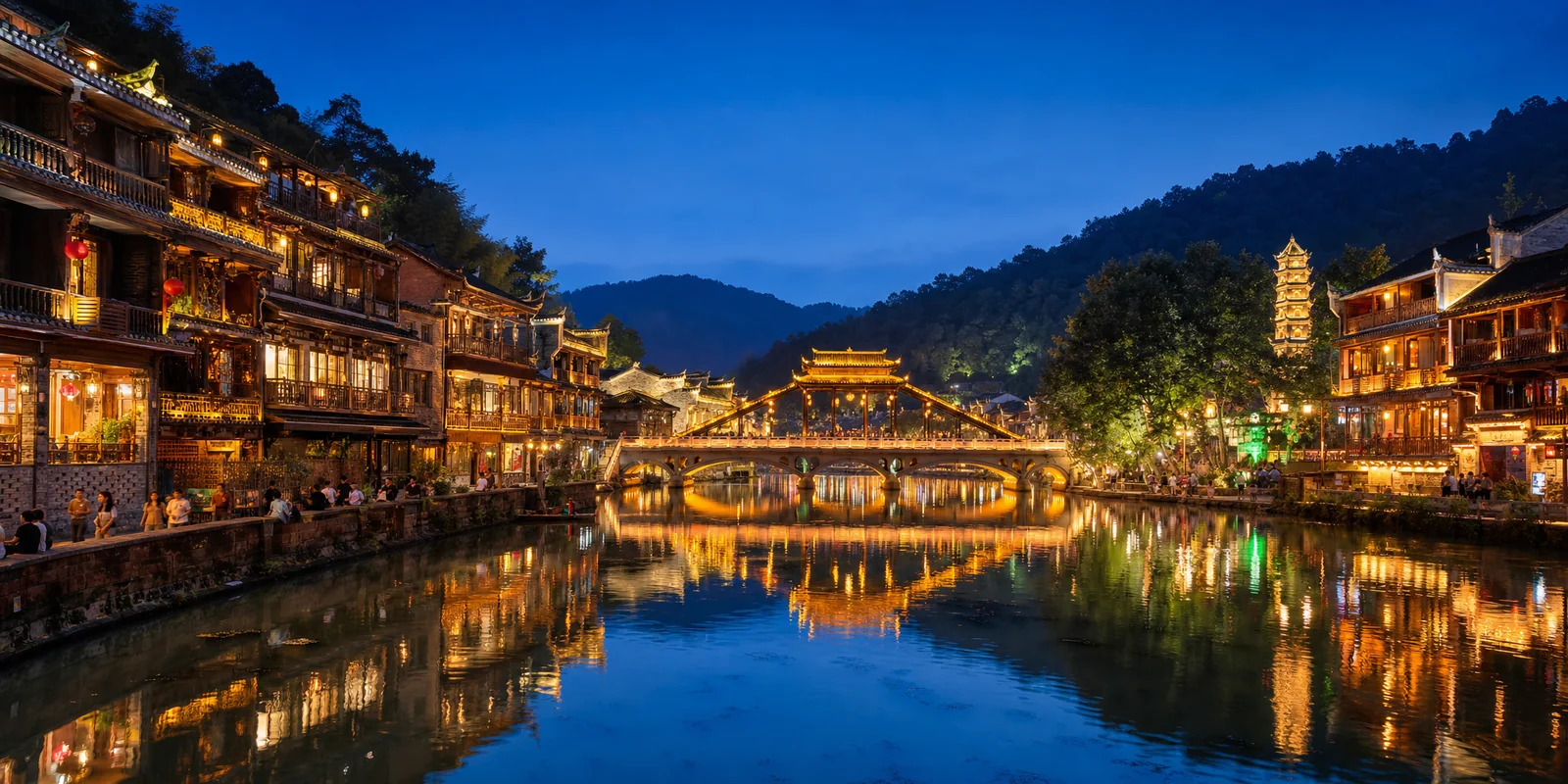
Fenghuang Ancient Town Guide
Stilt houses on the Tuojiang River, Miao villages, and a 1,300-year-old town that comes alive at night. Here's how...
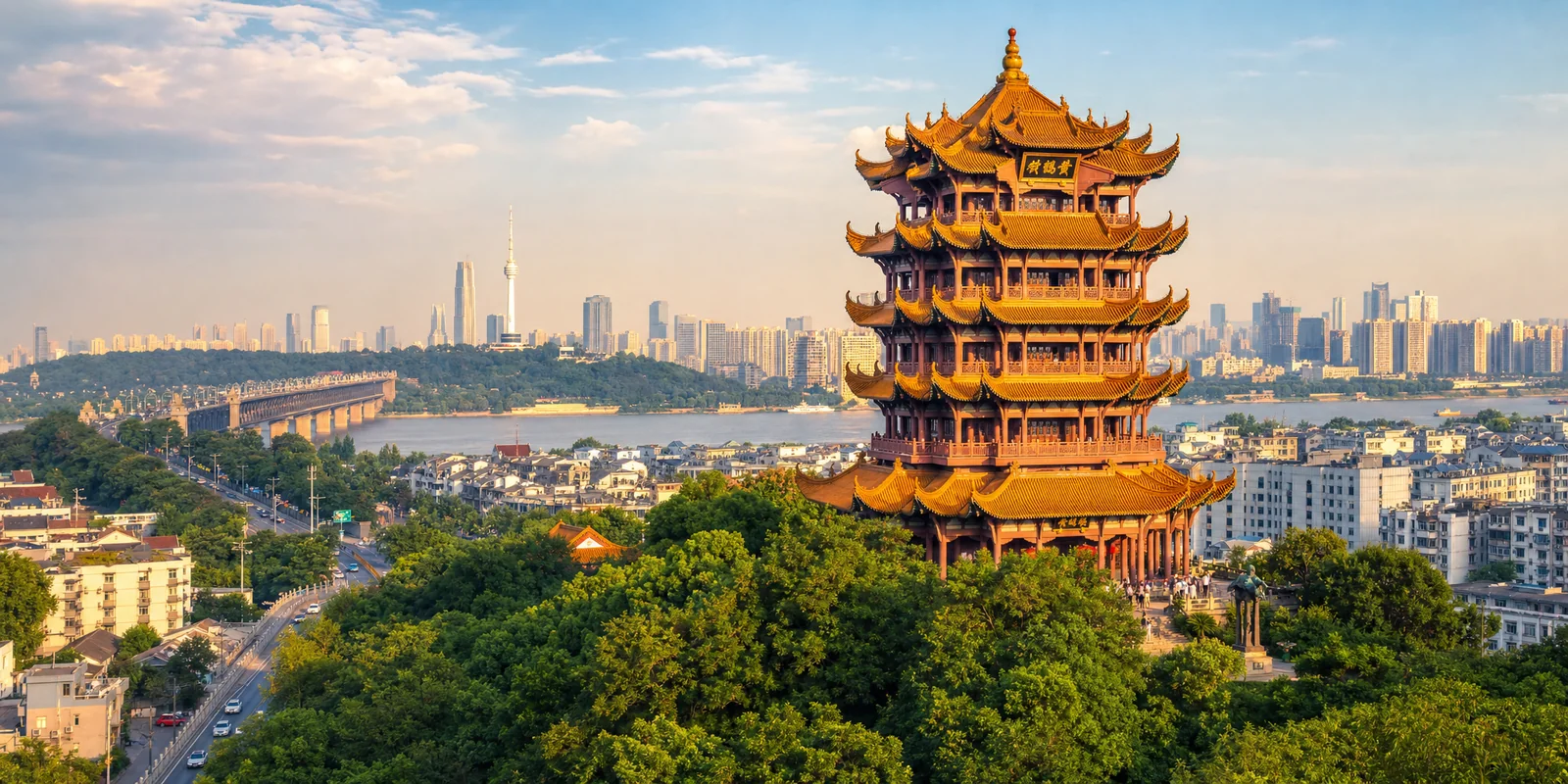
Wuhan Complete Guide
Everything you need to plan a 2-3 day trip to Wuhan: the Yellow Crane Tower, East Lake, Hubei Provincial Museum,...
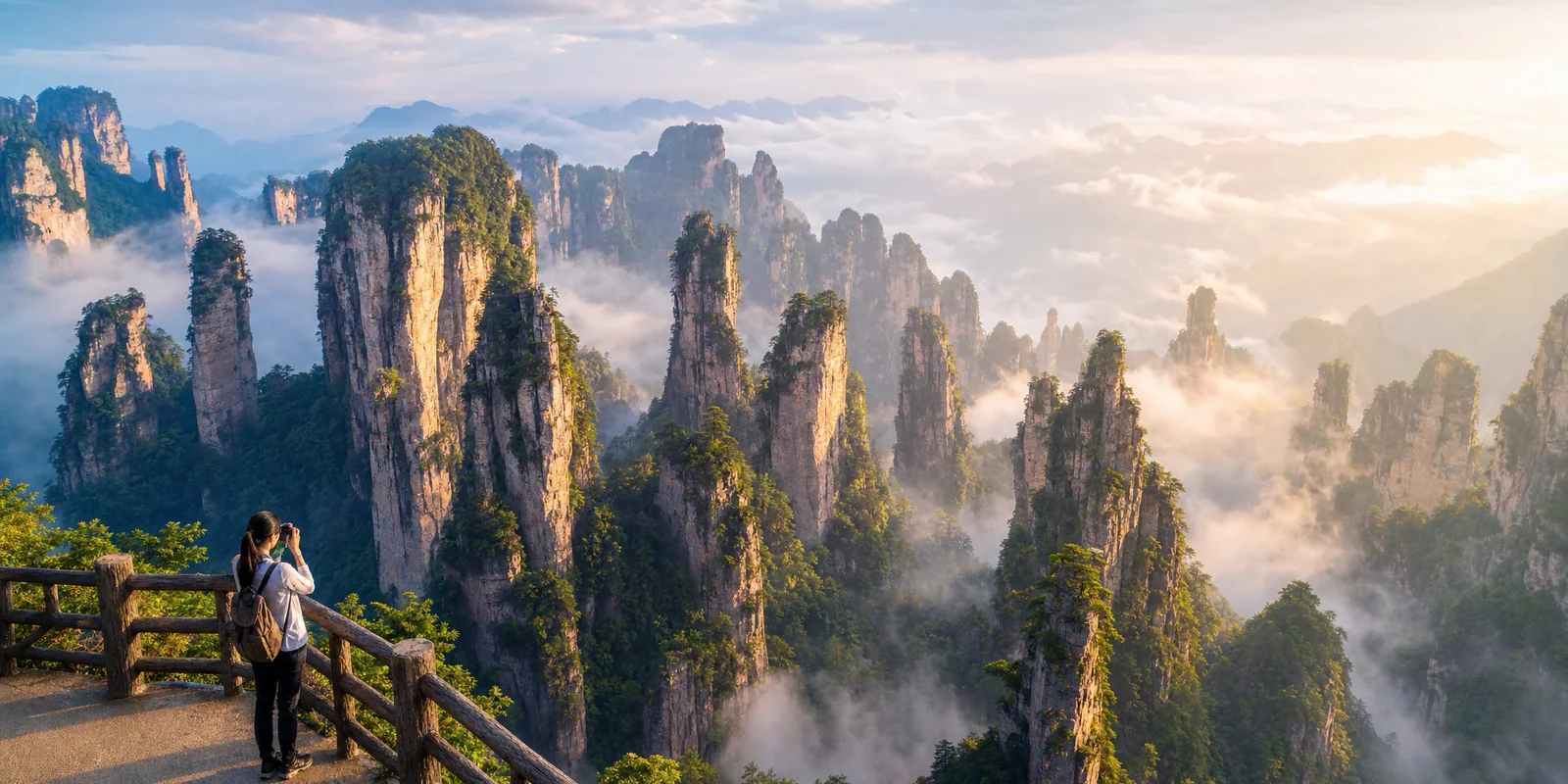
Zhangjiajie Travel Guide
The sandstone pillars that inspired Avatar's floating mountains are real, and they're in Zhangjiajie. Here's how to...